Managing a loved one’s trust can feel overwhelming, especially when you expected a distribution and nothing has arrived. You may be checking the mail, refreshing your email, and wondering whether the trustee is being careful or dragging things out.
That uncertainty is common. A beneficiary often knows a parent, spouse, or grandparent intended to leave support through a trust, but the actual process feels hidden behind paperwork, tax questions, and silence.
The good news is that Texas law does give you a framework. A trustee can delay payment in some situations, but not whenever they want. The issue is usually not just the delay itself. It’s whether the delay is reasonable, whether the trustee is following the trust’s terms, and whether the trustee is keeping beneficiaries informed.
Waiting for an Inheritance? Understanding Trust Distributions
A common situation looks like this. A mother dies, leaving a trust for her three children. One child thinks the money should arrive right away because the house has already been listed for sale. Another child hears from the trustee once, then nothing for months. The trustee says, “I’m working on it,” but never explains what “it” means.
That gap between expectation and explanation is where most anxiety starts.

Under Texas law, some waiting is normal. Trust assets may need to be gathered, valued, protected, or sold. Debts and taxes may need attention. The trust document itself may set conditions before anyone receives money.
But not every delay is lawful.
A trustee in Texas can’t treat distributions like a personal favor. They serve in a fiduciary role, which means the law expects honesty, care, and timely action. If you’re trying to understand how long a trustee has to distribute assets in Texas, the answer usually depends on what the trust owns, what the trust says, and how well the trustee is communicating.
The most important question usually isn’t “Has there been a delay?” It’s “Is there a valid reason, and is the trustee being transparent about it?”
That same rule helps first-time trustees, too. If you’re serving as trustee, you don’t need to panic over every delay. You do need to know which delays are part of proper administration and which ones can expose you to a breach claim.
The Trustee’s Core Responsibilities Under the Texas Trust Code
In Texas, a trustee is more than a person holding money. The trustee is legally responsible for following the trust document, protecting trust property, and acting in the beneficiaries’ best interests.

That responsibility has a practical goal. The trustee is supposed to move the trust from administration to distribution in an orderly, lawful way. Delay is sometimes part of that job. Unexplained delay is where trouble begins.
If you want a fuller legal breakdown of these obligations, this overview of the Texas Trust Code trustee duties is a helpful starting point.
Loyalty comes first
The duty of loyalty means the trustee must act for the beneficiaries, not for personal convenience or personal gain.
This sounds simple, but it answers many delay questions. A trustee may need to wait because the trust owns a house that should be sold carefully, or because taxes must be addressed before money goes out. Those delays can serve the beneficiaries. A delay meant to help the trustee is a different matter.
For example, suppose the trust owns a home. If the trustee pauses distributions while getting the home ready for sale and trying to obtain a fair price, that may be proper. If the trustee lives in the home, postpones the sale, and gives no clear explanation, the loyalty problem is obvious.
Prudence means careful, timely administration
The duty of prudence requires the trustee to manage the trust like a careful, sensible fiduciary. That includes protecting assets, keeping accurate records, reviewing the trust terms, handling taxes and expenses, and avoiding distributions that are rushed or uneven.
Texas law does not give every trustee one fixed deadline that applies to every trust. Instead, the standard is reasonableness. A simple trust with cash and a few straightforward tasks can often be administered faster than a trust holding real estate, business interests, or disputed assets.
That is why delay exists on a spectrum. Some delay is prudent administration. Too much delay, especially without a sound reason, can become a breach of duty.
Impartiality matters when there are multiple beneficiaries
A trustee must usually act fairly toward all beneficiaries, not just the one asking the loudest or most often.
That can create real tension. One beneficiary may want immediate cash. Another may prefer the trustee to hold or sell property later. The trustee cannot pick sides based on family pressure, personal preference, or convenience. The trustee must follow the trust document and balance competing interests fairly.
Information is part of the job
Communication is critical because beneficiaries need enough information to protect their rights.
A beneficiary usually becomes most anxious when money is delayed and no one explains why. By contrast, a trustee who says, “The trust owns a house, taxes are still being reviewed, and I expect to update you by this date,” is usually doing two important things at once. That trustee is administering the trust and reducing the risk that a reasonable delay will look like misconduct.
Here’s a short explanation from a Texas-focused discussion:
A careful trustee usually handles four basic tasks before making distributions:
- Collects the assets and confirms what the trust owns
- Reviews the trust terms so distributions happen on the right schedule and under the right conditions
- Addresses debts, expenses, and tax issues before releasing property too early
- Keeps beneficiaries informed so a necessary delay is understood, documented, and tied to a real reason
Practical rule: A delay with records, explanations, and a clear plan is often reasonable. A delay with silence often leads to trust disputes.
Lawful Reasons a Trustee Might Delay Payments
Many beneficiaries ask some version of the same question: can a trustee delay payment texas lawfully? Sometimes the answer is yes.
The key is whether the trustee has a real administrative or legal reason for waiting, and whether that reason connects to the trust’s duties. Delay is not automatically misconduct. In some cases, rushing a distribution can create bigger problems for everyone involved.
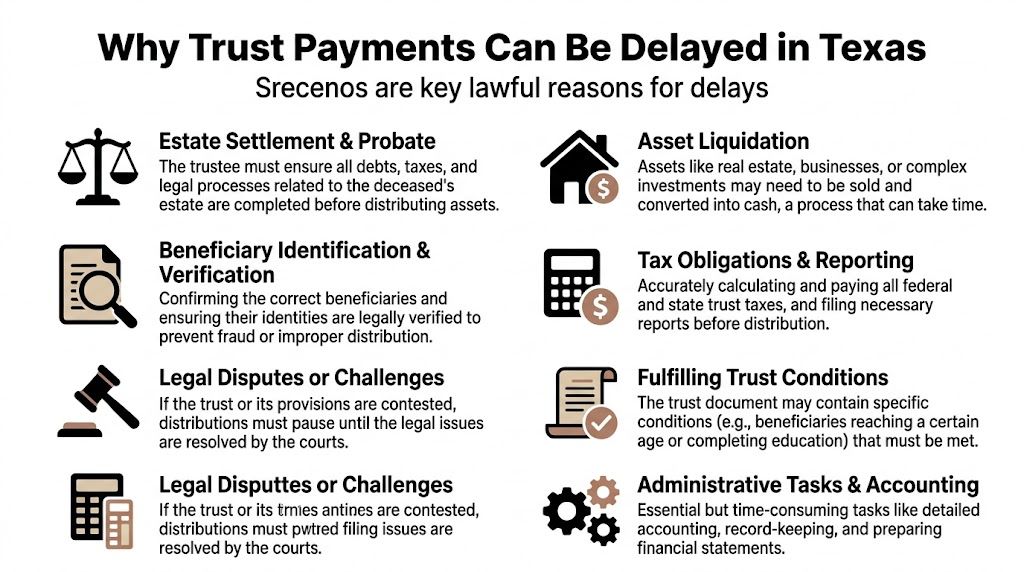
Common reasons a payment may need to wait
A trustee may need time because trust administration happens in stages, not all at once.
Some of the most common valid reasons include:
Paying final expenses and debts
A trustee shouldn’t empty the trust before known obligations are handled.Preparing tax filings
Tax compliance can delay distributions, especially in larger estates with complicated reporting.Selling illiquid assets
A trust may hold a house, mineral interests, a closely held business, or investments that can’t be divided neatly.Obtaining appraisals and valuations
Before a trustee distributes property fairly, they often need reliable values.Following trust conditions
Some trusts require a beneficiary to reach a certain age, finish school, or meet another condition before receiving funds.Resolving identity or entitlement questions
Trustees need to be sure they’re paying the right person, in the right amount, under the right part of the trust.
Tax and high-value estate issues can take real time
One area that often surprises families is tax compliance.
For high-net-worth clients with estates over $5 million, IRS Form 706 estate tax compliance delays can average 18 to 24 months, and that kind of delay can legally excuse a trustee if it is properly documented and communicated to beneficiaries, according to the discussion published by Texas CPA Magazine.
That’s a good example of the article’s core point. The same delay can look either prudent or suspicious depending on communication. If the trustee says, “We’re waiting on the Form 706 process, here’s the timeline, and here’s what has been filed,” beneficiaries usually understand the reason. If the trustee says nothing, people assume the worst.
Valid delays vs potential breaches of duty
| Valid Reason for Delay | Potential Red Flag (May Indicate a Breach) |
|---|---|
| Waiting to pay legitimate debts, expenses, or taxes | No clear reason is given for months |
| Selling real estate or other hard-to-divide assets | Trustee won’t market the property or explain next steps |
| Obtaining appraisals to divide assets fairly | Trustee ignores requests for basic information |
| Waiting for a trust condition to occur, such as a stated age milestone | Trustee invents conditions not found in the trust |
| Holding funds until a dispute or title issue is resolved | Trustee uses the dispute as an excuse for total silence |
| Completing records and accounting before final distribution | Trustee keeps poor records and cannot justify the delay |
A simple example
Suppose a trust owns one home, one brokerage account, and some cash. If the trustee needs time to gather statements, pay a few bills, and prepare a final accounting, a moderate delay may be normal.
Now change the facts. The trustee has already liquidated the account, collected the cash, and paid the known bills, but still doesn’t distribute anything and won’t answer emails. That moves away from administration and toward possible breach.
A lawful delay protects the trust. An unlawful delay protects the trustee.
When a Delay Crosses the Line into a Breach of Duty
A delay becomes dangerous when the trustee stops acting like a fiduciary and starts acting like an owner.
That line isn’t always marked by a calendar date alone. Texas courts look at reasonableness in context. A complicated trust may justify more time than a simple cash-heavy trust. But even a valid reason can sour into a breach if the trustee refuses to explain what’s happening.

Silence is often the biggest warning sign
Beneficiaries often focus first on time. Lawyers often focus first on communication.
A trustee who says, “The house appraisal is delayed, I’m waiting on the accountant, and I’ll update you next month,” is in a very different position from a trustee who disappears.
That’s why delay should be viewed on a spectrum of reasonableness. At one end, there’s a careful trustee finishing necessary tasks. At the other, there’s neglect, obstruction, or self-interest.
Red flags that suggest a breach
Watch for patterns like these:
- No meaningful updates even after repeated requests
- No accounting or records showing where trust assets are and what expenses have been paid
- Favoritism toward one beneficiary over another without support in the trust language
- Self-dealing, such as using trust assets personally
- Invented excuses that don’t connect to actual administration work
- Hostile or evasive responses when a beneficiary asks routine questions
A familiar real-world scenario
A trustee may say the trust-owned home can’t be sold yet. That could be true.
But if the trustee is living in that same home rent-free, delaying repairs, rejecting market offers without explanation, and making no interim distributions from available cash, a court may see more than a delay. It may see misuse of trust property and a breach of fiduciary duty.
The legal harm isn’t only emotional. Delay can also reduce value. Property can deteriorate. Investments can be mishandled. A beneficiary who needed a timely distribution for housing, education, or medical needs may suffer concrete losses.
Intent matters, but conduct matters more
Some trustees think they’re safe if they didn’t mean to do anything wrong. That’s not enough.
A trustee can breach duties through carelessness, poor recordkeeping, and prolonged inaction. In other words, “I was overwhelmed” may explain conduct, but it doesn’t automatically excuse it.
Courts often care less about a trustee’s personal frustration and more about whether the trustee acted reasonably, documented decisions, and kept beneficiaries informed.
If you’re a beneficiary and several of these warning signs are showing up at once, it may be time to speak with a Texas trust administration lawyer. If you’re a trustee and this description feels uncomfortably familiar, the right move is usually to fix the communication and documentation problem quickly, not to keep waiting.
Your Rights and Remedies as a Beneficiary in Texas
A long delay can feel like being locked out of a room that is supposed to hold your money. Texas law gives beneficiaries tools to find out what is happening and, if needed, to push the trustee to act.
The first question is not always, “Can I sue?” Often it is, “What can I reasonably demand right now?” That matters because delay exists on a spectrum. A short, explained delay tied to taxes, appraisals, or a property sale may be proper. A long, unexplained delay is much harder for a trustee to defend.
Start with a written request for information
Begin by asking for a clear written explanation of the delay. If the circumstances justify it, ask for a formal accounting too.
An accounting can answer practical questions such as:
- What property and accounts the trust owns
- What money has come into the trust
- What bills, taxes, or expenses have been paid
- What distributions have already been made
- What specific reason the trustee gives for holding back payment
Written requests matter for a simple reason. They create a timeline. If the trustee responds clearly and provides records, that often lowers the temperature. If the trustee ignores you or gives shifting explanations, that pattern can matter later.
Know that deadlines apply
Beneficiaries do not have unlimited time to bring a claim.
Under Texas Property Code §111.004(25), a breach of trust claim is generally subject to a four-year statute of limitations. The harder issue is usually when that clock starts. In many cases, it begins when the beneficiary discovered, or reasonably should have discovered, the problem.
That is why silence from a trustee can be so harmful. If records are withheld, a beneficiary may not know whether the delay is reasonable or whether trust property is being mishandled. Waiting too long can also make a case harder to prove because documents disappear and memories fade.
Build a paper trail
If you are worried the delay has crossed from administration into misconduct, collect and organize your records now.
Keep copies of:
- Emails and letters from the trustee
- Text messages discussing the delay
- The trust document and any amendments
- Account statements, notices, or other records showing what has or has not been distributed
- A dated timeline of conversations, promises, and missed deadlines
A good paper trail works like a ledger. It helps separate suspicion from proof.
If part of the problem is the person serving as trustee, it can help to understand replacement issues too. For a practical outside resource, see this guide on how to change your successor trustee.
Ask the court for relief if necessary
If the trustee ignores reasonable requests or refuses to explain the delay, court involvement may be the next step. A beneficiary can seek orders that force transparency, require action, or address harm already done. This overview of how to sue a trustee explains the process in more detail.
Depending on the facts, a Texas court may order:
- An accounting, so the trustee must disclose what happened with trust property
- A distribution, if there is no lawful reason to continue holding funds
- Surcharge, which can make the trustee personally responsible for losses caused by a breach
- Removal and replacement of the trustee, in serious cases
- Other protective orders to preserve trust assets while the dispute is pending
Courts often focus on reasonableness. Was the delay tied to real administrative work, or was the trustee stalling? Did the trustee communicate, document decisions, and respond to beneficiary concerns? Those facts often shape the outcome.
Do not overlook related planning problems
Some trust disputes are really administration problems. Others begin with an outdated trust, unclear distribution language, or a poor trustee choice.
In these situations, related planning work can matter. Families may need help with the current dispute, and they may also need to review the trust structure, probate issues, or future transfer planning. Law Office of Bryan Fagan, PLLC handles matters involving trust administration, probate, and related planning concerns for Texas families.
If a trustee will not explain a delay, ask in writing. If the trustee still will not respond, get legal advice before more time passes.
A Trustee’s Guide to Proactive Communication and Documentation
Many trust disputes don’t start with theft or obvious misconduct. They start with silence.
A trustee may be doing legitimate work, but beneficiaries don’t know that. They see months passing and assume something is wrong. In Texas, communication isn’t just polite. It’s part of fiduciary practice.
Why communication changes everything
Texas Trust Code §113.106 requires trustees to keep beneficiaries reasonably informed. According to the source provided, trustees who proactively communicate during disputes can reduce the likelihood of litigation by up to 60%, and poor communication can still lead to surcharge claims even when the underlying delay was valid, as discussed in this article about a trustee claiming the estate isn’t ready to distribute.
That makes sense in real life. Beneficiaries can tolerate a delay more easily than they can tolerate being ignored.
A practical trustee checklist
A trustee who wants to lower risk should create a simple routine.
Send regular updates
Even a short message can help. State what has been done, what remains, and what the expected timeline looks like.Keep a distribution log
Write down each decision, the date, and the reason. If a delay relates to taxes, valuation, or a property sale, note it.Preserve backup documents
Save appraisals, tax correspondence, bank statements, invoices, and sale records.Separate trust activity from personal activity
Never blur the line between your own money and trust property.Use formal accountings when needed
Informal updates are helpful, but they don’t replace proper records.
What a good update sounds like
A useful update doesn’t need legal jargon. It can be plain and direct.
“The trust still owns the house and brokerage account. I’m waiting on the final appraisal and tax information before making final distributions. I expect another update within 30 days.”
That kind of message does three things. It identifies the assets, explains the reason for delay, and gives a timeframe for the next communication.
Documentation protects more than the trustee
Careful records also protect beneficiaries because they make the administration process visible. Clear documentation reduces suspicion, narrows disputes, and preserves family relationships that might otherwise collapse under stress.
Trustees should also think upstream. Better estate planning often prevents these problems by naming the right fiduciary, setting clear distribution terms, and anticipating common administrative issues. That’s one reason many families work with a Texas estate planning attorney before conflict starts.
Navigating Trust Disputes and When to Call a Lawyer
Sometimes a disagreement can be fixed with one clear letter. Sometimes it can’t.
When a trustee won’t provide records, won’t explain the delay, or appears to be acting in self-interest, legal help becomes less about escalation and more about structure. A lawyer can frame the problem correctly, gather the right documents, and choose the best next step.
The usual progression of a dispute
A trust dispute often unfolds in stages:
Informal request
The beneficiary asks for information or a timeline.Formal written notice
The issue is described clearly, with a request for correction.Negotiation or mediation
The parties try to resolve the dispute without a court hearing.Court petition
If needed, the beneficiary asks the probate court for relief.
Texas Estates Code §113.151 allows a beneficiary to petition for court intervention after providing a 30-day written notice of an alleged breach. The source provided also states that a 2025 Texas appellate case, In re Estate of Smith, treated an 18-month delay tied to an IRS audit as reasonable while still penalizing the trustee for failing to communicate with beneficiaries, as discussed in this article on failure to properly terminate a trust and distribute assets.
That example captures the central theme well. Delay alone doesn’t decide the case. Communication often does.
What a court may do
Depending on the facts, a court may:
- require a full accounting,
- order a distribution,
- review trustee conduct,
- remove or restrict the trustee,
- award relief tied to losses caused by the breach.
Not every problem needs a courtroom battle. But waiting too long can shrink your options and make a clean resolution harder.
When legal advice makes sense
You should consider speaking with counsel if:
- Months have passed with little or no explanation
- The trustee refuses to provide records
- You suspect self-dealing or favoritism
- You’ve received inconsistent stories about why payment is delayed
- You’re a trustee who realizes the administration has stalled
A seasoned Texas trust administration lawyer can help beneficiaries enforce rights and help trustees get back into compliance before a manageable issue turns into a lawsuit.
Get Trusted Guidance for Your Texas Trust Matter
A delayed trust payment can mean many different things. It may reflect careful administration. It may reflect tax or property issues. Or it may signal a breach of fiduciary duty.
The difference often comes down to reasonableness, documentation, and communication. Beneficiaries deserve answers. Trustees need a clear process. Both sides benefit when the trust is handled according to the Texas Trust Code, the Texas Estates Code, and the terms of the trust itself.
If you’re managing a trust, facing a distribution delay, or planning your estate, contact The Law Office of Bryan Fagan, PLLC for a free consultation. Our attorneys provide trusted, Texas-based guidance for every step of the process, ensuring your family's legacy is protected.
If you’re managing a trust or planning your estate, contact Law Office of Bryan Fagan, PLLC for a free consultation. Our attorneys provide trusted, Texas-based guidance for every step of the process.