Navigating decisions about a loved one's future care can feel overwhelming, especially when their ability to make choices for themselves is in question. The key difference between a guardianship and power of attorney comes down to timing and control. A Power of Attorney is a proactive step you take while you have full capacity, choosing someone you trust to act for you. In contrast, a guardianship is a reactive, court-ordered solution implemented after capacity is lost, placing the decision in a judge's hands.
Understanding these legal tools is the first step toward protecting what matters most. With the right legal guidance, you can face these challenges with clarity and confidence, ensuring your family is prepared for whatever lies ahead.
Understanding Your Options: A Compassionate Overview
Planning for a time when you or a loved one might not be able to handle personal or financial decisions is one of the most important conversations a family can have. The legal landscape can seem complex, but this guide will explain the difference between guardianship and power of attorney in plain English, empowering you to make informed choices.
A Power of Attorney (POA) is a private document you create as part of your estate planning, while a guardianship is a public court proceeding. This distinction has a significant impact on cost, privacy, and your freedom to choose who will manage your affairs.

Key Differences at a Glance: Guardianship vs. Power of Attorney
Seeing the core differences side-by-side can make the best path forward much clearer. Here is a simple comparison of how guardianship and a Power of Attorney stack up under Texas law.
| Attribute | Power of Attorney (POA) | Guardianship |
|---|---|---|
| Creation | Created by an individual (the "principal") with legal capacity. | Ordered by a court after a finding of incapacity. |
| Timing | Proactive; created before incapacity occurs. | Reactive; established after incapacity occurs. |
| Control | The principal chooses their agent and defines the agent's powers. | A judge appoints the guardian and determines their authority. |
| Privacy | A private document between the principal and the chosen agent. | A public court record and proceeding. |
| Cost | Less expensive; typically a one-time fee for legal drafting. | Significantly more expensive due to court costs and ongoing fees. |
These differences are not minor legal details; they fundamentally change who is in control, the associated costs, and how much of your personal life becomes public. One path empowers you to make your own choices in advance, while the other places those choices in the hands of the court.
How These Legal Tools Are Created and Activated
Understanding how a Power of Attorney (POA) and a guardianship are established reveals the core difference between them: a choice between proactive planning on your own terms and reactive intervention by the courts.

Establishing a Power of Attorney: A Private Choice
Creating a Power of Attorney is a private act, typically done as part of your personal estate planning. The essential requirement is that the principal—the person granting the authority—must have full legal capacity when signing the document. The process is straightforward: they execute a specific legal document, often notarized, to appoint an agent of their choosing.
A POA can be tailored to take effect immediately or only become active if the principal becomes incapacitated in the future, offering significant flexibility. This is an act of empowerment, allowing you to decide who you trust long before a crisis arises. A skilled Texas estate planning attorney can help you draft a document that meets your specific needs.
Securing a Guardianship: A Public Court Process
In contrast, establishing a guardianship is a public and often complex court proceeding governed by the Texas Estates Code. The process begins when a concerned party files a formal application with the court, providing medical evidence to prove a loved one is incapacitated. The court then schedules a hearing to determine if the proposed "ward" is truly unable to manage their own affairs. You can find out more about the specific steps in our detailed guide on how to gain guardianship of a parent.
This court-driven process is inherently more intrusive, time-consuming, and expensive. Instead of empowering an individual through their own choice, it can strip them of their rights through a court order.
Nationally, the scale of these court actions is massive, with an estimated 1.3 million adults living under some form of guardianship. This statistic underscores how often families must turn to the courts simply because proactive documents were not put in place ahead of time. It is important to note that other legal tools, like legal parenting plans, also involve specific processes for managing decisions for children in various family situations.
Comparing the Scope of Authority and Decision-Making Power
The scope of authority granted by a guardianship versus a power of attorney is one of the most significant distinctions between them. The level of power, flexibility, and oversight are vastly different, directly impacting an individual’s autonomy and personal freedom.
A Power of Attorney (POA) is a document built on choice. The principal—the person creating the POA—is in complete control. They decide exactly what powers their chosen agent will have. This authority can be very specific, such as giving an agent the power to sell one piece of property, or it can be broad, granting them full control over all financial and business affairs. This flexibility allows a principal to tailor the document to fit their precise needs, ensuring their agent has just enough authority to help without surrendering more control than necessary.
The Guardian’s Court-Mandated Authority Under Texas Law
Guardianship operates under a different set of rules. Here, a judge—not the individual—defines the scope of power. Governed by the Texas Estates Code, a court order outlines the guardian's authority, which often results in a nearly total loss of personal freedom for the person under guardianship, known as the "ward."
While Texas law permits a "limited guardianship," intended to restrict a guardian's power to only those areas where the ward has proven incapacity, courts often grant a "full guardianship." For the individual involved, this can be a devastating blow to their independence.
A full guardianship can strip a person of their most fundamental civil rights—the right to vote, to marry, to decide where they live, or to manage their own money. The decision-making power is transferred almost entirely to the court-appointed guardian.
This is a world away from a POA, where the principal retains all their rights and can revoke the agent’s authority at any time, provided they still have the legal capacity to do so.
Fiduciary Duties in Texas and Court Oversight
Both an agent under a POA and a guardian are considered fiduciaries. This legal term means they have a strict duty to act solely in the best interests of the person they represent, a core component of fiduciary principles. They must manage assets with care and avoid any conflicts of interest. The key difference, however, is the level of supervision.
An agent under a POA usually operates without direct court supervision. While they can be held accountable if they abuse their power, there is no mandatory reporting system. The arrangement relies heavily on the agent’s integrity. This is why choosing a trustworthy agent is a critical part of your asset protection strategy.
A guardian, on the other hand, is under the constant supervision of the court. They are required to:
- File an initial inventory of the ward’s assets.
- Post a bond as a financial guarantee against mismanagement.
- Submit detailed annual reports accounting for all financial transactions.
- Seek the court's permission before making major decisions, such as selling real estate.
This intensive oversight is designed to protect the ward, but it also makes guardianship a much more cumbersome, public, and expensive process. A POA is an instrument of trust, while guardianship is an instrument of court-enforced protection.
Real-World Scenarios: When to Choose Guardianship vs. Power of Attorney
Understanding the legal theory is helpful, but seeing how these tools apply in real-life situations makes the choice clearer. Every family’s situation is unique, and the right path depends on the specific circumstances. Let's explore a few examples showing how trust and estate issues arise in Texas.
This flowchart provides a simple visual to help you begin thinking about which path aligns best with your family’s needs.
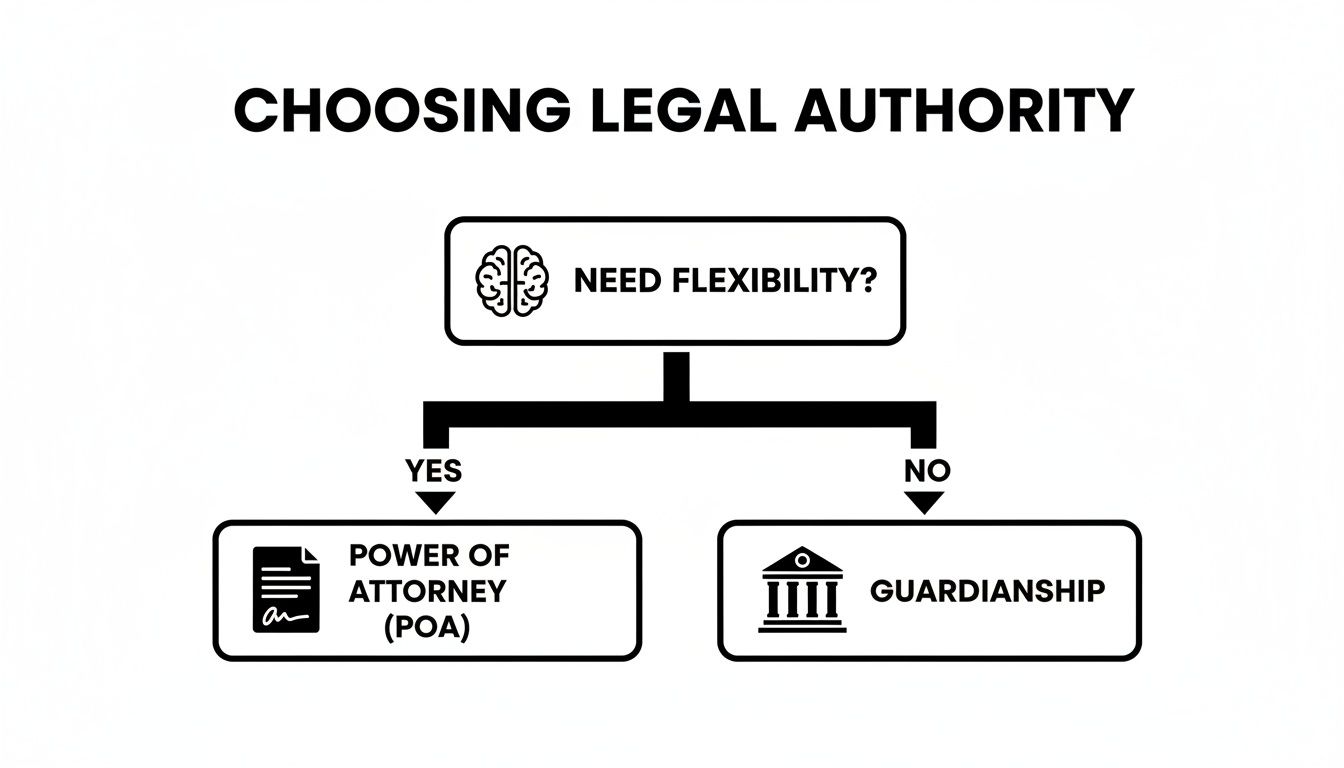
As you can see, the need for flexibility and proactive control often points toward a Power of Attorney. In contrast, situations demanding court oversight typically lead to guardianship.
Scenario One: The Proactive Planner
Situation: Maria is 65, in good health, and concerned about the future. Her mother had dementia, and Maria wants to ensure her daughter, Sofia, can manage her finances and make medical decisions for her without court intervention if she becomes incapacitated.
Solution: Maria meets with an estate planning attorney and signs a Durable Power of Attorney for finances and a Medical Power of Attorney for healthcare, naming Sofia as her agent. These documents are stored securely, ready for use only if and when Maria needs them.
Recommendation: A Power of Attorney is the ideal choice. Maria has the capacity to choose who she trusts and define her agent's powers. This proactive step saves her family the future time, expense, and emotional strain of a guardianship proceeding.
Scenario Two: The Sudden Crisis
Situation: John, an 80-year-old widower, suffers a major stroke that leaves him cognitively impaired. He never created any estate planning documents. Now, his bills are overdue, and his doctors need consent for a critical medical procedure.
Solution: John’s children are unable to act. They have no legal authority to access his bank accounts or make healthcare decisions. Their only option is to petition the court for help.
Recommendation: Guardianship is the necessary solution. Because John is incapacitated and has no POA, his children must ask a Texas court to appoint one of them as his guardian. This will grant them the legal authority to manage his affairs under the court's direct supervision.
Scenario Three: The Young Adult with Special Needs
Situation: Leo is 17 and has a significant developmental disability. His parents have managed his needs his entire life. When Leo turns 18, he will legally be an adult, and his parents will lose automatic authority to make decisions for him. Leo lacks the capacity to sign a Power of Attorney.
Solution: To continue providing the care he needs, his parents need a legal framework that protects him in adulthood.
Recommendation: Guardianship is the appropriate tool. His parents can petition the court to be appointed as co-guardians shortly before his 18th birthday. A judge can create a limited guardianship tailored to Leo's abilities, preserving his independence where possible while ensuring his parents can continue to manage his healthcare and finances.
Scenario Four: The Family Dispute
Situation: Clara, an elderly widow, signed a POA years ago naming her son, David, as her agent. Now, as her health declines, her daughter, Emily, suspects David is mismanaging their mother's money and isolating her from family. Emily believes David is exerting undue influence and not fulfilling his fiduciary duties.
In cases of suspected abuse, neglect, or financial exploitation, a private Power of Attorney may not offer enough protection. A court-supervised guardianship can provide the necessary oversight to protect a vulnerable person.
Recommendation: Contesting the POA and seeking guardianship may be Emily's best option. By filing for guardianship, she brings the situation before a judge. The court will investigate, appoint an independent attorney to represent Clara, and determine if David is acting in his mother's best interest. If not, the court can revoke the POA and appoint a neutral guardian to protect Clara and her assets.
For more guidance, you can learn about creating a power of attorney for aging parents and the immense trust required for it to work.
How Each Arrangement Can Be Modified or Terminated
One of the most telling differences between a Power of Attorney and a guardianship emerges when a change is needed. One is a private agreement built for flexibility, while the other is a court order designed to be difficult to undo. This contrast highlights the fundamental difference in an individual's control over their own life.
Revoking a Power of Attorney: A Simple Written Notice
Ending a Power of Attorney in Texas is designed to be straightforward, keeping the principal in control. As long as the principal is competent, they can revoke the agent's power at any time, for any reason.
All that is required is a clear, written notice of revocation delivered to the agent. It is also wise to notify any institutions, such as banks or healthcare providers, that have a copy of the original POA to prevent confusion. This ease of termination makes a POA an empowering tool that can be taken back if a relationship changes or an agent is no longer suitable.
The ability to revoke a Power of Attorney at will is its greatest strength. It ensures the arrangement serves the principal’s best interests and can be changed if circumstances require it.
It's also crucial to remember that a POA is not permanent. Understanding the expiration of a Power of Attorney upon death is a key part of planning. A POA manages affairs during life; its authority ends at the moment of death, making it distinct from a will.
Terminating a Guardianship: A High Legal Hurdle
Terminating a guardianship is a complex legal process because it is a court order, and only another court order can undo it. The process is intentionally difficult to protect the ward from being left vulnerable.
To terminate a guardianship in Texas, a petition must be filed with the same court that created it. The petitioner has the significant burden of proving one of two things:
- The Ward Has Recovered: You must present compelling evidence, typically from medical experts, that the ward has regained the ability to manage their personal and financial affairs.
- The Guardianship Is No Longer Necessary: You must demonstrate that circumstances have changed so significantly that the guardianship is no longer needed, perhaps because the ward’s assets are depleted or other support systems are in place.
The court will schedule a hearing, appoint an attorney to represent the ward’s interests, and weigh all the evidence. It is a very high bar to clear, which is why many guardianships become permanent. This difficult judicial process is why guardianship is considered a last resort in incapacity planning and probate, used only when less restrictive options are unavailable.
Common Questions About Guardianship and Power of Attorney in Texas
When a family is facing the possibility of managing a loved one's affairs, the questions can be overwhelming. Getting clear, Texas-specific answers is the first step toward making a confident decision. Here are some of the most common questions we hear.
Can a Power of Attorney Prevent a Guardianship in Texas?
Yes, in most cases, a well-drafted set of documents can prevent the need for a court-ordered guardianship. A Durable Power of Attorney for finances and a Medical Power of Attorney for healthcare are your front-line defense in proactive estate planning.
Under the Texas Estates Code, guardianship is a last resort. A court must first look for less restrictive alternatives, and a valid POA is the most effective one. However, it is not an absolute shield. If the appointed agent is abusing their power or the document does not grant the necessary authority for a specific issue, a court may still step in and appoint a guardian.
What Happens if Someone Tries to Get Guardianship Over a Person with a POA?
If a family member files for guardianship over someone who already has a valid Power of Attorney, it initiates a judicial review. The agent named in the POA has the right to appear in court and contest the guardianship petition.
A judge's primary concern is the well-being of the incapacitated person. They will investigate several key questions:
- Is the agent acting in the principal's best interest and fulfilling their fiduciary duties?
- Is there any evidence of abuse, neglect, or financial mismanagement?
- Is the Power of Attorney document legally sound and sufficient to handle the principal's needs?
If the court is satisfied that the agent is performing their duties properly, the guardianship case will likely be dismissed. However, if there is clear evidence of wrongdoing, the court can suspend the agent's powers and appoint a guardian. For a deeper understanding, read our guide to unraveling the POA and advanced directive mysteries.
Which Is More Expensive to Set Up: Guardianship or Power of Attorney?
A Power of Attorney is dramatically more cost-effective. Creating a POA typically involves a one-time fee to an attorney for drafting and execution.
A guardianship, on the other hand, is a full court proceeding. The expenses can quickly accumulate, often running into thousands of dollars.
Costs associated with a guardianship can include:
- Court filing fees
- Attorney's fees for the petitioner
- Fees for the "attorney ad litem"—a lawyer the court appoints to represent the proposed ward
- Ongoing costs for court reporting, bond premiums, and preparing annual accountings
This significant financial difference is a primary reason why proactive estate planning with a POA is strongly recommended.
Does a Guardian Have More Power Than an Agent Under a POA?
Yes, a guardian's power is generally broader and more absolute. Their authority comes directly from a court order, which legally strips the ward of many civil rights and can override prior arrangements, including a POA.
An agent's power is strictly limited to what is written in the Power of Attorney document. A crucial difference is that the principal can revoke an agent's authority at any time, as long as they have the mental capacity to do so. In a guardianship, the ward loses this right entirely. The guardian's authority is court-backed and all-encompassing, making it a much more restrictive and powerful tool.
Your Next Step in Protecting Your Family
Navigating the complexities of estate planning and incapacity requires a compassionate and knowledgeable guide. Whether you are planning ahead by creating a Power of Attorney or facing a difficult situation that requires a guardianship, understanding your options under Texas law is the first step toward peace of mind. Making these decisions now can save your family from significant stress and uncertainty in the future.
The choice between a guardianship and a power of attorney is a critical one with lasting implications for control, cost, and privacy. A Texas estate planning attorney can provide practical advice and help you determine the best path for your unique situation, ensuring your wishes are honored and your loved ones are protected. Don't leave these monumental choices to a judge; take control of your future today.
If you’re managing a trust or planning your estate, contact The Law Office of Bryan Fagan, PLLC for a free consultation. Our attorneys provide trusted, Texas-based guidance for every step of the process.