Your home is often the center of the family plan. It's where children grew up, where mail still arrives, and where many Texas families hold a large share of their wealth. When people start thinking about incapacity, probate, or how to make things easier for the next generation, the house is usually the first asset they worry about.
That concern is reasonable. Putting your house into a trust can feel technical, and many homeowners worry they'll lose control, trigger a tax problem, or create a title issue by trying to do the right thing. In practice, the process is manageable when it's handled in the right order and with the right documents.
A trust, in plain English, is a legal arrangement that lets one person or institution hold property for the benefit of someone else. In estate planning, it often works as a way to manage property during life, plan for incapacity, and simplify what happens after death. Families often start with one practical question: will this help avoid probate? A helpful overview of that issue appears in this discussion of whether a trust avoids probate in Texas.
Securing Your Texas Legacy Starts with a Plan
Texas homeowners usually come to this decision from a place of responsibility, not paperwork. They want the home handled smoothly if they become ill. They want a surviving spouse or adult child to avoid a courthouse process. They want fewer loose ends.
That's why putting your house into a trust in Texas step by step matters. The trust itself is only part of the job. The larger goal is to line up your legal documents, your ownership records, and your practical family plan so they all point in the same direction.
Why families use a trust for a home
A trust can help in several real-life situations:
- Incapacity planning: If the person managing the home can't act, a successor trustee may be able to step in under the trust terms.
- Probate planning: A properly structured and funded trust is often used to keep the home from being handled through a standard probate estate.
- Family administration: If there are children from a prior marriage, concerns about remarriage, or a beneficiary who needs ongoing oversight, a trust can add structure.
- Privacy and continuity: Families often prefer private administration over public court filings.
Texas estate planning always sits within a larger legal framework. The Texas Trust Code governs trust formation and administration. The Texas Estates Code shapes how probate, non-probate transfers, and fiduciary roles work around the trust. Those rules matter because trustees don't just hold title. They owe fiduciary duties in Texas, including duties of loyalty, care, and proper administration.
Practical rule: A trust is a planning tool, but it only protects what has actually been transferred into it.
What usually worries homeowners most
Most anxiety falls into a few categories. Will the mortgage company object? Will the homestead exemption be lost? Will insurance still cover the property? Will the family create a title problem by signing the wrong deed?
Those are the right questions. The process works best when each concern is addressed before the deed is signed, not after. That's one reason many families work with a Texas estate planning attorney or a Texas trust administration lawyer when the home is involved. Real estate, taxes, and fiduciary planning all meet in one place.
Selecting the Right Texas Trust for Your Property
The first decision isn't about the county clerk's office. It's about structure. Before you transfer title, you need to know what kind of trust should own the home and what trade-offs come with that choice.
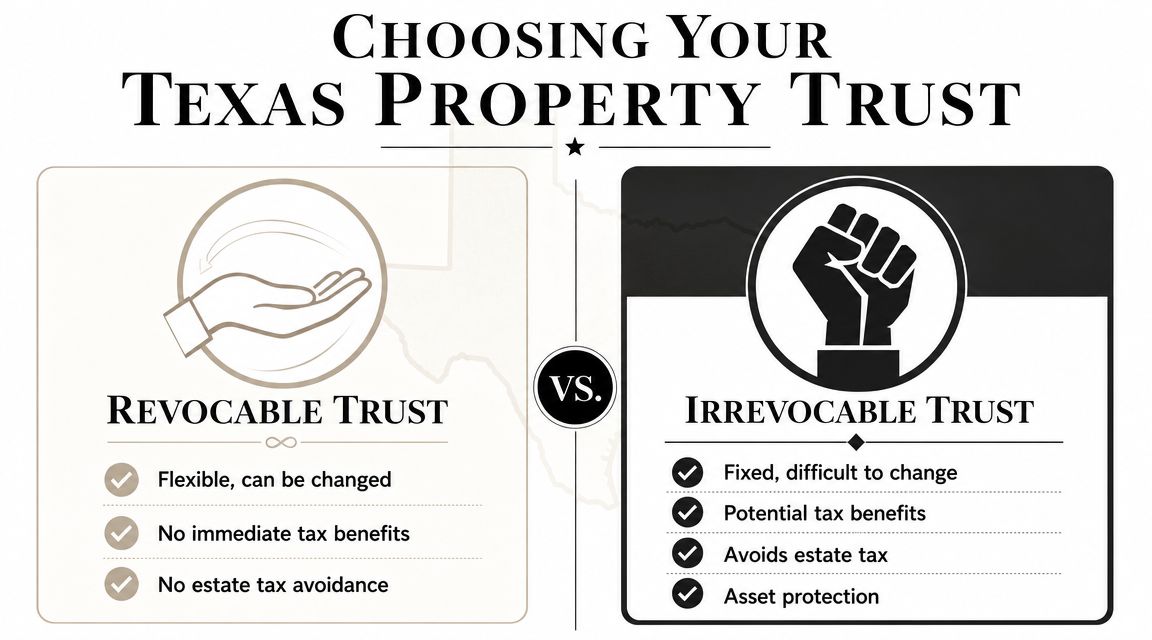
Revocable trusts and day-to-day control
A revocable trust is usually the starting point for homeowners who want flexibility. The person creating the trust often serves as the initial trustee and keeps broad control while living and competent. If life changes, the trust can often be amended or revoked under its own terms.
That flexibility matters in ordinary Texas life. A couple in The Woodlands might move later, refinance, sell, or update who receives the house after death. A revocable structure usually fits that kind of changing family plan better than a more rigid trust.
A revocable trust is often about management and administration, not immediate insulation from every outside claim. Homeowners who choose it are commonly prioritizing convenience, continuity, and probate planning.
Irrevocable trusts and stronger separation
An irrevocable trust usually involves a more serious transfer of control. Once created and funded, changing it can be difficult and sometimes requires additional legal steps. That trade-off is the point. Some families use irrevocable planning when they are focused on asset protection, long-term care planning, or more advanced wealth-transfer goals.
For example, a family with significant exposure to future creditors or concerns about preserving assets across generations may consider an irrevocable structure. The goal is different. Instead of flexibility first, the goal is stronger separation between the individual and the asset.
That doesn't mean irrevocable trusts are automatically right for everyone. They can create practical limits that surprise people later. If you may want to retitle, sell, borrow against, or revise your plan freely, rigidity can become frustrating.
A side-by-side view
| Feature | Revocable trust | Irrevocable trust |
|---|---|---|
| Control during life | Usually retained by the creator | Usually reduced once funded |
| Ability to change terms | Often flexible | Often limited |
| Probate planning | Common use | Can also be used |
| Asset protection focus | Usually limited | Often stronger than revocable planning |
| Best fit | Families wanting control and continuity | Families prioritizing protection or advanced planning |
Texas families sometimes also compare a trust to other transfer tools. In some cases, a deed-based strategy may fit a narrower goal. This overview of protecting your home with a Lady Bird deed in Texas is useful when a homeowner wants to compare options rather than assume a trust is always the answer.
The right trust isn't the one with the most features. It's the one that matches your actual goals, your family dynamics, and how much control you want to keep.
What Texas law adds to the choice
Texas law also raises issues that are easy to overlook. Community property concerns, homestead protections, and fiduciary administration all affect how a trust should be drafted and funded. A trust that looks fine in broad terms may still be a poor fit if it doesn't account for who owns the home now, whether both spouses must sign, and how the trustee will act later.
That's why trust selection is more than checking a box marked revocable or irrevocable. It's a legal design choice.
Drafting the Trust and Preparing the New Deed
Once the trust type is chosen, the work becomes document-driven. At this stage, there are two separate legal instruments to get right. The trust agreement creates the trust relationship. The deed moves the property into that relationship.
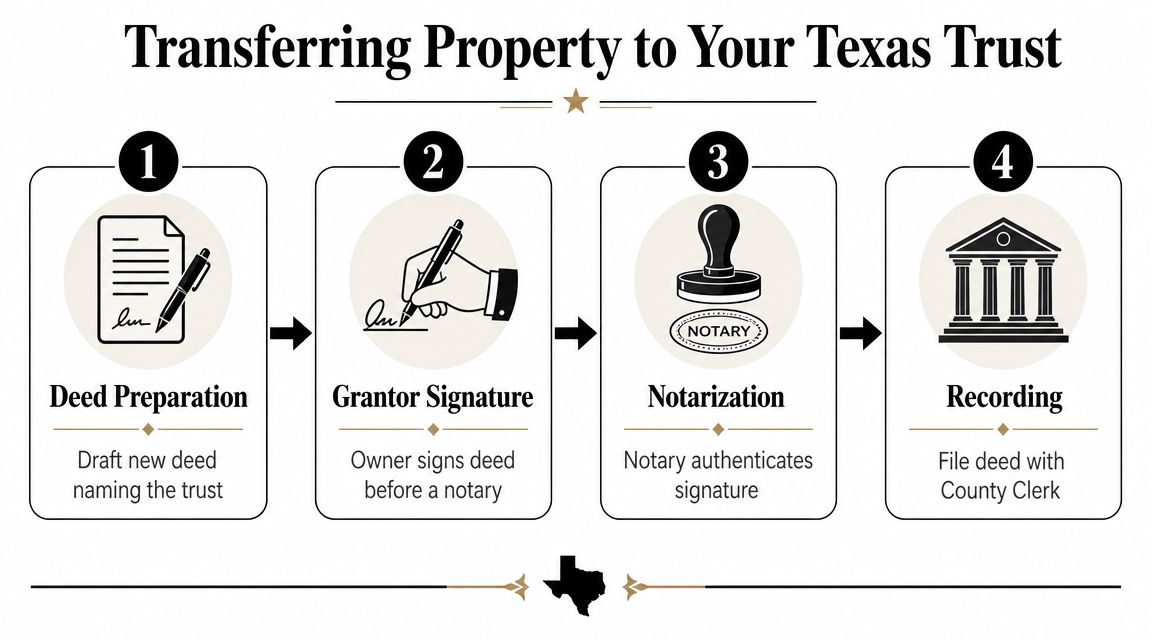
Texas guidance on the process is straightforward. The core workflow is to create the trust instrument, prepare a new deed transferring the residence to the trust, execute the trust and deed with notarization, and record the deed with the county clerk so title is updated in the public record. That same guidance also notes that homeowners should notify their insurance carrier after transfer to keep coverage administration accurate, as explained in this discussion of how to put your Texas house in a living trust.
What belongs in the trust agreement
The trust agreement should clearly identify the parties and the rules of administration. In most home-transfer situations, that means defining:
- Grantor or settlor: The person creating the trust.
- Trustee: The person who holds and manages the trust property.
- Beneficiaries: The people who benefit from the trust now or later.
- Successor trustee provisions: Who steps in if the initial trustee resigns, dies, or becomes incapacitated.
- Management terms: What the trustee may do with the home, such as insure it, maintain it, lease it, or sell it.
Under the Texas Trust Code, the trustee's role is not honorary. It carries fiduciary obligations. That means a trustee has to act in accordance with the trust terms and in the interests of the beneficiaries. If a parent puts a home into trust and names an adult child as successor trustee, that child is stepping into a legal role, not just receiving a favor.
The deed does the transfer work
The deed is where many do-it-yourself efforts fail. Families often assume the signed trust agreement changes ownership by itself. It doesn't. Ownership of real property changes through a properly prepared and executed deed.
The deed should reflect the current owner as the grantor and the trust, or trustee of the trust, as grantee in the correct legal form. Precision matters here. If the trust name on the deed doesn't match the trust agreement, or if the property description is sloppy, title problems can surface later during a sale, refinance, or after death.
For homeowners who want a more detailed look at mechanics, this guide on how to transfer property to a trust is a useful companion.
Drafting note: The legal description should come from the current deed, not from memory and not from the mailing address.
What works and what does not
What works is boring, exact drafting. Names match. Dates match. Trustee capacity is clear. The legal description is copied carefully from the existing recorded deed. Signatures are prepared with the right capacity language.
What doesn't work is a shortcut. A street address is not enough. An informal note that “my house goes into my trust” is not enough. A trust summary is not a deed.
If the house is separate property, community property, or jointly owned, that ownership status should also be reviewed before preparing the transfer document. Seeking legal advice at this stage often prevents expensive clean-up later.
The Official Transfer Executing and Recording the Deed
The transfer becomes real when the paperwork is signed correctly and placed in the public land records. Until then, the trust plan may be well written, but the title record may still show the individual owner.
The signing step
In Texas, a practical transfer usually has four core legal actions: identify the trust as grantee exactly as written in the trust agreement, prepare a deed that lists the current owner as grantor, sign before a notary, and record the deed with the county clerk in the county where the property sits. The same Texas-focused guidance emphasizes that the recorded deed is what publicly shows the trust now owns the home, as outlined in this explanation of putting a house into a trust in Texas.
A notary public has an important role here. The notary verifies identity and witnesses the signature in the manner required for recordable real estate documents. If multiple owners are transferring the house, each person who must sign should do so correctly and in the right legal capacity.
A common real-world example is a married couple in Harris County who created a revocable trust years ago but never transferred the house. They finally sign the deed before a notary, and for the first time the estate plan and the public title record line up.
Recording with the county clerk
Recording is not a courtesy step. It is the public filing that places the ownership change in the county's real property records. If the property is in Bexar County, it goes to the Bexar County records. If it is in Dallas County, it belongs there.
This is the moment many families miss. They sign a deed, put it in a file folder, and assume the home is now in trust. It isn't enough. A signed but unrecorded deed can leave a family arguing later about whether the transfer was completed and whether title examiners will treat it as effective.
A simple sequence to follow
- Confirm the final deed language: Check trust name, trustee name, and legal description.
- Arrange signing before a notary: Make sure each necessary owner signs.
- File in the correct county: The county is where the property is located.
- Keep proof of recording: Store the recorded copy with the trust papers.
Recording is the milestone that turns a planning document into a publicly reflected ownership change.
Texas families often feel relief at this stage because the transfer is no longer theoretical. The county record now shows the trust relationship tied to the home, which is what makes the planning function in practice.
Managing Your Home in a Trust Key Texas Issues
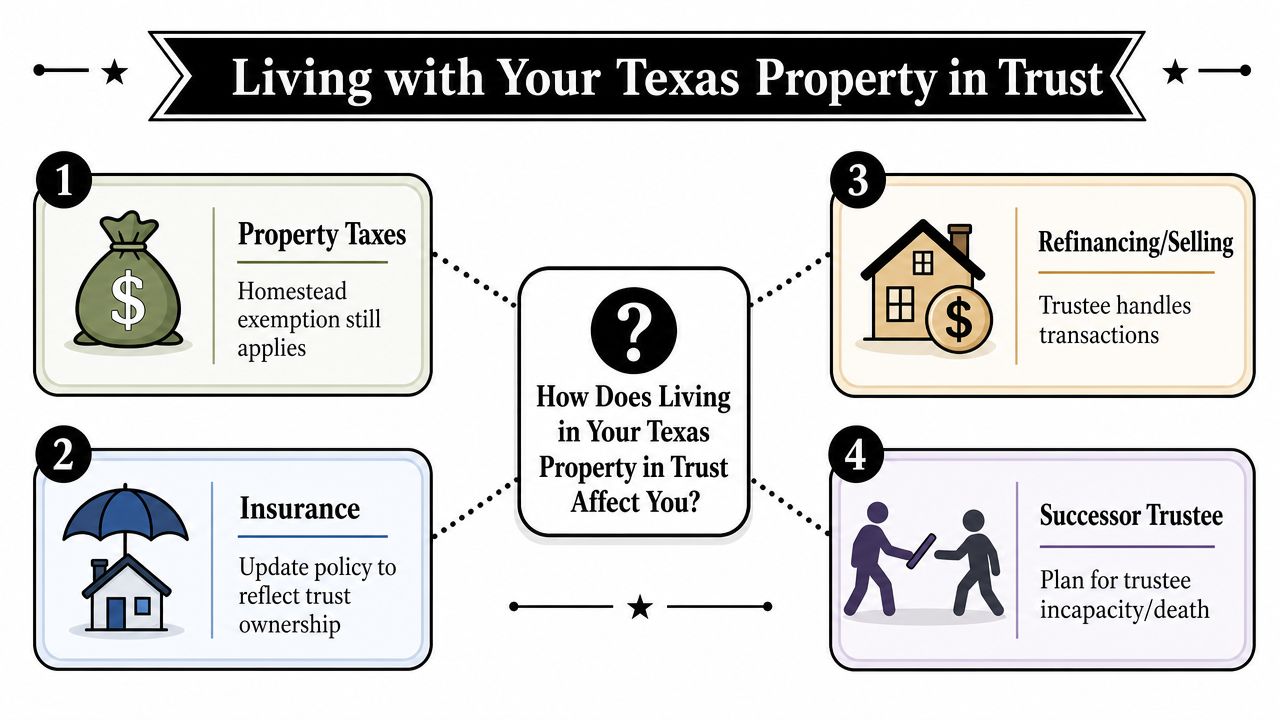
A Dallas homeowner records the deed into her revocable trust, then the practical questions arrive fast. The appraisal district still shows her individual name. The insurance policy has not been updated. The mortgage statement keeps coming as if nothing changed. That does not mean the transfer failed. It means the follow-through matters.
Homestead and property tax concerns
For Texas families, homestead rights are often the first concern, and for good reason. A home is not just another asset on a balance sheet. It carries property tax consequences, creditor protections, and in many households, real anxiety about doing anything that could disturb those benefits.
In many standard revocable trust arrangements, transferring the home into trust does not mean the owner has given up the property as a principal residence. But no family should rely on assumptions here. After the deed is recorded, check the appraisal district account, confirm the ownership and mailing address are shown correctly, and address any request for supporting documents quickly. A small clerical problem can turn into missed notices or confusion about an exemption.
The legal answer and the administrative answer are not always the same. On paper, the trust may be structured correctly. In practice, the county still needs records that make sense.
Insurance should match the new ownership
Insurance claims are handled by policy language, not by good intentions. If title is now held by a trustee, but the homeowner's policy still names only the individual owner, that mismatch can create avoidable questions after a fire, storm, or liability claim.
Call the carrier or the local agent after the transfer and ask for a trust review. Many Texas homeowners do not need an entirely new policy, but they often do need an endorsement, an updated named insured, or confirmation that the trust and trustee are reflected properly.
A useful post-transfer insurance check includes:
- Named insureds: Confirm whether the trustee, the trust, or both should appear on the policy
- Mailing information: Make sure premium notices and renewals go to the right place
- Use of the property: Verify the policy still fits a primary residence, second home, or rental
- Liability coverage: Review whether the current limits still make sense for the family
If the deed says the trust owns the home, the insurance file should tell the same story.
Mortgages and lender questions
A mortgage usually creates the next round of worry. Texas homeowners often ask whether transferring a house to a trust will trigger the due-on-sale clause. For a typical revocable living trust, where the borrower remains in control and continues to live in the property, the concern is often manageable. Still, the answer depends on the loan documents and the exact form of the transfer.
Read the deed of trust, review the note, and contact the servicer if the account records need updating. Some lenders barely react. Others want a copy of the trust certification or other paperwork for their file. Families generally do better by addressing that early instead of waiting until a refinance, payoff request, or insurance claim exposes a mismatch.
Selling, refinancing, and successor trustee administration
Putting a Texas home into trust usually does not take away day-to-day control. If the homeowner is also the current trustee of a revocable trust, the house can usually still be sold, refinanced, insured, repaired, or leased in the ordinary course. The main difference is that documents are signed in the trustee's capacity, and title companies often ask for trust-related paperwork before closing.
This is also where trust planning shows its value during incapacity. If the homeowner later cannot manage affairs, a named successor trustee can step in under the trust terms and handle the property without asking a court to appoint a guardian just to keep the house insured, listed for sale, or maintained. For many Texas families, that is a key benefit. Less disruption, fewer delays, and a clearer path for the person already chosen to act.
Common Mistakes to Avoid When Funding Your Trust
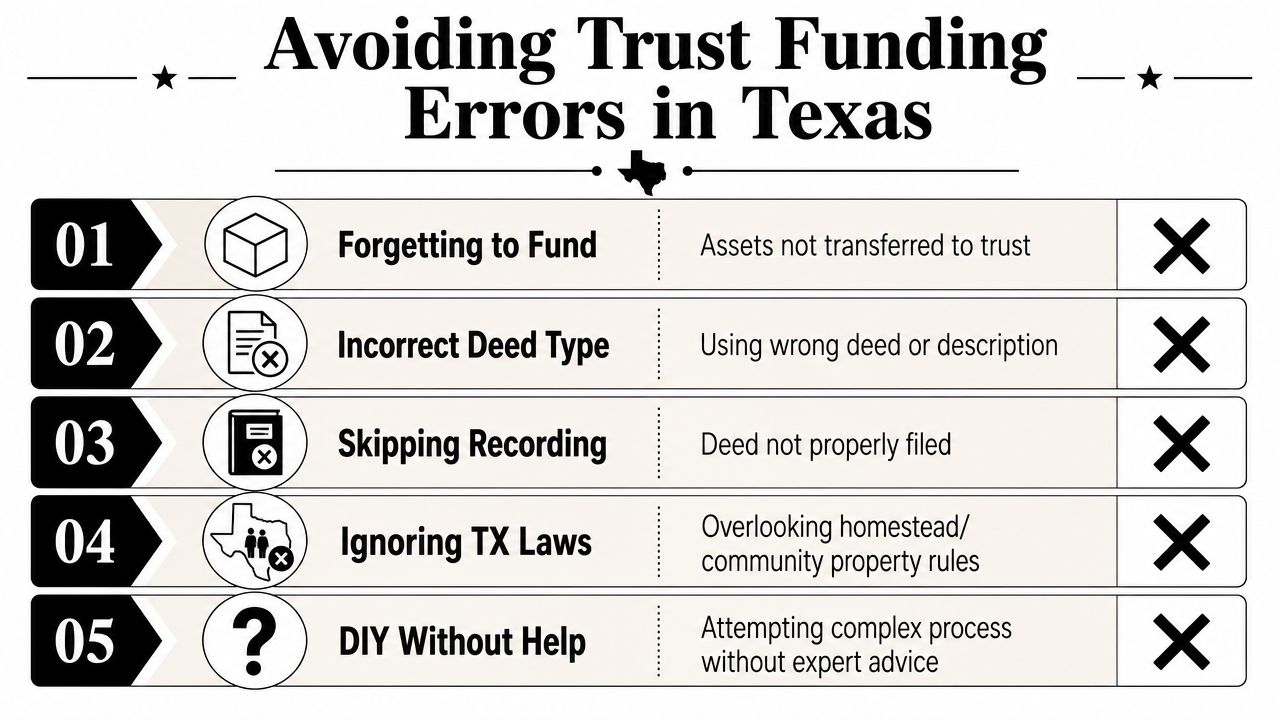
The most common trust failure is not a drafting disaster. It's incompletion. A family signs a trust, feels relieved, and assumes the house is covered. If the deed was never prepared and recorded, the trust may exist on paper while the home remains outside it.
That problem has a specific name. Failure to fund the trust. A technically important pitfall is that the trust document alone does not move title. The home must be funded into the trust by a separate deed and recorded at the county level. Failure to retitle the asset is a common reason a trust does not function as intended for probate avoidance or administration, as noted in this article about putting a home in trust.
The mistakes that create the most trouble
Some errors are especially common:
- Creating the trust but never transferring the house: This leaves the trust empty as to the home.
- Using an incomplete legal description: A street address is not the same as the record description.
- Naming the grantee inconsistently: The trust and deed must match in legal naming.
- Ignoring post-transfer administration: Insurance, tax records, and trustee records still need attention.
- Trying to solve a complex ownership issue with a simple form: Community property, prior deeds, divorce history, or inherited interests often need legal review.
A short post-transfer checklist
After the deed is recorded, keep a practical checklist:
- Store the recorded deed: Keep it with the trust agreement and any amendments.
- Review insurance: Update the carrier and keep written confirmation.
- Check county and tax records: Confirm ownership and mailing details.
- Keep trustee information organized: Successor trustees should know where the papers are.
- Revisit the overall estate plan: A house in trust helps, but the rest of the assets should also be reviewed.
Many families can handle parts of the process smoothly with professional guidance from an estate planning lawyer, title professionals, insurance agents, and tax advisers. For those who want coordinated help, the Law Office of Bryan Fagan, PLLC provides Texas-based assistance with trust creation, funding, administration, probate, guardianship, and asset protection planning.
An unfunded trust doesn't fail because the idea was wrong. It fails because the title work was never finished.
If you're managing a trust or planning your estate, contact Law Office of Bryan Fagan, PLLC for a free consultation. Our attorneys provide trusted, Texas-based guidance for every step of the process.