Skip to content
Being named in a trust often arrives at the worst possible time. A parent has died. A grandparent is declining. A sibling has stepped into the trustee role. You know you're supposed to receive something, but you don't know when, what information you're entitled to, or whether the trustee has to answer your questions.
Many beneficiaries come in with the same worry: “I don't want to start a fight. I just want to know what's going on.” That's a reasonable position, and Texas law gives you more protection than many people realize.
Introduction Navigating Your Role as a Beneficiary
A common first meeting starts like this. A daughter brings in a trust summary she barely understands. Her brother is the trustee. Months have passed, and she's heard little beyond “the trust is being handled.” She isn't sure whether she can ask for bank records, whether she gets to see the trust itself, or whether silence from the trustee is normal.
That uncertainty can feel heavy, especially when grief and family dynamics are already in the room.
Texas trust law gives beneficiaries real rights, not just hopeful expectations. Those rights exist to protect the person who created the trust, the beneficiaries who depend on it, and the integrity of the administration process. If you've been searching for answers about trust beneficiary rights in Texas, the most important starting point is this: your role matters, and your questions are legitimate.
Some trusts also hold assets that create practical planning issues beyond family heirlooms and brokerage accounts. For example, if trust property includes investment real estate, it helps to understand how real estate trusts are used in planning and ownership structures. This overview of tax-efficient real estate opportunities can give helpful context when a trust owns property rather than cash.
Beneficiaries rarely need more complexity. They need clear answers, timely information, and a path forward.
Understanding Your Status Current vs Remainder Beneficiary
Before you can tell what rights you can enforce today, you need to know what kind of beneficiary you are.
Why your label matters
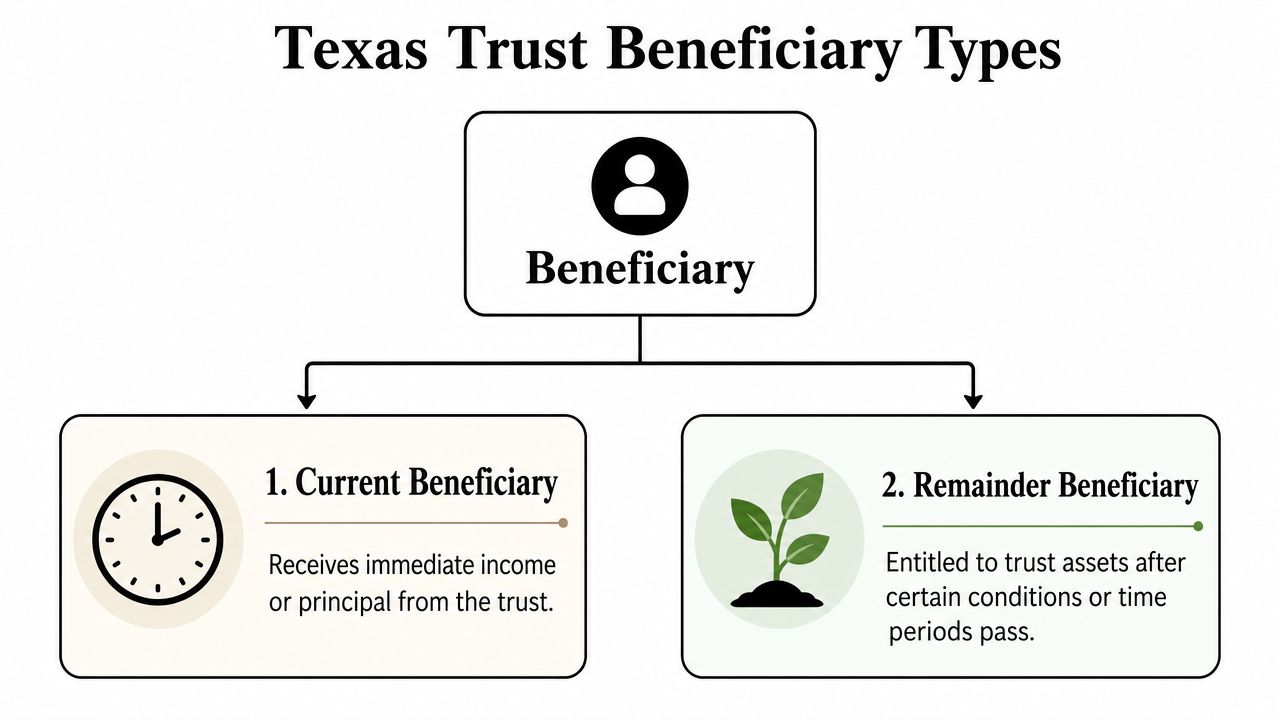
A beneficiary is a person or entity that receives a benefit from the trust. That sounds simple, but Texas law draws an important line between people who are entitled to benefits now and people who may receive trust property later.
Think of a trust like a house with two doors.
| Beneficiary status | What it usually means | Practical effect |
|---|---|---|
| Current beneficiary | You're entitled to present distributions, income, or current benefits | You usually have stronger rights to information and enforcement now |
| Remainder beneficiary | You receive assets later, often after another event or person's death | Your rights can be narrower and more dependent on timing and standing |
A current beneficiary is the person standing at the front door today. A remainder beneficiary is waiting for the second door to open later.
That distinction is often the turning point in a dispute. The critical difference between current and remainder beneficiaries is often overlooked, but under the Texas Trust Code, non-waivable accounting provisions apply almost exclusively to “first-tier” beneficiaries, so your power to force a trustee to account may depend on your status as a beneficiary under this discussion of Texas beneficiary rights.
A simple example
Suppose a trust says:
- A surviving spouse receives income during life.
- The children receive what remains after the spouse dies.
In that setup, the spouse is usually the current beneficiary. The children are usually remainder beneficiaries.
If the trustee isn't communicating, the spouse often has immediate ability to demand information tied to present administration. The children may still have interests worth protecting, but their standing can be more limited and more fact-specific.
Practical rule: Never assume “beneficiary” means every beneficiary has identical rights at the same time.
That's also why it helps to understand what trust administration includes. Texas Trust Administration: A Trustee's Guide explains what trust administration involves and how it differs from probate, which is useful when families confuse the trustee's role with the role of an executor.
Questions to ask right away
If you're unsure where you fall, start with these questions:
- Am I entitled to distributions now or only after a future event?
- Does the trust call me a current, income, contingent, or remainder beneficiary?
- Has the trustee identified my status in writing?
- Would the trust end now if the present beneficiary died?
Those answers shape everything else, including whether you can demand documents now, whether you can challenge conduct directly, and how quickly you should act.
Your Fundamental Right to Information and Accounting
For many beneficiaries, the most useful right is the right to information. Silence is where confusion grows. Texas law does not treat transparency as optional.
What the trustee must provide
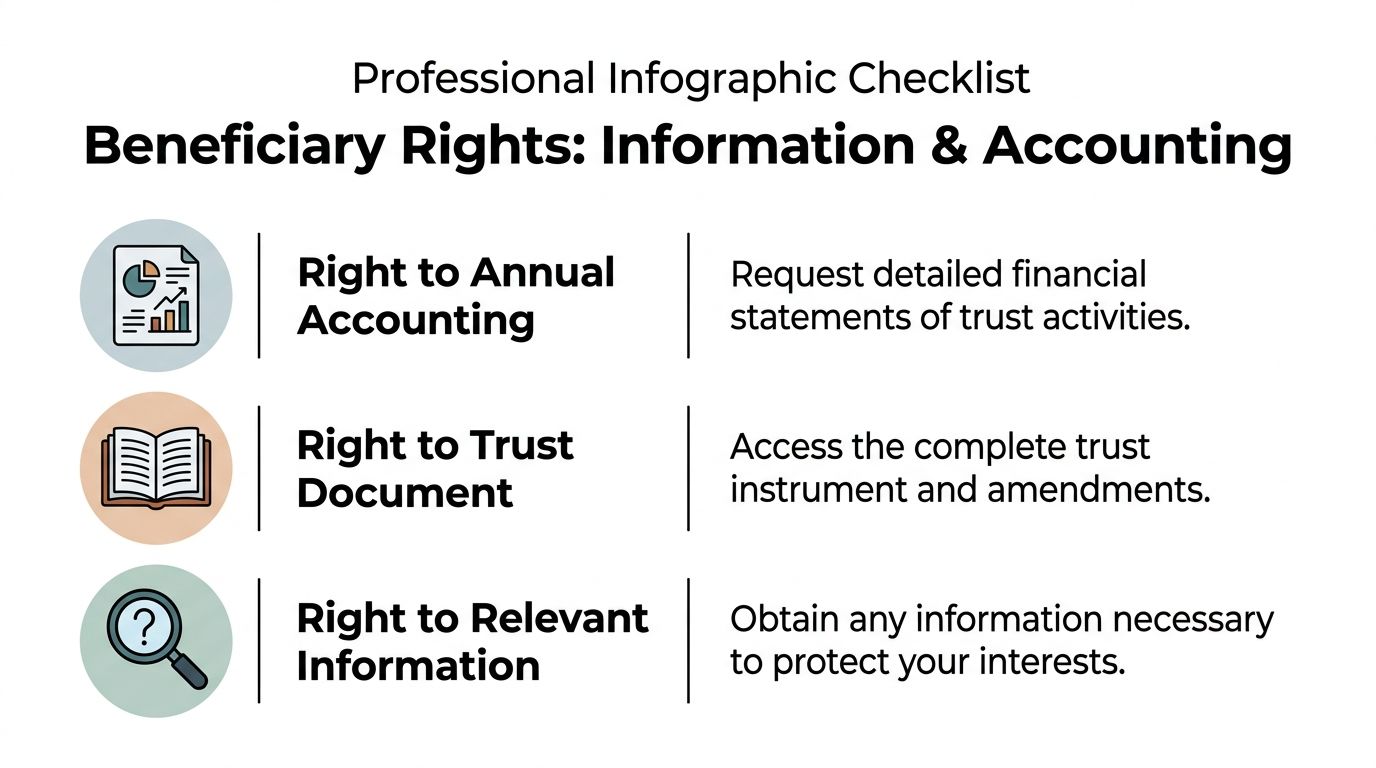
Under the Texas Trust Code, current beneficiaries have an affirmative, non-waivable right to information and formal accountings. Texas Property Code § 113.152 requires trustees to keep current beneficiaries reasonably informed, and § 111.0035 provides that this duty cannot be limited or waived by the trust instrument, as explained in this summary of beneficiary rights in a Texas trust.
That principle rests on both the Texas Trust Code and broader fiduciary principles. Trustees hold property for someone else's benefit. Because of that, they must communicate material facts that affect a beneficiary's rights.
The documents and details that matter
A beneficiary's right to information usually includes concrete items, not vague reassurances. In Texas, beneficiaries have an automatic right to receive a complete copy of the trust document and other governing terms, and they may demand a formal accounting under Texas Trust Code § 113.151. That statute also provides that a second accounting generally cannot be required until 12 months have passed since the prior one, as discussed in this overview of rights in trust disputes.
A formal accounting often helps answer questions like:
- What assets are in the trust
- What money came in
- What money went out
- What the trustee paid themselves
- Whether distributions were made properly
- Whether debts, taxes, or expenses were paid from trust property
If the trust instrument doesn't require periodic accountings, the trustee may not have to send them automatically without a formal request. Even so, beneficiaries still retain the right to key information such as trustee compensation, the identity of beneficiaries or changes in beneficiary status, a copy of the trust instrument or relevant portions, and a settlor's letter of wishes regarding personal property, as described in this discussion from Today's CPA on trust disclosure obligations.
How to make a request that gets taken seriously
A verbal request is easy to ignore. A written request is harder to sidestep.
Use a short, respectful letter or email that identifies:
- Your status as a beneficiary
- The trust name
- The information you're requesting
- Whether you are requesting a formal accounting
- A reasonable deadline for response
If you need a model for the process, this resource on a demand for trust accounting in Texas gives practical guidance on how beneficiaries typically frame the request.
Ask for documents, not explanations. Documents answer questions that stories often don't.
If you are the trustee reading this
Many disputes start because a new trustee doesn't know what has to happen immediately after taking over. First Steps for a Successor Trustee in Texas is useful for understanding what to do right after stepping into that role.
A trustee's duty to inform also includes disclosing material facts that might affect a beneficiary's rights, both through mandatory disclosures and by responding to specific requests, as explained in this summary of what every Texas trust beneficiary should know.
When a Trustee Breaches Their Fiduciary Duties
The trustee's job isn't just to hold property. The trustee is a fiduciary. That means the law expects a very high standard of honesty, care, and fairness.

The three duties beneficiaries should know
Most beneficiary complaints fall into one of three fiduciary categories.
Loyalty
The trustee must act for the benefit of the beneficiaries, not for personal advantage. A loyalty problem appears when a trustee uses trust property for themselves, directs business to themselves, or puts personal conflicts ahead of the trust's purpose.
Prudence
The trustee must manage trust assets responsibly. Prudence doesn't require perfect investment results, but it does require thoughtful decision-making, attention, and care.
Impartiality
When a trust has more than one beneficiary, the trustee must treat them fairly according to the trust's terms. A trustee can't favor the loudest sibling, the nearest child, or the beneficiary they personally like best.
What a breach can look like in real life
A breach of fiduciary duty in Texas often looks ordinary from the outside. That's why beneficiaries sometimes miss it.
Examples include:
- Self-dealing transactions where the trustee buys trust property cheaply or uses trust assets for personal expenses
- Unexplained withdrawals that don't match trust purposes
- One-sided distributions that ignore the trust language
- Poor recordkeeping that leaves no clear paper trail
- Refusal to share information when a beneficiary asks for records tied to their interest
Sometimes the red flag isn't one dramatic act. It's a pattern. Delays, incomplete answers, missing statements, and hostility can point to deeper administration problems.
Red flag: When a trustee says “trust me” but won't show records, the problem is often the lack of records or what the records reveal.
How courts evaluate the issue
Courts usually focus on conduct, documents, and the trust terms. The question isn't whether the trustee is pleasant or whether family members get along. The question is whether the trustee complied with the trust and with fiduciary duties in Texas.
If you suspect misconduct, this guide on trustee breach of fiduciary duty is a useful starting point for spotting the legal issues that matter.
A breach case often becomes stronger when the beneficiary can show a timeline, written requests, incomplete responses, and financial records that don't line up.
How to Enforce Your Rights and Remove a Trustee
A common Texas trust dispute starts the same way. A beneficiary asks a fair question, the trustee gives a vague answer, and weeks turn into months.
At that point, many beneficiaries are unsure what they can do. They do not want to overreact, but they also do not want to sit still while trust property is mishandled. The right approach is usually orderly, documented, and tied closely to your beneficiary status. That last point matters more than many guides explain. A current beneficiary often has a stronger basis to demand present information or distributions, while a remainder beneficiary may need to frame the request around protecting a future interest from waste or mismanagement.

Start with a written demand
Court is often the second step, not the first.
A written demand does two jobs at once. It tells the trustee exactly what you are asking for, and it creates a record a judge can later read. In trust litigation, that paper trail often matters as much as the complaint itself.
A useful demand usually includes:
- The trust's identifying details. List the trust name and date if known.
- Your beneficiary status. Say whether you are a current beneficiary, a remainder beneficiary, or whether that issue is being disputed.
- The specific information or action you want. That may include the trust instrument, an accounting, backup records, or an explanation for a decision.
- A reasonable deadline. Clear timing helps prevent delay.
- Copies of everything sent and received. Save letters, emails, attachments, and delivery confirmations.
The wording should match your role. If you are a current beneficiary, your request may focus on present distributions, current income, or records tied to ongoing administration. If you are a remainder beneficiary, your request may focus more on preserving trust assets, examining unusual transactions, or confirming that the trustee is not favoring current interests in a way that harms what should remain later. The trust is one vehicle, but current and remainder beneficiaries are often sitting in different seats.
When court action becomes necessary
Sometimes the trustee complies after receiving a clear demand. Sometimes the response confirms the problem.
If the trustee still refuses to provide information, ignores the trust terms, or appears to be mishandling assets, a Texas court can be asked to intervene. Depending on the facts, that may include compelling an accounting, ordering the trustee to act, surcharging the trustee for losses, or removing the trustee altogether. If you want a closer look at that process, this guide on removing a trustee in Texas explains the grounds and procedure in more detail.
Removal is a serious remedy. Judges usually want to see more than family tension or personality conflict. They focus on whether the trustee can continue to serve the trust properly and fairly. A trustee who withholds records, ignores trust instructions, misuses funds, or lets personal interests interfere with administration may create grounds for removal.
Timing matters too. Trust claims can become harder to prove if records disappear, memories fade, or account activity becomes more difficult to trace.
What removal cases often turn on
A judge usually looks for a clear story supported by documents. You can picture it like assembling a ledger rather than making a speech. The more each record fits into the timeline, the easier it is to show what happened and why the court should act.
Helpful evidence often includes:
| Type of evidence | Why it matters |
|---|---|
| Trust language | Shows the trustee's actual duties and limits |
| Account statements and ledgers | Shows how trust money was handled |
| Emails and letters | Shows what was requested, what was refused, and when |
| Distribution history | Shows whether the trustee treated beneficiaries according to the trust terms |
| Evidence of conflicts | Shows self-interest, favoritism, or misuse of authority |
Current and remainder beneficiaries often gather different kinds of proof. A current beneficiary may focus on missed distributions, unexplained withholding, or unequal treatment in the present. A remainder beneficiary often needs to document depletion of principal, risky transfers, self-dealing, or other conduct that shrinks what should remain for the future. That distinction can shape both the legal theory and the remedy requested.
One sentence can change a case. So can one bank statement.
Getting practical help
If you believe a trustee may need to be challenged, legal advice is often most useful before positions harden. A Texas trust administration lawyer can review the trust terms, identify your exact status, and help frame requests in a way that fits your rights as a current or remainder beneficiary.
That focused review can also prevent a common mistake. Beneficiaries sometimes ask for everything, all at once, without tying the request to the trust language or their own interest. A stronger approach is narrower and more precise.
The Law Office of Bryan Fagan, PLLC handles trust administration and related Texas trust and estate matters. That can matter when a trust dispute overlaps with probate, incapacity issues, guardianship concerns, or estate planning questions.
A Beneficiary's Own Liabilities and Responsibilities
Many beneficiaries assume the legal burden falls only on the trustee. That's not always true.
Texas law can also hold a beneficiary responsible when the beneficiary's own conduct harms the trust.
When a beneficiary can create liability
Under Texas Trust Code § 114.031, a beneficiary is liable for loss to the trust if the beneficiary misappropriates trust property, expressly consents to a trustee's breach of trust, fails to repay an advance or loan of trust funds, fails to repay a distribution exceeding the beneficiary's entitlement, or breaches a contract to deliver property to the trustee. Unless the trust says otherwise, the trustee may offset that liability against the beneficiary's trust interest, even if the trust contains a spendthrift provision, as stated in Texas Property Code § 114.031.
That catches people off guard.
A beneficiary might think, “I only accepted what the trustee offered,” but problems can arise if the beneficiary knew the trustee was acting improperly or participated in the misuse of trust property.
Common examples
Consider these situations:
- You take trust property without authority. That can create direct liability to the trust.
- You agree to a trustee's improper transfer. Express consent can weaken your position and expose you to liability.
- You receive too much and keep it. If a distribution exceeds what you were entitled to and you don't repay it, the issue may be charged against your share.
- You borrowed from the trust and never repaid it. The trustee may seek repayment or offset.
A better way to protect yourself
If a trustee suggests a shortcut, asks you to sign off on a questionable transaction, or proposes an uneven distribution, pause before agreeing.
Ask for the trust language. Ask for the accounting. Ask how the action fits the trustee's fiduciary duties in Texas.
Good beneficiaries don't just protect their inheritance. They avoid stepping into the trustee's mistake.
That approach helps preserve your rights and reduces the chance that your own share becomes part of the dispute.
Your Next Steps Toward Clarity and Confidence
Trust administration can feel personal because it is personal. The trust usually exists because someone cared enough to put instructions in writing for the people they loved, supported, or wanted to protect. When communication breaks down, beneficiaries often feel they're being asked to trust a process they can't see.
You don't have to stay in that position.
If you know your beneficiary status, understand your right to information, recognize the warning signs of a fiduciary breach, and act promptly when something feels wrong, you're already in a stronger position. Those same principles matter to trustees, executors, and families trying to avoid conflict before it grows.
Some readers also find it helpful to compare approaches across practice areas when a trust dispute overlaps with business interests, real estate, or broader litigation strategy. For that reason, a review of SMB Law's legal expertise may offer useful context on how legal issues can intersect across different matters.
A Texas estate planning attorney or trust dispute lawyer can review the trust document, explain where the Texas Trust Code and Texas Estates Code fit into your situation, and help you decide whether the next step is a simple request for information or formal court action. If you're also thinking ahead about succession, probate avoidance, or how to modify a trust in Texas, legal advice is often the clearest path to peace of mind.
If you're managing a trust or planning your estate, contact Law Office of Bryan Fagan, PLLC for a free consultation. Our attorneys provide trusted, Texas-based guidance for every step of the process.