Managing a loved one's trust can feel overwhelming, especially when two people are supposed to manage it together and can't agree on what should happen next. A common Texas scenario involves siblings serving as co-trustees who reach a standstill over selling a house, handling investments, or making distributions to a family member who needs support now. The beneficiaries feel the delay. The trust stalls. Tension spreads into every conversation.
That doesn't always mean one co-trustee should be removed. But sometimes removal is the only practical way to protect the trust and get administration moving again. The hard part is that Texas law doesn't treat co-trustee conflict as enough by itself. The question is whether the co-trustee's conduct has crossed into a legal problem that a court can fix.
Families often come to this issue from different angles. A beneficiary may think a co-trustee is dragging their feet or favoring one side of the family. A co-trustee may believe the other trustee is withholding records, refusing to cooperate, or making decisions that put trust property at risk. Those are very different positions, but they lead to the same legal concern. Has someone breached fiduciary duties in Texas in a way that justifies removal?
If you're dealing with that kind of dispute, it helps to start with a grounded overview of co-trustee disputes in Texas. The details matter. So does the wording of the trust itself.
Navigating Co-Trustee Conflicts in Texas
Two co-trustees can work well when each brings something useful to the role. One may know the family history. The other may be better with bookkeeping, tax matters, or investment oversight. But that balance breaks down fast when one trustee stops sharing information, delays basic decisions, or treats the trust like personal property.
In practice, the most stressful co-trustee disputes usually don't start with obvious theft or dramatic misconduct. They start with friction that keeps growing. One trustee won't sign off on repairs to trust real estate. One refuses to approve a distribution the trust appears to allow. One starts making side deals with a tenant, a broker, or a family member without real transparency. At that point, a beneficiary or the other co-trustee starts asking the question no one wanted to ask at the beginning. Can this person be removed?
That's where Texas trust law becomes both helpful and frustrating. Helpful, because there is a structured process. Frustrating, because the law requires more than family tension, poor manners, or stubbornness. If you're trying to learn how to remove a co-trustee in Texas, the answer depends on two things first. What authority the trust document gives, and what evidence you have.
Practical rule: Courts care far more about documented harm, missed duties, and financial risk than they do about who was rude, secretive, or difficult at Thanksgiving.
The path also looks different depending on who is acting. A beneficiary may push for removal because the trust is suffering. A co-trustee may seek removal because administration has become impossible. That co-trustee angle is often overlooked, even though it comes up often in family trusts where one trustee is trying to do the work and the other is blocking every move.
Understanding the Legal Grounds for Removal
Texas courts don't remove trustees just because people don't get along. The legal standard is narrower than most families expect, and that's important to understand before anyone files anything.
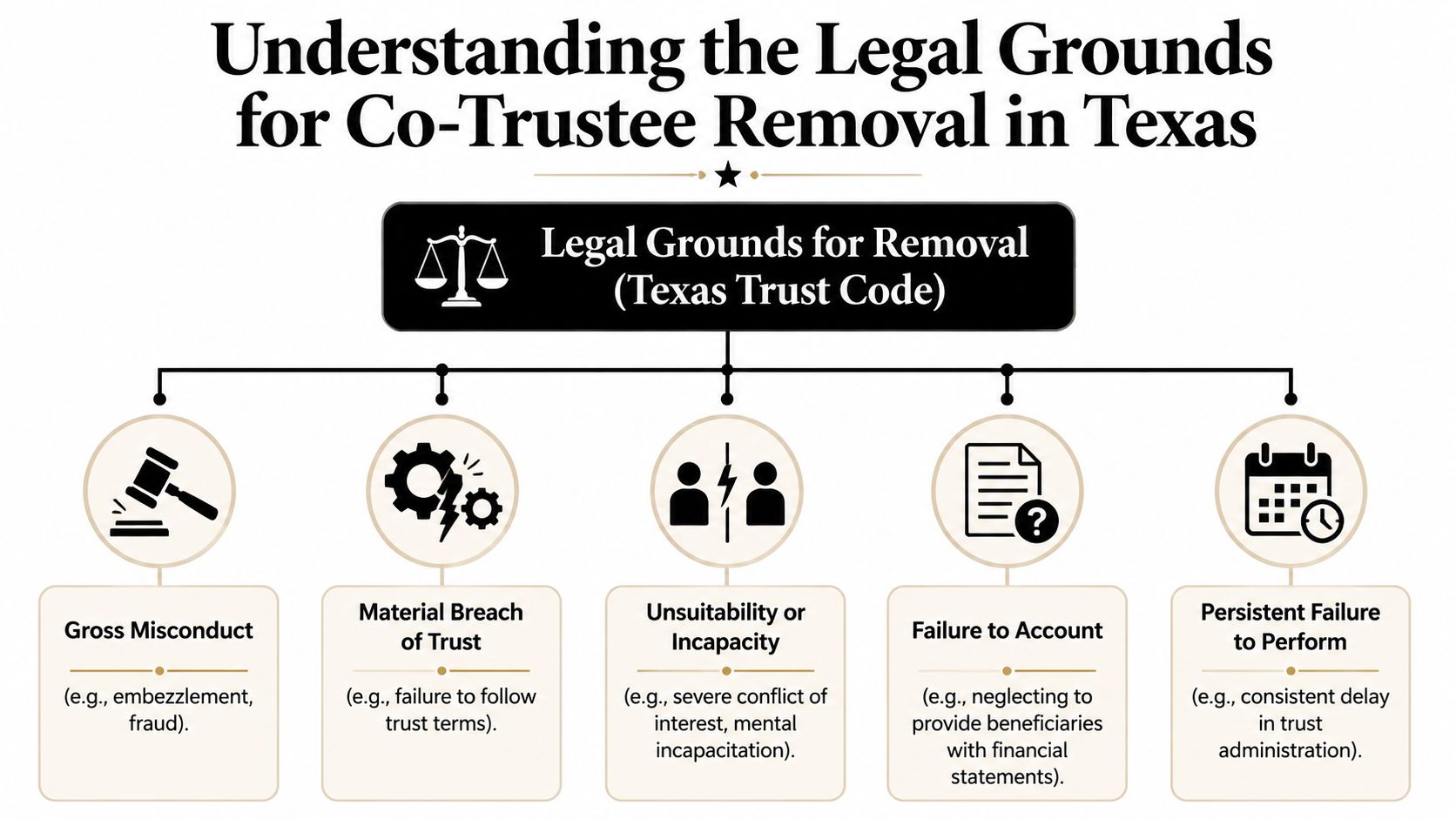
Under Texas Property Code § 113.082, a court may remove a trustee, including a co-trustee, if the trustee materially violates the trust terms and that violation causes a material financial loss to the trust. The statute also lists four mandatory grounds: material violation resulting in financial loss, incapacitation or insolvency, failure to make a legally required accounting, and other cause found by the court. The same statute gives the court discretion to deny compensation alongside removal.
What a court usually wants to see
A removal case gets stronger when the complaint ties specific conduct to a fiduciary failure. In plain English, that means showing the trustee didn't just make you angry. It means showing the trustee failed to carry out legal duties tied to the trust.
Examples that often matter include:
- Breach of loyalty: The co-trustee uses trust opportunities for personal gain or puts personal interests ahead of beneficiaries.
- Breach of prudence: The co-trustee handles assets carelessly, ignores obvious risks, or refuses to manage property responsibly.
- Failure to account: The co-trustee won't provide records that Texas law or the trust requires.
- Incapacity or insolvency: The co-trustee can't competently serve or has financial problems that affect trust administration.
A more detailed discussion of trustee breach of fiduciary duty in Texas can help when you're trying to sort misconduct from ordinary disagreement.
What does not usually work
Many people assume that “hostility” is enough. It usually isn't. Courts may consider conflict under the statute's “other cause” language, but hostility has to affect actual performance. Ill will by itself doesn't carry a removal petition very far.
That point matters even more in co-trustee cases. Co-trustees often disagree over timing, strategy, or family dynamics. One may want to sell a ranch now. The other wants to hold it. One may want conservative investments. The other wants growth. Those disputes can be serious, but if both trustees are acting in good faith and staying within the trust terms, a judge may not treat the disagreement as grounds for removal.
A strong petition names acts, dates, records, and trust provisions. A weak petition says the trustee is difficult, unfair, or impossible to work with.
The co-trustee angle that gets missed
A co-trustee trying to remove another co-trustee often faces a narrower lane than a beneficiary expects. In many trusts, the document does not clearly give one co-trustee authority to force out the other without court involvement. That's one reason these cases require close reading of the trust instrument before strategy is set.
If removal does happen, someone still has to administer the trust the next day. In that situation, First Steps for a Successor Trustee in Texas is a useful starting point because it focuses on what to do immediately after stepping into the trustee role.
For readers comparing fiduciary roles across states, 2026 Florida executor duties can also be a helpful contrast. Executors and trustees serve different legal functions, but both roles involve fiduciary decision-making, recordkeeping, and accountability.
The Step-by-Step Process of Filing a Removal Petition
If informal efforts have failed and there's no workable non-judicial path, the case moves into court. At that point, precision matters more than emotion.
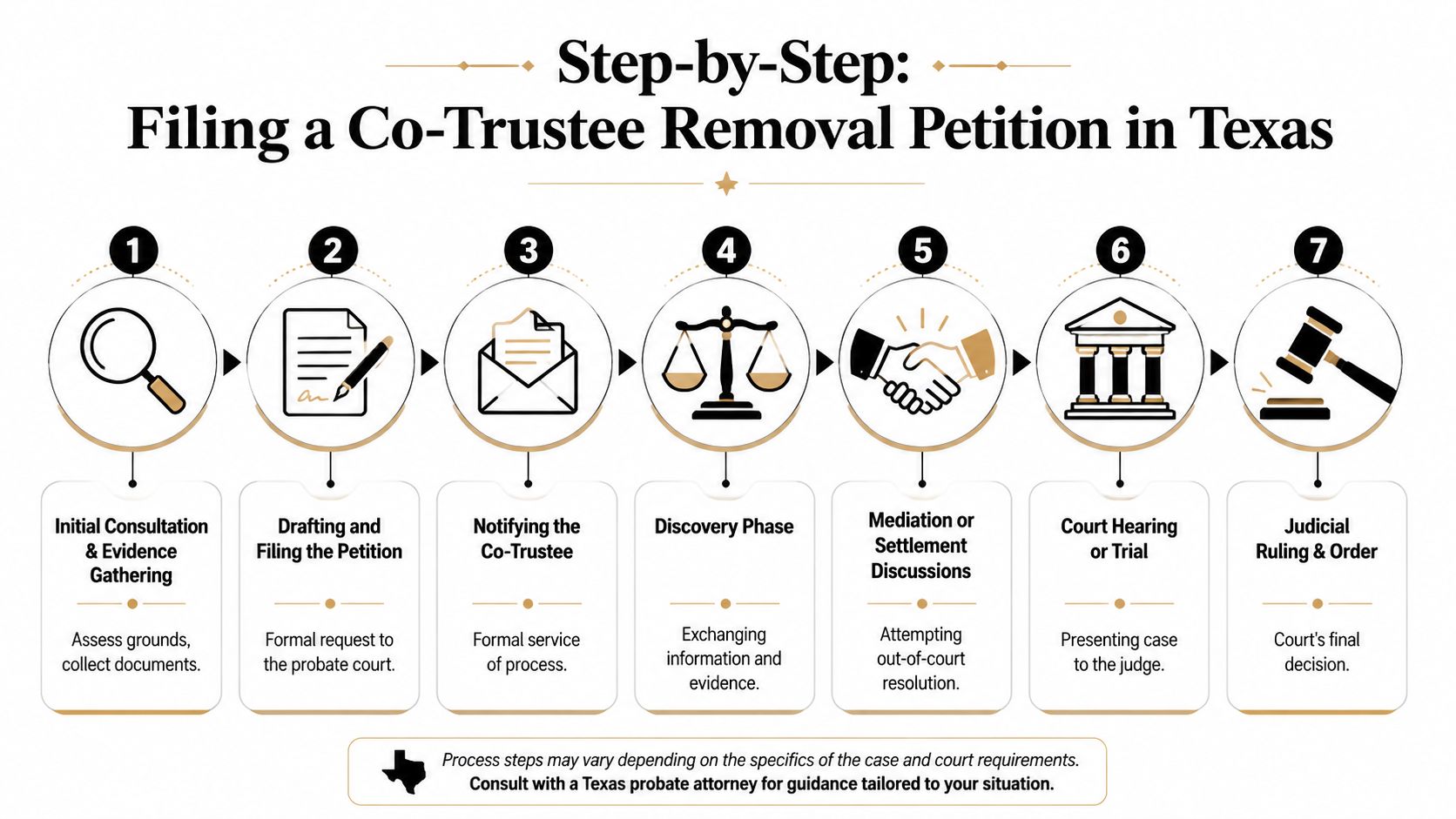
The formal process begins when a beneficiary files a Petition for Removal of Trustee in the probate or district court of the county where the trust is administered. The petition must cite legal grounds under the Texas Trust Code, such as § 113.082, and include specific factual allegations like bank statements, investment records, or communications showing refusal to cooperate, as described in this discussion of the removal process.
What should happen before filing
A rushed filing often creates problems that could have been avoided with a better record. Before a petition is filed, the person seeking removal should organize the trust instrument, amendments, prior accountings, financial statements, communications, and any documents that show the disputed conduct.
For a co-trustee, that usually means collecting the paper trail of administration. That may include emails about blocked decisions, records showing failure to sign required documents, property records, ledgers, or written requests for information that went unanswered. For a beneficiary, the file may look different. Beneficiaries often have partial records and need to assemble the timeline from account statements, notices, and correspondence.
What the petition needs to say
A good petition is concrete. It identifies:
- The parties: The petitioner, the respondent co-trustee, and interested beneficiaries.
- The trust at issue: Name of the trust, date, and relevant terms.
- The legal basis: The specific Texas Trust Code sections relied on.
- The facts: What happened, when it happened, and how the conduct harmed administration or the trust estate.
- The requested relief: Removal, possible denial of compensation, and appointment of a successor if needed.
This isn't a place for broad accusations. Saying a co-trustee is “unreasonable” won't do much by itself. Saying the co-trustee failed to provide required accountings, refused to cooperate in paying trust expenses, or diverted trust opportunities creates a record a court can evaluate.
Service, response, and evidence development
After filing, the petition must be legally served on the trustee and other required parties. That service step matters. A removal case can stumble on procedure if notice is incomplete or improperly handled.
Then the case usually turns to evidence development. Depending on the dispute, the parties may exchange records, request documents, take testimony, and narrow the core points of disagreement. In a co-trustee case, one issue often becomes central very quickly. Is this a dispute over judgment, or a dispute over breach?
A short comparison helps:
| Issue | Usually weaker for removal | Usually stronger for removal |
|---|---|---|
| Investment choices | Good-faith disagreement over strategy | Reckless handling or self-interested decisions |
| Communication problems | Personality conflict or rudeness | Refusal to provide records or required information |
| Administration delays | Short-term disagreement | Ongoing inaction harming trust property or distributions |
| Family friction | Mutual distrust alone | Conflict that prevents the trustee from performing duties |
Case-building focus: Judges look for evidence that ties conduct to trust harm, not just evidence that the relationship has broken down.
What happens at the hearing
At the hearing, the burden is on the person seeking removal. That means the petitioner has to prove the legal grounds with evidence, not suspicions. Courts may review the trust terms, financial records, communications, testimony from witnesses, and sometimes expert testimony on administration or investment decisions.
A co-trustee petitioner needs to stay disciplined here. Courts are less interested in long family history than in fiduciary facts. If there has been deadlock, the key question is usually whether the deadlock caused actionable harm or whether the trust itself gives a way to break it.
Possible outcomes can include removal, denial of compensation, appointment of a successor, or denial of the petition. Sometimes a judge leaves the trustee in place but issues directions that change how the trust is administered. That's one reason litigation strategy should focus on a realistic remedy, not just the desire to “win.”
Exploring Alternatives to Court-Ordered Removal
Court isn't always the right first move. In some families, it's the only option. In others, it turns a difficult administration problem into a lasting family fracture.

Texas law recognizes a non-judicial path in some cases. While judicial removal is the default path for contested co-trustee removals, a co-trustee can sometimes be changed without court involvement if the trust document explicitly grants a removal power or if all beneficiaries agree through a Non-Judicial Settlement Agreement, as long as the change doesn't impair a material purpose of the trust, as explained in this overview of changing trustees without court in Texas.
Start with the trust document
The first practical question is simple. Does the trust already provide a removal mechanism?
Some trust documents allow a named person, trust protector, majority of beneficiaries, or another specified actor to remove and replace a trustee. If that language exists and it applies to co-trustees, that may solve the issue without a contested petition. But the wording has to be read carefully. Many trusts discuss successor trustees without creating a removal power.
For families also weighing broader changes to administration, this can overlap with issues a Texas estate planning attorney would evaluate when advising on how to modify a trust in Texas or preserve the settlor's original intent.
Non-judicial settlement and mediation
A Non-Judicial Settlement Agreement can work when the beneficiaries agree that a change in trusteeship is necessary and the agreement does not defeat a material purpose of the trust. That option is often overlooked in co-trustee disputes because everyone assumes a judge must decide. Sometimes that's true. Sometimes it isn't.
Mediation is different. Mediation doesn't remove a trustee by itself, but it can produce a resignation, a defined division of responsibilities, a communication protocol, or an agreement on a successor. Those results can preserve assets and reduce hostility.
This video gives a useful general overview of issues families often face in trustee disputes:
A practical comparison looks like this:
- Trust-based removal power: Fastest when the document is clear. Least useful when the language is vague.
- Non-Judicial Settlement Agreement: Best when beneficiaries can still cooperate. Not available if key parties won't consent.
- Mediation: Helpful when there's room for compromise. Less effective if one trustee is hiding records or acting in bad faith.
- Court petition: Strongest when formal findings and enforceable orders are needed. Usually more expensive, slower, and harder on family relationships.
Sometimes the smartest move isn't proving the other co-trustee was wrong. It's finding the lawful path that protects the trust with the least damage to the people involved.
For people trying to decide between litigation and agreement, a Texas trust administration lawyer can help compare those options before positions harden.
Common Mistakes and How to Avoid Them
A common pattern looks like this. One co-trustee is convinced the other has crossed a line. Beneficiaries are upset, emails are getting sharper, and someone decides the court will “see what's going on.” Then the case stalls because the proof shows friction, not misconduct.
That gap matters. Texas courts do not remove a co-trustee just because the working relationship has broken down or because two fiduciaries would manage the trust differently. The question is whether the conduct has harmed the trust, threatens the trust, or shows a failure to perform fiduciary duties in a way the court can act on.
The errors that hurt cases most
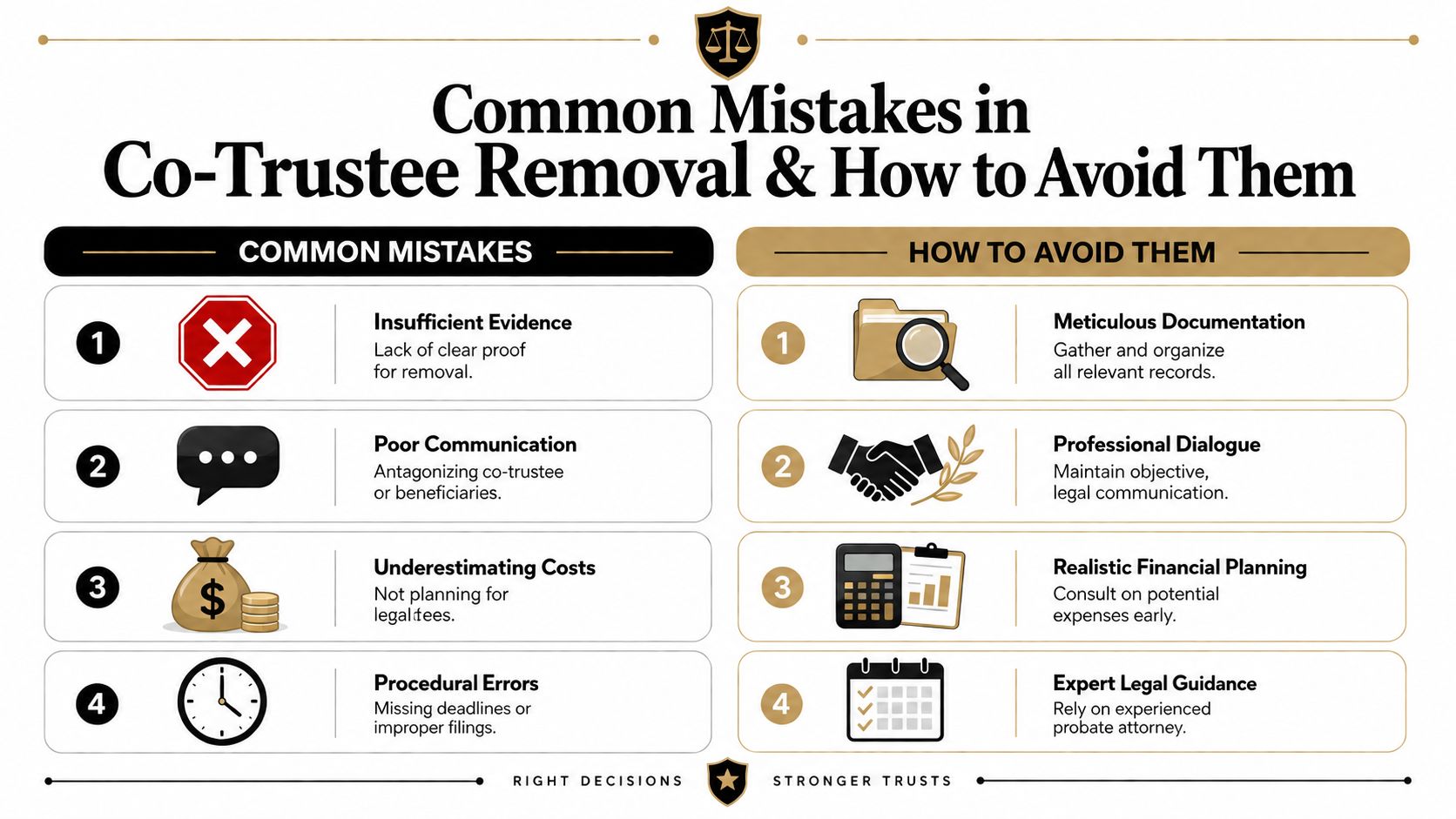
The first mistake is confusing mismanagement with disagreement. A co-trustee may make a decision you would not have made and still remain within the bounds of the trust and Texas fiduciary law. Removal cases get stronger when the complaint is specific: refusal to provide records, self-dealing, missed tax obligations, unexplained distributions, failure to protect trust property, or a pattern of ignoring required trustee duties.
Another mistake is failing to build a record before accusing the other trustee of wrongdoing. If you are a beneficiary, that usually means keeping written requests for accountings, responses, bank statements, notices, and trust provisions that show what the trustee was supposed to do. If you are the other co-trustee, the record often needs one more layer. Proof that you objected, asked for information, proposed a lawful fix, and tried to prevent harm without abandoning your own duties.
Poor communication also causes avoidable damage. Angry texts, threats, and broad accusations can make a reasonable concern look personal. For co-trustees, this is especially dangerous because your own conduct may come under review. A judge who sees both sides acting recklessly may be less interested in removing only one of them.
Procedure is another weak point. Parties sometimes file before they identify the right legal grounds, the right requested relief, or the right successor plan. Even a strong complaint can lose force if the petition is vague or if no one has addressed who will manage the trust after removal.
A better way to approach the dispute
Start by separating bad conduct from bad chemistry. If the issue is delay, document the missed deadlines and the effect on the trust. If the issue is money, trace the transaction and identify why it violated the trust terms or fiduciary duties. If the issue is stonewalling, keep the written requests and the nonresponses.
For co-trustees, one practical point is often overlooked. You may still have a duty to protect trust assets while you are trying to remove your counterpart. If insurance is lapsing, property taxes are due, or a beneficiary distribution has to be evaluated, address what you can lawfully address and document what the other trustee blocked. That helps protect the trust and helps show the court the difference between obstruction and responsible administration.
Use a disciplined paper trail. Short emails are usually better than emotional ones. Confirm requests in writing. Cite the trust provision when you can. Ask for records by a date certain. If there is suspected self-dealing or misuse of funds, gather the underlying documents before making conclusions you may have to defend later.
Early legal review can change the strategy. Sometimes the facts support removal. Sometimes the smarter course is a negotiated resignation, a temporary agreement on limited trustee authority, or a demand that forces production of records before anyone files suit. A Texas trust administration lawyer, or a firm such as Law Office of Bryan Fagan, PLLC, can review the trust, the factual record, and the available options before the dispute becomes harder and more expensive than it needs to be.
Your Next Steps and When to Consult a Trust Attorney
Those seeking to remove a co-trustee in Texas are usually already under pressure. The trust may be stalled. Beneficiaries may be demanding answers. A co-trustee may be refusing to cooperate. That urgency is real, but the legal response still has to be careful.
Start with a short checklist:
- Check the trust document: Does it give any removal or replacement power without court involvement?
- Identify the actual legal problem: Is there evidence of breach, failure to account, incapacity, insolvency, or another serious cause affecting performance?
- Gather proof: Trust disputes are won with records, not conclusions.
- Consider the least damaging path: A negotiated solution may protect the trust better than a court fight. Sometimes court is still necessary.
- Plan for succession: If the co-trustee is removed, who takes over and how will administration continue?
Fiduciary law, trust administration, and family reality all converge. Removing a co-trustee isn't just a dispute tactic. It can reshape control of the trust, affect distributions, and change how the settlor's plan is carried out. It also often overlaps with broader estate planning, probate, guardianship, and asset protection concerns that need to be handled as one coordinated matter, not in isolation.
If you're managing a trust or planning your estate, contact The Law Office of Bryan Fagan, PLLC for a free consultation. Our attorneys provide trusted, Texas-based guidance for every step of the process.
If you're facing a co-trustee dispute, serving as a trustee, or trying to protect a loved one's trust from mismanagement, Law Office of Bryan Fagan, PLLC offers Texas-based guidance on trust administration, probate, estate planning, guardianship, and asset protection. Schedule a free consultation to get advice suited to your trust, your documents, and the specific facts of your case.