A lot of Texas families sit at the kitchen table with the same concern. They want to make sure a husband or wife is financially secure if something happens first, but they also want to protect what they've built for their children. That concern gets sharper in a second marriage, in a family with separate property, or when one spouse handles most of the money decisions.
That's where a bypass trust often enters the conversation. It isn't just a tax device for the very wealthy. In the right plan, it can also act like a protected family fund. The surviving spouse can benefit from it, but the assets stay on the path the first spouse intended.
Texas law matters here. Community property rules, the Texas Estates Code, the Texas Trust Code, and core fiduciary duties all shape how a bypass trust should be drafted and administered. If the trust language is loose, families can face disputes, tax problems, or confusion about what a trustee may and may not do.
Families who are starting this process often begin with broader estate planning in Texas because a bypass trust only works well when it fits into the full plan. Wills, beneficiary designations, deeds, powers of attorney, and trustee selection all need to line up.
Planning Your Legacy in Texas
Maria and David own a home in Texas, some investment accounts, and an interest in a family business. They're not trying to create a complicated structure for the sake of complexity. They want three simple outcomes. First, the surviving spouse should have support. Second, their children should eventually inherit what each parent intended. Third, the family shouldn't lose assets because the plan was vague or outdated.
That's the kind of situation where families start asking, what is a bypass trust used for in real life?
In plain English, a bypass trust is often used when a married couple wants to divide responsibilities and protect intent. After the first spouse dies, selected assets move into a trust that the surviving spouse can benefit from under stated rules. Those assets do not automatically become the survivor's personal property to spend, retitle, or leave to someone else.
Why Texas families pause at this point
Texas families often get stuck on one question. If we trust each other, why add another layer?
The answer usually has less to do with distrust and more to do with life changing after a death. A surviving spouse may remarry. Adult children may disagree about what a parent “would have wanted.” A new caregiver, a creditor issue, or a later estate plan can shift where property ends up. A bypass trust gives the family written instructions and a fiduciary structure to follow.
A well-drafted trust doesn't replace family trust. It protects it when grief, pressure, and changing circumstances make decisions harder.
What Texas law adds to the conversation
Texas is a community property state, so couples need to identify what belongs to the marital community and what is separate property before funding any trust. The Texas Estates Code governs how property passes at death. The Texas Trust Code governs how trustees administer trusts, keep records, follow the trust terms, and act for beneficiaries. Those fiduciary duties in Texas are not optional. A trustee must act loyally, prudently, and in line with the document.
That's why bypass trust planning isn't just about signing papers. It's about building a structure your family can administer later.
The Core Purpose of a Bypass Trust
A bypass trust has one central job. It holds certain assets after the first spouse dies so those assets can support the surviving spouse while staying outside the survivor's taxable estate. According to Cornell Law School's explanation of a bypass trust, a bypass trust is primarily used to maximize each spouse's federal estate tax exemption by placing assets up to the applicable exclusion amount into an irrevocable trust upon the first spouse's death, thereby ensuring those assets and their future growth are not included in the surviving spouse's taxable estate.
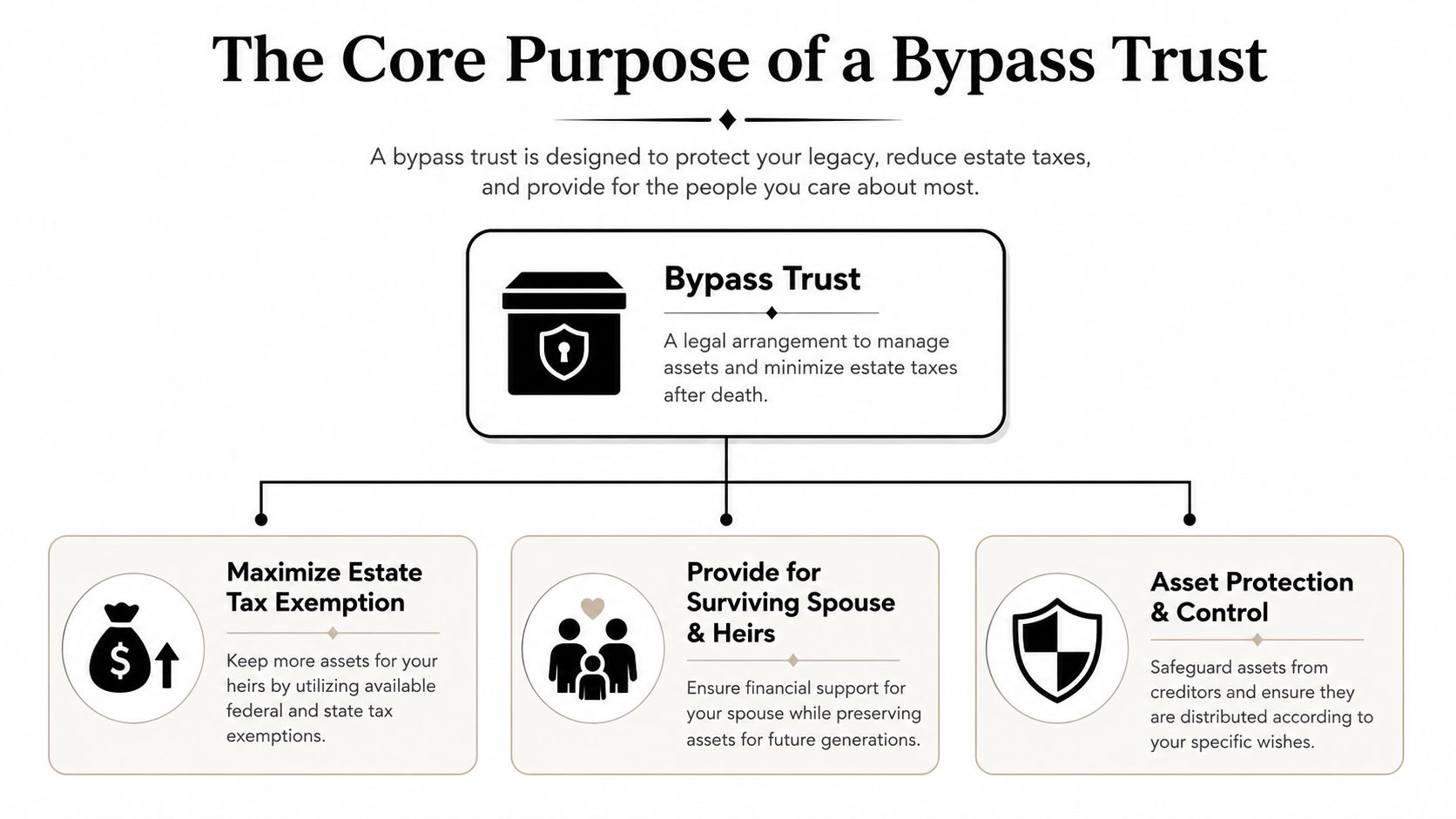
For families trying to understand the concept, I often compare it to a family vault. The vault is funded when the first spouse dies. The surviving spouse may receive income from it and may be able to access principal for approved needs, but the vault itself doesn't become the survivor's unrestricted personal account.
The three jobs this trust usually performs
Use estate tax shelter effectively
The classic tax purpose is to use the first spouse's available exclusion amount instead of wasting it. That's one reason families researching ways to minimize estate taxes often encounter bypass trusts.Support the surviving spouse
The surviving spouse isn't cut off. The trust can be drafted to provide income and, in many plans, limited principal access for defined needs.Protect the final destination of the assets
The trust can preserve the first spouse's intent so the remainder passes to named beneficiaries, such as children from that marriage or a prior one.
Why this matters in Texas
For many Texas families, the tax conversation is only half the story. The more pressing concern is control. If all assets pass outright to the surviving spouse, that spouse may later change beneficiary designations, rewrite a will, or blend assets in ways that make tracing difficult. With a bypass trust, the first spouse's instructions remain in place.
That's especially important in blended families. A husband may want his wife cared for during her lifetime while also making sure his children from an earlier marriage ultimately inherit his share. A bypass trust can help accomplish both goals at once.
Practical rule: If your top concern is “take care of my spouse, but make sure my children still inherit,” a bypass trust deserves serious attention.
Families who want a plain-language overview of post-death administration sometimes find Texas Trust Administration: A Trustee's Guide useful because it explains what trust administration involves and how it differs from probate. That distinction matters. A bypass trust isn't just drafted. It has to be administered correctly.
How a Bypass Trust Works in Practice
The legal idea becomes much easier once you see the sequence.
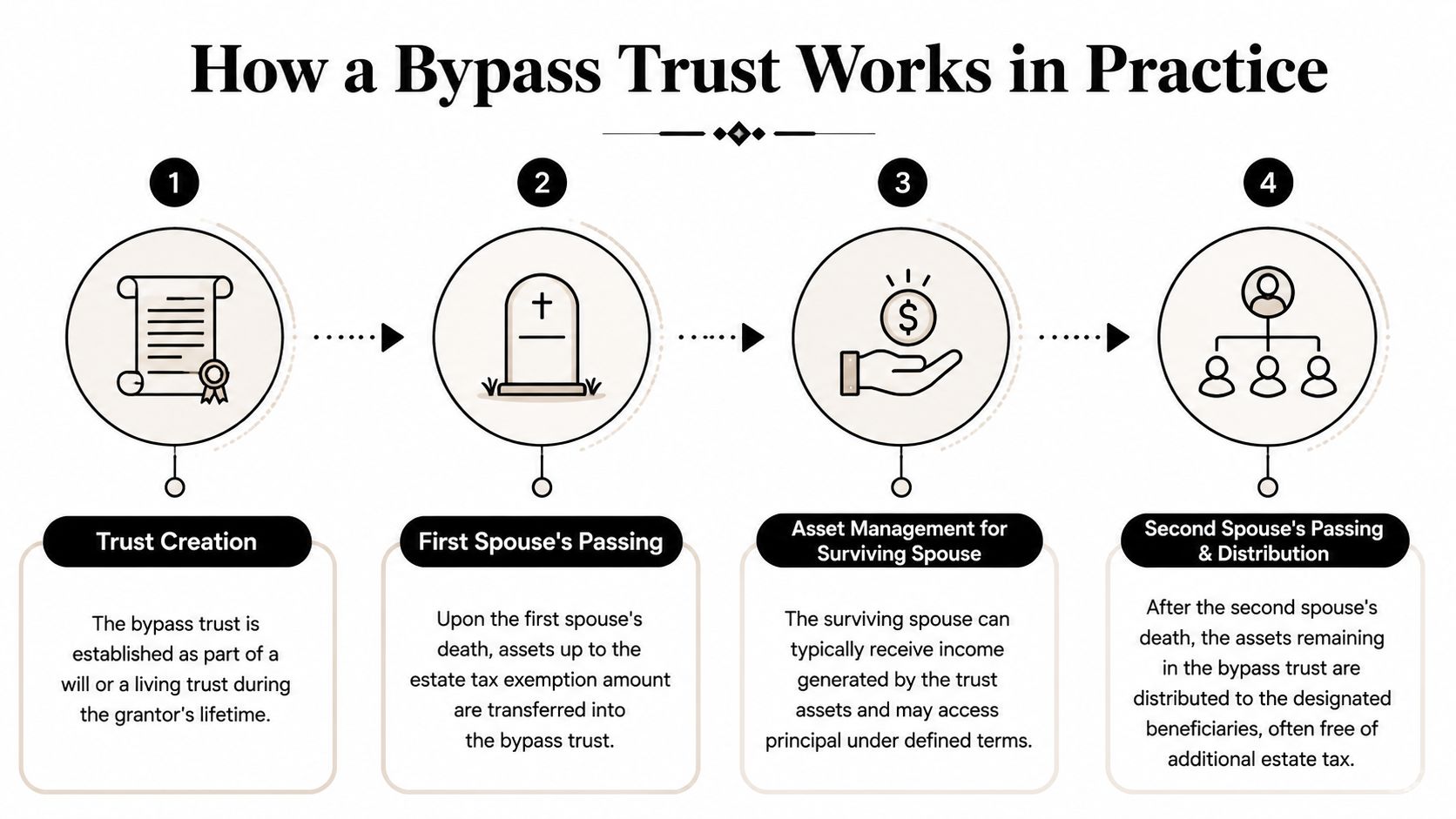
Step one through step three
First, the couple creates the plan while both spouses are alive. The bypass trust may be built into wills or a revocable living trust. The documents identify what happens at the first death, who will serve as trustee, and who will receive the trust property later.
Second, when the first spouse dies, the trust is funded. That means designated assets are transferred into the bypass trust under the estate plan's terms. At this stage, families often need help from a Texas estate planning attorney, a probate lawyer, and sometimes a CPA, because assets must be titled and allocated correctly.
Third, the trustee takes over management of the trust property. Under the Texas Trust Code and general fiduciary principles, the trustee must follow the trust terms, protect trust assets, keep beneficiaries reasonably informed when required, and avoid self-dealing.
A helpful visual overview appears below.
Step four and step five
The surviving spouse may receive benefits from the trust according to the document. As explained in this discussion of bypass trust structure and administration, the bypass trust is structured as an irrevocable trust that cannot be altered by the surviving spouse, which legally severs the assets from the survivor's taxable estate and provides creditor protection for the ultimate beneficiaries. The trustee manages and invests the trust assets, distributing income and, if the trust terms permit, principal for the surviving spouse's qualifying needs.
That word irrevocable matters. Once funded, the trust isn't something the surviving spouse can casually rewrite because family relationships changed.
When the surviving spouse later dies, the bypass trust assets pass to the named beneficiaries under the trust terms. Those assets do not pass under the survivor's will, and they aren't controlled by the survivor's later beneficiary choices.
Where families get confused
Here are the most common pressure points:
Who owns the property
The trust owns it. The surviving spouse benefits from it, but doesn't automatically own it outright.Who makes decisions
The trustee makes trust decisions. That person must act under fiduciary duties in Texas, not personal preference.Does this replace probate
Not always. Some assets may still pass through probate, while trust assets are administered under trust law. That's why coordination with the Texas Estates Code is so important.
The strength of a bypass trust depends less on the concept itself and more on funding, trustee conduct, and careful administration after death.
Bypass Trusts Compared to Other Planning Tools
A bypass trust is powerful, but it isn't the only tool available. Families often compare it to a marital trust or a QTIP trust because all three can support a surviving spouse. The distinctions involve control, estate inclusion, and who decides where the remainder goes.
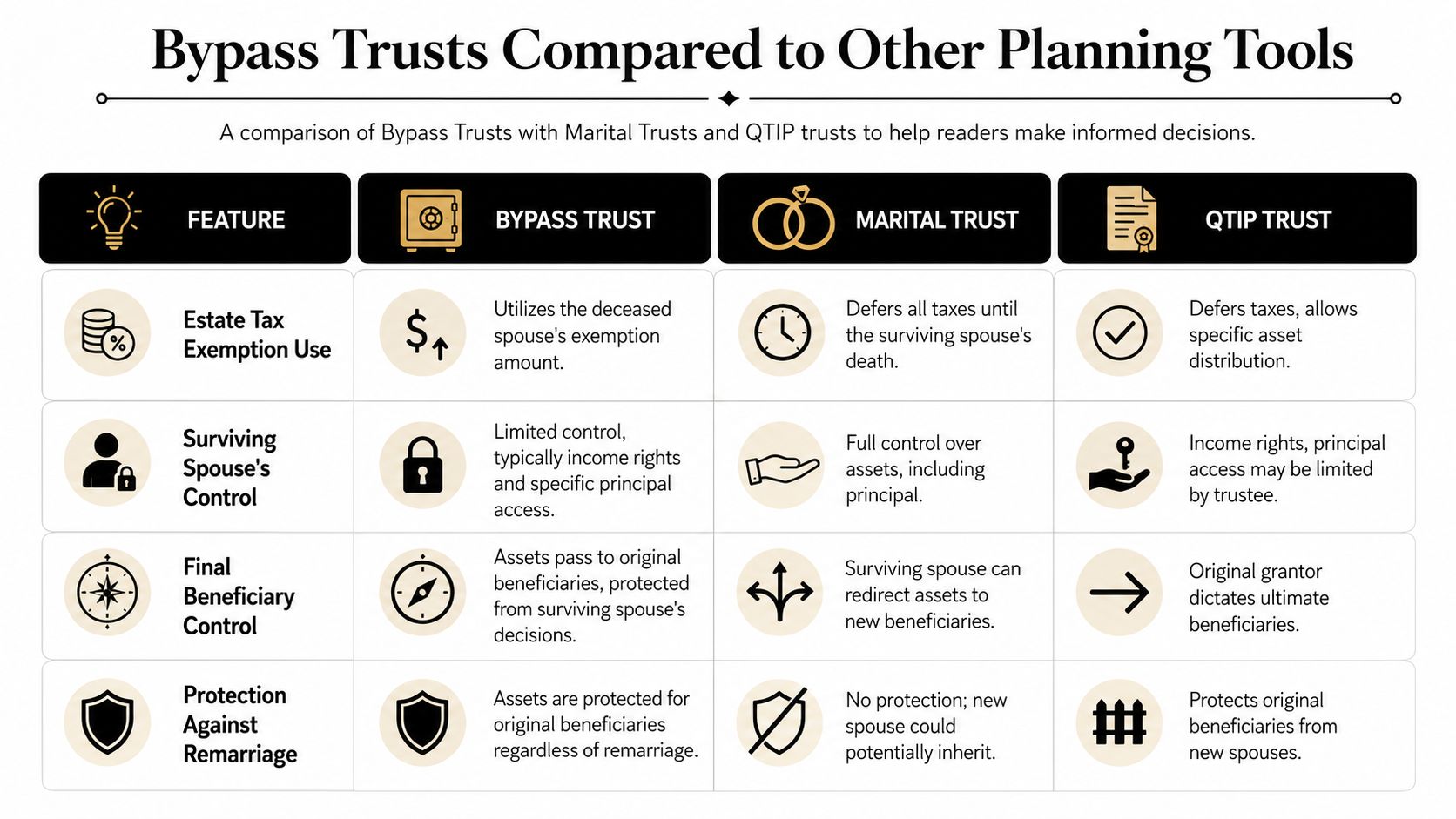
A simple comparison
| Feature | Bypass trust | Marital trust | QTIP trust |
|---|---|---|---|
| Primary focus | Use the deceased spouse's exemption and preserve remainder control | Defer taxes and maximize support for spouse | Support spouse while preserving original beneficiary control |
| Surviving spouse control | Limited by trust terms | Often broader | Income rights, with limits depending on terms |
| Where assets go later | To beneficiaries named by the first spouse | May be redirected through survivor's planning | To beneficiaries chosen by the first spouse |
| Use in blended families | Often strong fit | Can create risk if survivor later changes plan | Often useful when balancing spouse support and final control |
Texas families exploring this issue often also ask about marital trusts in Texas, because a marital trust can be a better fit when flexibility for the surviving spouse matters more than keeping assets outside the survivor's estate.
When each tool tends to fit
A bypass trust usually makes sense when the family wants hard lines. The first spouse wants to support the survivor, but also wants a protected remainder for children or other beneficiaries.
A marital trust can make sense when the couple wants to defer taxes and give the surviving spouse more freedom. The tradeoff is that more freedom can mean less protection for the original beneficiaries.
A QTIP trust often sits in the middle. It can support the spouse while preserving the first spouse's control over who gets the remainder.
The Texas angle
In Texas, these decisions can't be made in a vacuum. Community property versus separate property changes how assets are categorized before death. Business interests, ranch property, mineral interests, and real estate also create practical administration issues that a Texas trust administration lawyer should evaluate.
Here's the practical takeaway. If your concern is remarriage risk, beneficiary control, or the need for a strong trustee structure, a bypass trust often offers more built-in protection than an outright transfer to the surviving spouse.
Real-World Scenarios for Texas Families
The abstract rules make more sense when you see how families use them.

A Houston couple worried about future law changes
James and Elena have spent years building investment accounts, real estate holdings, and a closely held business interest. They know estate tax laws can change over time, and they don't want all planning options to depend on what Congress does later.
Their bypass trust plan gives the surviving spouse support while preserving a portion of the estate in an irrevocable structure. That creates certainty. It also gives the trustee a clear legal framework for management and distribution under Texas fiduciary standards.
A Dallas blended family trying to keep peace
Robert and Michelle both have children from prior marriages. They love each other and want the survivor comfortable for life. At the same time, each wants to know that their own children won't be unintentionally disinherited later.
A bypass trust helps because the surviving spouse can benefit from trust assets, but can't rewrite the final beneficiary designations for those assets. That's often the emotional heart of this planning. It reduces the chance that later remarriage, pressure from others, or a new estate plan changes the first spouse's intent.
Families often think trust disputes begin with greed. More often, they begin with unclear documents, mixed expectations, and assets that passed with too much freedom.
An Austin business owner thinking about protection
Tanya owns part of a family company. She wants her husband cared for if she dies first, but she also wants to reduce the risk that business-related assets become vulnerable to later creditor problems or poor spending decisions.
A bypass trust can place management authority in a trustee who must act prudently and follow the trust terms. That creates a layer of discipline. It also keeps the assets on a defined path to Tanya's intended beneficiaries.
These examples show why bypass trusts still matter even when a family's concern isn't purely tax-driven. Sometimes the primary value is order, protection, and a structure the family can rely on during a stressful period.
Is a Bypass Trust Still Necessary in 2026
This is the question many families ask first now, and it's a fair one.
For deaths after the first spouse, a bypass trust once had a nearly automatic role in tax planning. Today, the analysis is more nuanced because the federal exclusion is much higher than it used to be. According to this discussion of 2026 bypass trust planning, as of January 1, 2026, the federal basic estate tax exclusion amount is set at $15 million per person under the One Big Beautiful Bill signed in July 2025, and the source notes that married couples can shield nearly $30 million when both spouses' exemptions are used through bypass trust planning.
That high exclusion means some Texas families may rely more heavily on portability or simpler marital planning. But “less necessary for taxes” doesn't mean “obsolete.”
The non-tax reasons still matter
Many families use bypass trusts for reasons that have nothing to do with hitting a federal tax threshold.
Blended family protection
The trust can preserve the first spouse's chosen beneficiaries.Creditor and remarriage concerns
Assets held in the trust are separated from the surviving spouse's unrestricted ownership.Trustee management
If one spouse doesn't want to manage investments alone, a trustee can handle administration and follow documented standards.Long-term discipline
The trust can prevent quick changes after a death when grief and outside influence are strongest.
Texas drafting rules are critical
Texas families should also understand that drafting is not cosmetic. It controls whether the plan works. Under this explanation of Texas bypass trust requirements, to ensure assets in a bypass trust remain exempt from the surviving spouse's estate tax under IRC § 2041, the trust must limit the spouse's access to principal to an ascertainable standard, specifically for health, education, support, or maintenance, known as HEMS, which is a mandatory drafting requirement in Texas bypass trusts.
If the language is too broad, the tax objective can be undermined. If the trustee's powers are too vague, administration problems can follow. That's why trustee selection, beneficiary definitions, accounting rules, and distribution standards all deserve close attention under the Texas Trust Code.
The modern answer
A bypass trust is still necessary for some Texas families in 2026. For others, it's one of several good options. The right answer depends on asset mix, family structure, remarriage concerns, basis planning, and who will serve as trustee or executor under the Texas Estates Code.
A careful review with a Texas estate planning attorney is the only reliable way to sort that out.
Your Next Steps in Estate Planning
If you're considering a bypass trust, start with facts, not assumptions. Gather deeds, account statements, business records, beneficiary designations, and a rough list of community versus separate property. A lawyer can't draft a sound trust plan if the ownership picture is blurry.
A practical checklist
Define your goals
Decide whether your main priority is spouse support, protecting children's inheritances, asset protection, tax planning, or some combination.Choose the right fiduciaries
Pick a trustee and executor who understand fiduciary duties in Texas and can communicate clearly with beneficiaries.Review your current documents
Wills, revocable trusts, powers of attorney, and beneficiary forms should work together, not against each other.Ask about funding mechanics
A bypass trust on paper isn't enough. The plan needs a clear path for how assets will move at death and who handles each step.
Why updates matter now
Some older bypass trust formulas were drafted in a very different tax environment. According to this discussion of amending Texas bypass trusts, for many Texas couples in 2026, formula-based bypass trusts can be amended to cap the trust at a specific dollar range, often $1 million to $3 million, to preserve asset protection while allowing the bulk of the estate to receive a step-up in basis at the second death. That's not a one-size-fits-all answer, but it shows why reviews matter.
If you need guidance on planning, administration, or later changes, a Texas trust administration lawyer or other qualified Texas estate planning attorney can help evaluate whether your current documents still match your goals. The same is true if you're handling probate, considering guardianship issues for a vulnerable loved one, or trying to coordinate broader asset protection planning.
A bypass trust can be a strong tool. It just needs to be the right tool for your family, drafted carefully, funded properly, and administered with discipline under Texas law.
If you're managing a trust or planning your estate, contact Law Office of Bryan Fagan, PLLC for a free consultation. Our attorneys provide trusted, Texas-based guidance for every step of the process.