Skip to content
Managing a loved one's trust can feel overwhelming, especially when something doesn't seem right. Maybe a parent changed a trust late in life. Maybe a sibling suddenly became heavily involved and everyone else was pushed out. Or maybe the trust itself looks valid, but the trustee won't share records, won't answer questions, or seems to be using trust property for personal benefit.
A Texas trust dispute usually begins with one painful question. Are we challenging the trust itself, or are we challenging the way someone is managing it? Those are different legal paths, and choosing the right one matters.
Families searching for answers about a trust contest in Texas often assume the only option is to prove fraud or incapacity. Sometimes that's true. But many disputes are really about fiduciary duties in Texas: loyalty, prudence, honest accounting, and fair treatment of beneficiaries. The Texas Trust Code, the Texas Estates Code, and long-standing fiduciary principles all shape how these cases work. Once you understand the framework, the process becomes more manageable.
Understanding Your Right to Contest a Trust in Texas
The first issue isn't whether the trust feels unfair. The first issue is standing. In plain English, standing means you must be legally allowed to bring the case.
If you don't have standing, the court can dismiss the case before it ever reaches the facts. That surprises many families. A person may feel harmed by a trust, but courts still require a legally recognized interest in the outcome.

Who usually has standing
In Texas, standing often belongs to people such as:
- Named beneficiaries who currently receive trust benefits or are supposed to receive them later
- Contingent beneficiaries whose interest depends on a future event
- Excluded heirs who would have inherited if the trust were invalid and who can prove grounds such as undue influence or fraud
- Co-trustees in some disputes involving administration and fiduciary obligations
A practical example helps. If a father signed a new trust shortly before death and removed one child who had been included for years, that child may have standing if the child can show the new trust resulted from undue influence or fraud. But if a distant relative disagrees with the terms, that usually won't be enough.
Practical rule: Before anyone spends money on litigation, confirm standing first. A strong story without legal standing won't carry a case.
The legal grounds that support a trust contest
Once standing is established, the next question is the legal basis for the challenge. A trust contest in Texas usually rests on one of a few core claims.
Here's the simple version:
| Ground | What it means in plain English | Example |
|---|---|---|
| Lack of capacity | The person signing the trust didn't understand what they were doing | A parent with serious cognitive decline signs a major amendment |
| Undue influence | Someone pressured or manipulated the person into signing | A caregiver isolates the trustmaker and drives the changes |
| Fraud | False statements or deception caused the trust to be signed | Someone lies about what a document says |
| Duress | The signature was forced by threats or coercion | A family member uses intimidation to secure changes |
Texas families also get confused about the difference between a living trust and a testamentary trust. A living trust is usually signed during life. A testamentary trust arises through a will after death. That distinction matters because, as explained by this discussion of living trust contests in Texas, living trust disputes often focus on capacity at the time of signing, while testamentary trust disputes can track probate-style timing rules, including the two-year deadline often associated with will contests. That same discussion also notes that heirs-at-law may lack standing to contest a living trust unless they can prove fraud or undue influence that would invalidate the document under Texas Property Code Chapter 112.
Validity challenge or trustee misconduct
Not every trust dispute means the document itself is defective. Some trusts were created properly, but the trustee later mishandled administration.
That's where fiduciary law becomes central. Under Texas fiduciary principles, a trustee must act loyally, prudently, and in the beneficiaries' interests. If the trustee fails to do that, the case may be less about voiding the trust and more about correcting the administration.
For some families, a no-contest clause in a Texas trust also affects risk analysis. These clauses can complicate strategy, especially when a beneficiary is deciding whether to challenge the document itself or focus instead on trustee conduct.
The Critical Timelines and Deadlines You Cannot Miss
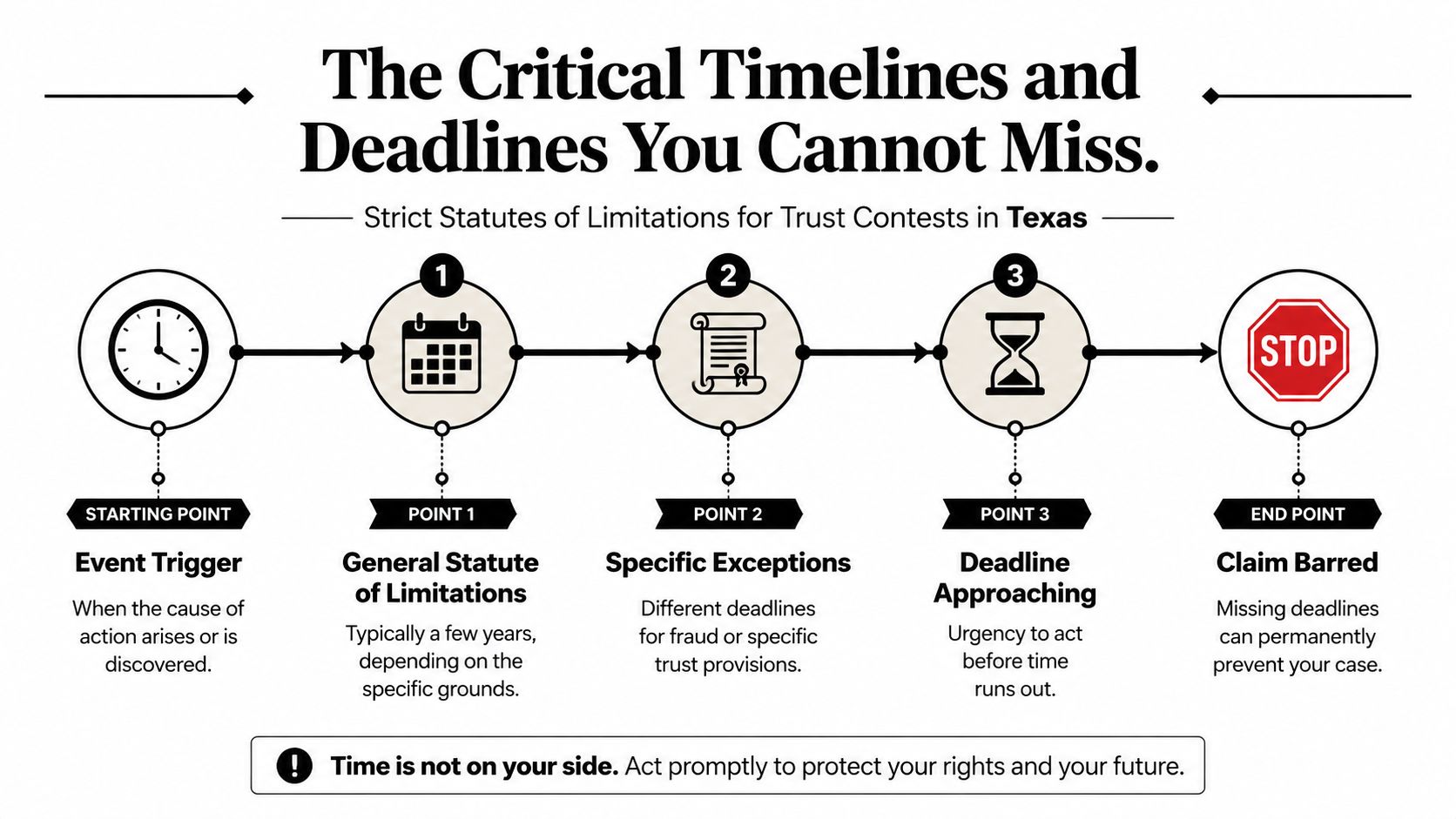
In trust litigation, delay can destroy a claim. Texas doesn't have one universal deadline for every trust dispute. The time limit depends on the legal theory you're using.
That's why people get into trouble. They assume they have plenty of time because the trust still feels “open” or because family discussions are ongoing. Courts don't stop the clock just because the family is still arguing at the kitchen table.
The main deadlines to know
According to this Texas trust contest timeline overview, a challenge analogous to a will contest is generally subject to a two-year deadline from the grantor's death. The same source explains that claims based on fraud, undue influence, or lack of capacity generally fall under the four-year statute in Texas Civil Practice and Remedies Code § 16.051, and breach of fiduciary duty claims must typically be filed within four years of when the beneficiary knew or should have known about the breach.
That means the same family could be looking at different clocks depending on the exact claim.
Consider these examples:
Validity challenge after death
A daughter says her mother lacked capacity when signing a trust amendment that effectively operated like a will substitute. That may call for close analysis of the shorter deadline.Fraud claim discovered later
A beneficiary learns much later that signatures were obtained through deception. That may fit the four-year framework tied to discovery.Trustee misconduct
A trustee hides transactions for a period of time, and a beneficiary uncovers self-dealing only after reviewing records. The timing may depend on when the beneficiary knew or should have known.
Missing the right deadline can permanently bar the claim, even if the underlying facts are compelling.
Why the trigger date matters
The deadline doesn't always begin on the same day. Sometimes it starts at death. Sometimes it starts when the trust becomes irrevocable. Sometimes it starts when misconduct or fraud was discovered, or reasonably should have been discovered.
That's one reason early document review matters so much. A family may think it's gathering information slowly and responsibly, while the legal window is already closing. A successor trustee should also move promptly when stepping into office, and First Steps for a Successor Trustee in Texas addresses what to do immediately after stepping into the trustee role.
For readers trying to sort out the filing window after a death, this guide on contesting a trust after death in Texas is a useful starting point for understanding how the timeline can shift based on the type of claim.
Navigating the Texas Trust Contest Process
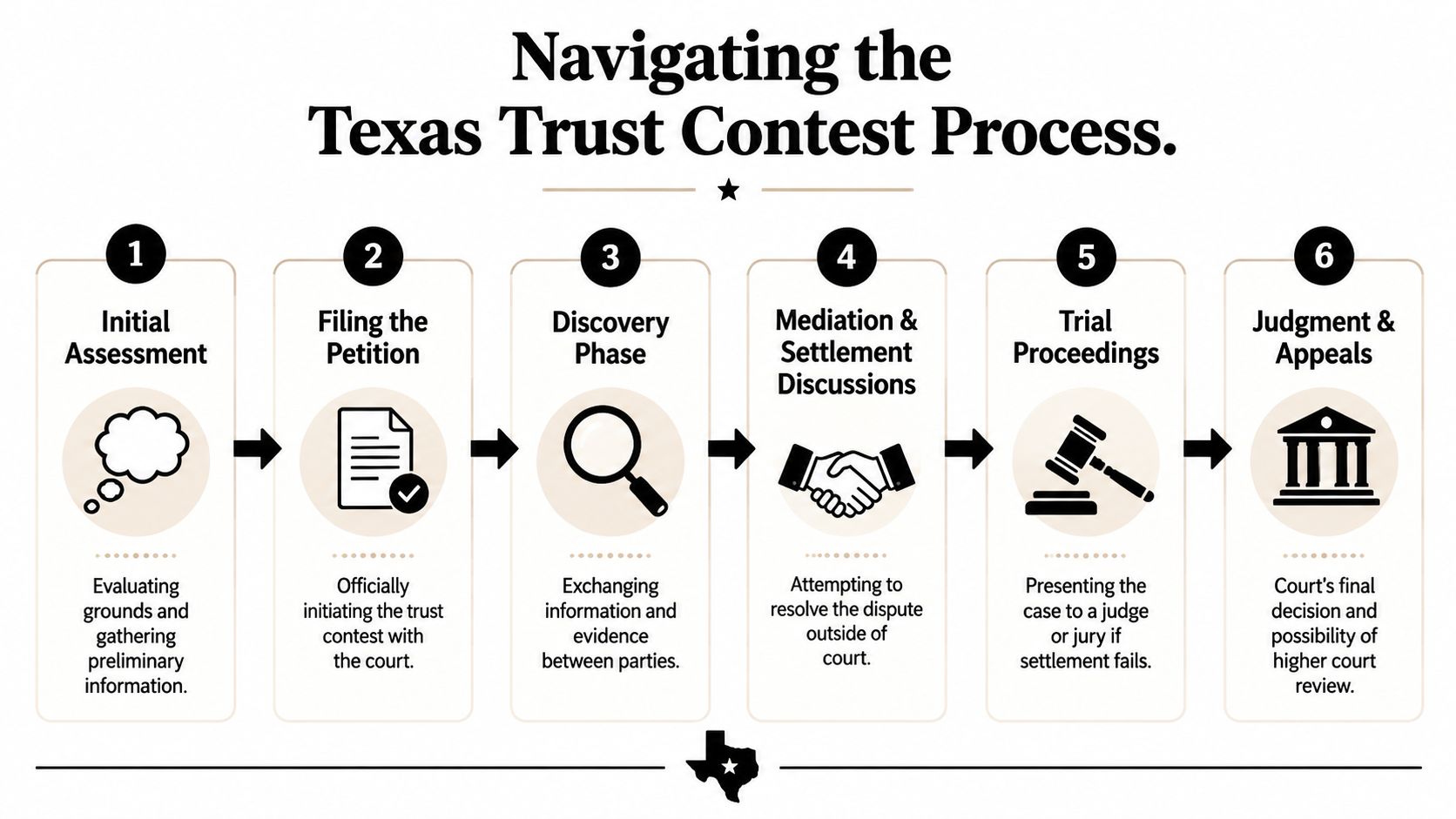
A common turning point looks like this. A child reviews a parent's final trust papers and believes a last-minute amendment was signed while the parent was confused. In another family, the trust itself may be valid, but the problem is what happened after death. A trustee refuses to share records, favors one branch of the family, or moves money in ways that do not make sense. Texas trust disputes can start in either place, and the process changes depending on whether you are challenging how the trust was created or how it has been managed.
Once a family confirms it has standing and a claim that appears timely, the case usually begins with a careful file review. That first stage often answers a practical question. Are you trying to set aside the trust or amendment, or are you trying to force a trustee to explain and correct misconduct?
Step one is collecting the right records
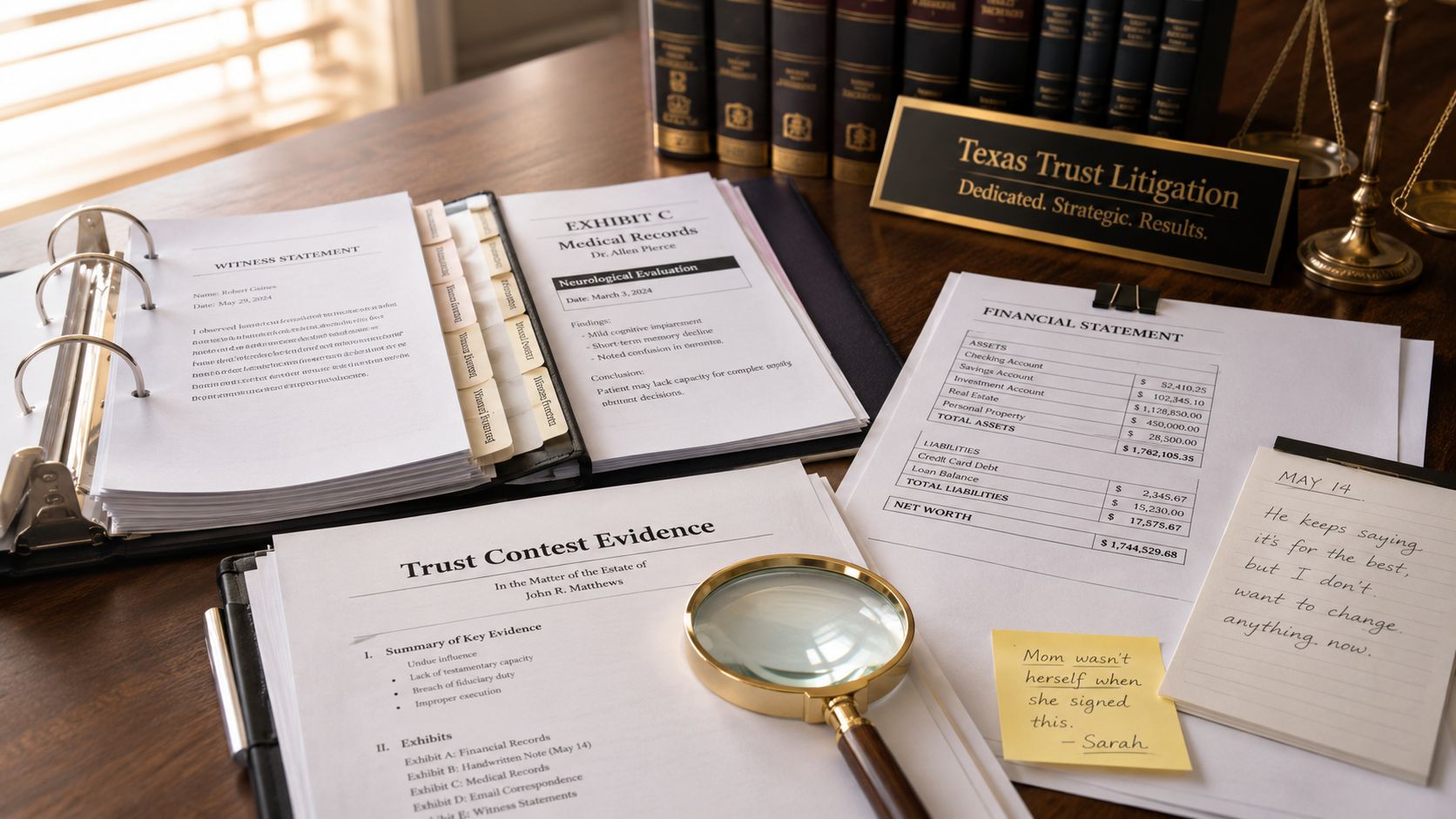
Early evidence gathering shapes the whole case. Lawyers usually start by lining up the documents in time order, much like putting together a timeline after a storm to see what happened first, what changed, and who was involved. That may include trust instruments, amendments, medical records, financial statements, emails, text messages, notes, prior estate plans, and witness accounts.
The documents depend on the claim. If the concern is incapacity, records close to the signing date often matter most. If the concern is pressure by a caregiver, child, or new spouse, communications showing dependence, isolation, secrecy, or sudden changes in long-standing plans may carry more weight. Families trying to understand that type of proof often benefit from reviewing how Texas courts evaluate undue influence in a trust case.
Trustee misconduct requires a different paper trail. In those cases, the key records are often accountings, bank statements, wire records, tax returns, appraisals, compensation records, and documents showing distributions to beneficiaries. For larger estates, this part can feel less like a family disagreement and more like a financial audit.
Filing begins the lawsuit
After the initial review, the next formal step is filing a petition in the proper probate or district court. The petition identifies the parties, states the legal claims, and tells the court what action is being requested.
The requested relief depends on the problem. A validity challenge may ask the court to invalidate the trust or strike a later amendment. A case against a trustee may ask the court to compel an accounting, freeze certain transactions, remove the trustee, surcharge the trustee for losses, recover property, or approve a replacement fiduciary.
A short video can help make the court process feel less abstract.
Discovery is where the case takes shape
After filing, each side has tools to request information from the other. That process usually includes written questions, document requests, subpoenas, and depositions under oath. In trust creation cases, discovery often focuses on the drafting attorney, the witnesses, the medical providers, and the people who were present when changes were discussed or signed.
In trustee breach cases, discovery often widens. A beneficiary may need records from banks, brokers, business entities, accountants, property managers, or anyone else who handled trust assets. That is one reason these cases are often overlooked at first. Families may assume the only option is to challenge the trust itself, when the stronger claim is against a trustee whose management harmed the beneficiaries after the trust was already in place.
Courts and lawyers also use discovery to test whether the case is as strong as it first appeared. Some claims improve once records come in. Others narrow.
Strong trust cases are usually built around a clear timeline, documents that match the timeline, and witnesses who can explain what those records mean.
Mediation often resolves the real dispute
Many trust cases settle before trial. Mediation gives the parties a structured setting to assess risk, discuss possible solutions, and decide whether a practical resolution is better than prolonged litigation.
That matters for families with ongoing relationships, but it also matters in high-value trusts where the dispute is not just personal. It may involve control of a business interest, management of investment accounts, sale of real estate, or unequal access to information. In that setting, a settlement might include a trustee resignation, a formal accounting, revised distribution procedures, repayment to the trust, or tighter reporting rules instead of an all-or-nothing fight over the trust's validity.
Some families also seek guidance from counsel who handle both trust administration and litigation. The Law Office of Bryan Fagan, PLLC is one example of a Texas firm that handles trust administration, estate planning, and trust-related disputes.
Evidence Required and Common Defenses to Expect
A trust case rises or falls on proof. Courts don't set aside trust documents because a family feels hurt, excluded, or suspicious. They require evidence tied to a legal claim.
That evidence looks different depending on what you're alleging. A capacity case isn't built the same way as an undue influence case, and a fiduciary breach case uses a different record altogether.
What supports a validity challenge
For a challenge based on lack of capacity, lawyers often look for:
- Medical records from the period near the signing
- Witness testimony from people who observed confusion, memory loss, or impaired judgment
- Drafting history showing abrupt or unusual changes
- Expert review where appropriate
For undue influence, the focus shifts. The court may examine isolation, dependence, secrecy, pressure, and a result that sharply departs from prior estate planning. If you're trying to understand how these facts are typically analyzed, how to prove undue influence in a Texas trust is a helpful reference point.
A simple example: an elderly widower had long treated his children equally, then suddenly signed a new trust leaving nearly everything to one person who had recently taken over his appointments, medications, and communications. That pattern doesn't prove undue influence by itself, but it raises the right questions.
What supports a fiduciary duty claim
Trust administration disputes often involve the trustee's conduct after the trust is already in effect. According to this discussion of Texas trust disputes, recent Texas litigation shows a significant increase in lawsuits alleging breach of fiduciary duty, especially in high-net-worth families in Houston and Dallas. Those cases commonly involve mismanagement, failure to account, or self-dealing, and they often lead to trust reformation or trustee removal rather than complete invalidation.
That distinction matters. If the document itself is sound, the better remedy may be to fix administration instead of trying to destroy the trust.
Texas fiduciary principles require trustees to act with loyalty and care. That includes keeping adequate records and treating beneficiaries fairly. Under Texas Trust Code accounting rules summarized here, a trustee must provide a written accounting within 90 days after a beneficiary makes a written demand, and the trustee doesn't have to provide one more than once every 12 months. And under Texas Trust Code Section 113.152 summarized here, the accounting must include trust property, receipts and disbursements, property being administered, cash balances and locations, and known liabilities.
When a trustee won't explain where the money went, the problem may be administration, not validity.
Defenses the other side may raise
The trustee or defending party usually won't just deny wrongdoing. Common defenses include:
- Statute of limitations saying the claim was filed too late
- Lack of standing arguing the challenger has no legal right to sue
- Ratification claiming the beneficiary knew the facts and accepted them
- No-contest clause issues if the trust penalizes certain challenges
- Capacity and independence evidence such as medical support or drafting testimony showing the trustmaker acted freely
These defenses are one reason careful preparation matters. A family may feel it has a strong moral case, but the legal case has to survive procedural attack first.
Potential Outcomes Costs and Settlement Strategies
A family may start a trust contest expecting one final answer from the court. Keep the trust or throw it out. Texas trust disputes usually end in a more practical place.
The better starting question is simpler. What needs to be fixed right now?
Sometimes the problem is how the trust was created. Sometimes the trust itself is valid, but the trustee is mishandling money, refusing to account, favoring one beneficiary, or putting assets at risk. For high-net-worth families, that second path often matters just as much as a validity challenge. If a trustee is driving the harm, removing or restricting that trustee may protect the estate faster than trying to erase the entire trust.
What a realistic result often looks like
Courts have more than one tool available, and settlement gives families even more flexibility. Depending on the facts, a case may lead to:
- Removal of the trustee
- A court-ordered accounting or audit of trust activity
- Repayment to the trust for losses caused by mismanagement or self-dealing
- Suspension or restriction of trustee powers while the case is pending
- Correction or reformation of trust terms
- Approval of a settlement that changes how assets will be managed or distributed
- In severe cases, partial or complete invalidation of the trust or an amendment
That range of outcomes matters. A trust contest is less like flipping a light switch and more like repairing a damaged house. If the foundation is bad, you address the foundation. If the wiring is dangerous, you fix the wiring before the whole structure suffers more damage.
For many families, success means getting records, stopping questionable transfers, protecting a business interest, or making sure one person can no longer control everything without oversight.
Costs usually come from time, conflict, and complexity
Trust litigation can be expensive, but the full cost is not limited to legal fees. Delays can freeze distributions. Family members may stop speaking. Property can lose value while everyone argues about control. If the trust holds a closely held business, investment accounts, or multiple properties, each month of conflict can create new problems that are harder to reverse.
A straightforward accounting dispute may settle early. A case involving medical records, allegations of undue influence, forensic accounting, and years of trustee conduct usually takes more work. The broader the dispute, the more important it becomes to decide what result is worth pursuing.
That is why families should match the strategy to the problem.
Why settlement often makes sense
Settlement is not surrender. It is often the clearest way to protect assets and reduce risk.
A negotiated resolution can require a trustee resignation, set deadlines for an accounting, appoint a neutral successor trustee, approve a distribution plan, or place guardrails around future decisions. A court can grant relief, but settlement often gives the family more control over timing, privacy, and detail. That can be especially helpful when the trust owns a family business, mineral interests, valuable real estate, or property that needs active management.
Mediation also gives people room to solve the dispute in layers. A family may agree on a temporary trustee first, then address reimbursement claims, then resolve final distributions. That step-by-step approach can lower pressure and preserve assets while the hardest issues are worked through.
A trial decides legal rights. A careful settlement can also solve the practical problems that keep the family stuck.
How to evaluate settlement offers
Before accepting or rejecting any proposal, measure it against a short list of concrete questions:
- Does it stop the immediate harm?
- Does it produce full financial records?
- Does it protect assets from further misuse?
- Does it repay losses or unfair distributions if money was mishandled?
- Does it create a realistic management plan for the trust after the dispute ends?
- Does it address taxes, business operations, or property management issues tied to the trust?
If the answer to those questions is no, the offer may buy peace only on paper.
A Texas trust administration lawyer should evaluate the facts and the family's goals together. If the central problem is secrecy, the first objective may be a formal accounting. If the problem is ongoing self-dealing, the immediate priority may be removing the trustee or limiting access to trust assets. If the evidence shows the trustmaker lacked capacity or was manipulated, then a direct challenge to the trust's validity may still be the right course.
For families who discover that the dispute also exposes larger planning problems, related legal work may be needed in estate planning, probate, guardianship, or asset protection.
If you're managing a trust or planning your estate, contact Law Office of Bryan Fagan, PLLC for a free consultation. Our attorneys provide Texas-based guidance for each stage of the process.