Managing a loved one's trust can feel overwhelming, especially when you discover that the document no longer fits the family's situation. That's a common moment in Texas trust administration. A parent dies, the successor trustee steps in, and the trust language that once seemed clear now creates practical problems.
The good news is that there usually is a structured path forward. The hard part is choosing the right one. Some changes can be handled cooperatively outside of court. Others need a judge's approval. The right choice often comes down to three things: what the trust says, what kind of change you want, and how much agreement exists among the people involved.
If you're searching for how to modify a trust after death Texas, start with one basic point. After death, this is no longer a matter of simple amendment. It becomes a matter of trust administration, fiduciary duty, and using the legal tools Texas law allows.
Why an Irrevocable Trust Might Need Changing
When a family hears the word irrevocable, it often sounds like the conversation is over. In practice, that word usually means something narrower. It means the old, informal way of changing the trust is gone. It does not always mean every adjustment is impossible.
Under the Texas Trust Code, a settlor may modify or amend a revocable trust, but may not enlarge the trustee's duties without the trustee's express consent. The turning point is death, because a revocable trust generally becomes irrevocable once the settlor dies. That means the surviving spouse, successor trustee, or beneficiaries usually can't rewrite the document by private agreement under Texas Trust Code provisions on trust revocation and modification.
That legal shift catches many families off guard. Before death, the person who created the trust usually controlled it. After death, control moves to the trust's administration framework. The trustee's job changes too. The trustee is no longer helping the settlor revise a plan. The trustee is carrying out fiduciary duties under a document that now has legal weight of its own.
The most common reasons families seek changes
A trust may need updating for reasons that have nothing to do with bad planning. Life changed after the document was signed.
Some frequent examples include:
- Family changes: A remarriage, divorce, estrangement, or a new child or grandchild can make old distribution terms feel out of step with the family's current reality.
- Administrative problems: The trust may name a trustee who can't serve, require procedures that no longer work, or use asset management rules that are now impractical.
- Beneficiary needs: A beneficiary may now have medical, support, or benefit-planning issues that the trust didn't anticipate.
- Tax and planning concerns: A structure that once made sense may now create inefficiency or unnecessary friction.
Practical rule: Most post-death trust changes are really about one of two issues. Either the trust's administration has become cumbersome, or the trust's terms no longer carry out the settlor's likely intent in today's circumstances.
What works and what doesn't
What usually doesn't work is an informal side deal. Families often say, “We all agree, so can't we just sign something?” Sometimes agreement helps a great deal. But agreement by itself does not create power that the trust or Texas law doesn't allow.
What does work is matching the problem to the correct legal path. If the issue is administrative, you may have more flexibility. If the issue changes who gets what, the path is usually narrower and more sensitive.
That distinction matters from the start. Many families assume every trust problem is a litigation problem. It isn't. Others assume every trust problem can be solved with a simple amendment. That usually isn't true either.
For a broader explanation of what makes these arrangements different, this discussion of an irrevocable trust in Texas is a helpful starting point.
Your First Step Reviewing the Trust Document
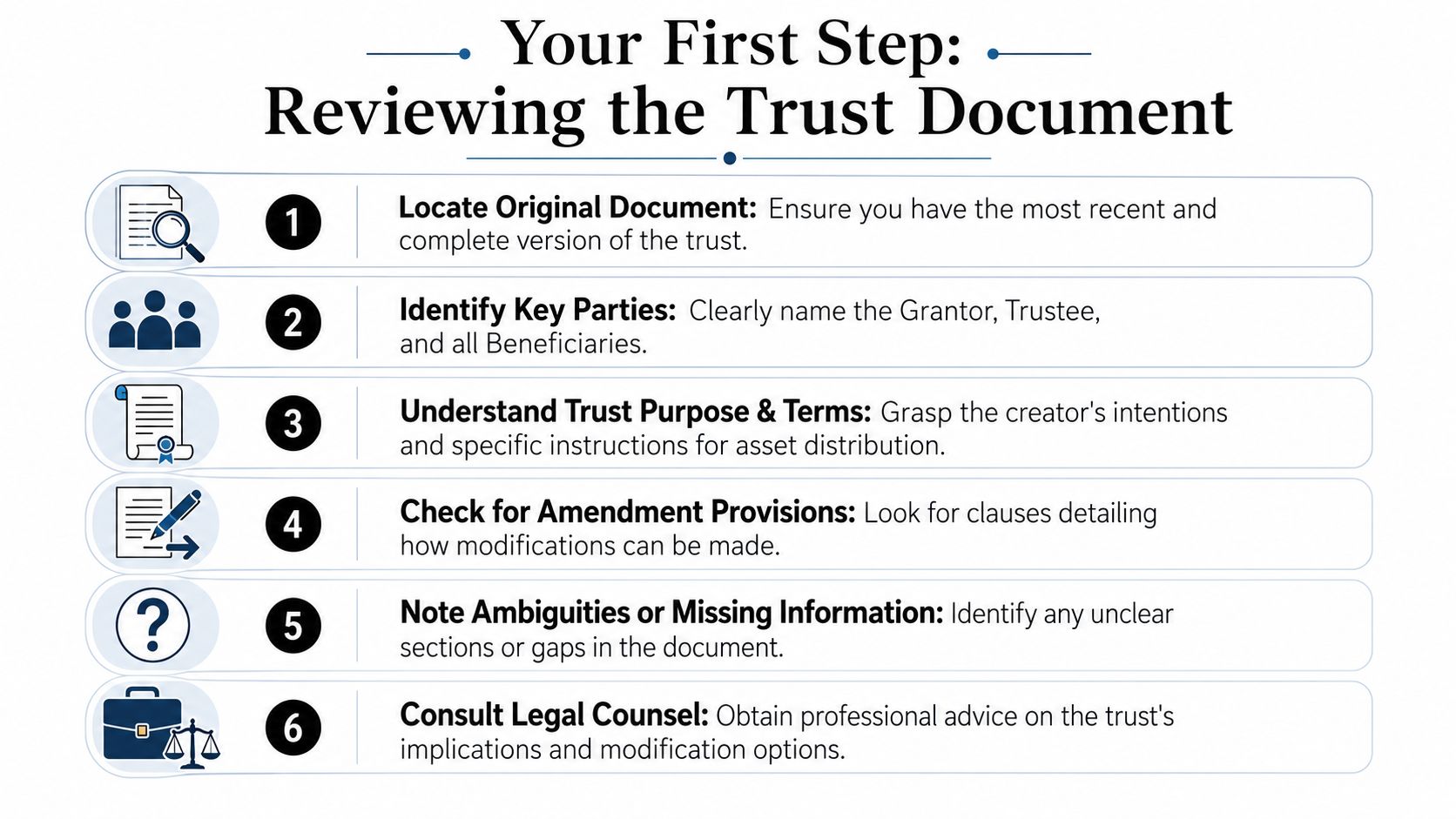
Before anyone talks about modification, court filings, or beneficiary consent, review the trust document carefully. In my experience, families either save themselves time or create avoidable trouble through this careful review. The answer to “Can this trust be changed?” often starts with “What exactly does the document already permit?”
Texas-focused trust administration guidance treats early document review as a key control. A practical post-death workflow is to obtain certified death certificates, locate the trust and all amendments, confirm successor-trustee authority, identify and retitle trust assets, notify beneficiaries, pay valid debts, taxes, and administration costs, then distribute the remaining assets and prepare a final accounting, as outlined in this Texas trust administration workflow after death.
Read the entire package, not just the signature page
Families often find one binder and assume they have the final trust. That's risky. You need the original trust, every amendment, and any restatement. If a later amendment changed trustee powers or beneficiary language, that later document may control.
Start by identifying:
- Who created the trust
- Who now serves as trustee
- Who the current and remainder beneficiaries are
- Whether the trust names a trust protector or another person with special powers
- What powers the trustee already has
If there's a built-in mechanism for adjustment, that's usually the cleanest place to begin.
Separate administrative terms from distribution terms
Not every trust term carries the same legal weight in a modification analysis. Some provisions deal with administration. These include trustee succession, investment powers, accounting procedures, notice provisions, and management rules.
Other provisions are dispositive. Those control who benefits, when they benefit, and under what conditions.
A useful way to think about it is this:
| Type of provision | Typical focus | Practical difficulty |
|---|---|---|
| Administrative | How the trust is managed | Often easier to address |
| Dispositive | Who gets what and when | Usually harder to change |
That doesn't mean administrative changes are automatic. It means they are often less disruptive to the settlor's basic plan.
Review the trust as if you were reading operating instructions, not just inheritance language. Many modification questions are really administration questions in disguise.
Look for hidden flexibility
Some trusts contain tools families overlook. The document may authorize a trustee to distribute assets in stages, divide shares, resign and appoint a successor, or exercise limited powers that reduce the need for court involvement.
Watch for language involving:
- Trustee discretion
- Power to divide or combine trusts
- Authority to resolve ambiguities
- Special tax-sensitive provisions
- Clauses naming substitute fiduciaries
A careful reading also helps the trustee stay inside the boundaries of fiduciary duties in Texas. Trustees should keep trust funds separate from personal funds, document transactions in writing, and avoid distributions before liabilities are understood. Those aren't technical details. They are the habits that help prevent disputes later.
If you're a trustee or beneficiary, this review is the point where a Texas trust administration lawyer becomes most useful. The goal is not to make the document say what the family wishes it said. The goal is to identify what it allows, what problems exist, and what legal options fit those facts.
Modifying a Trust Without Court Approval
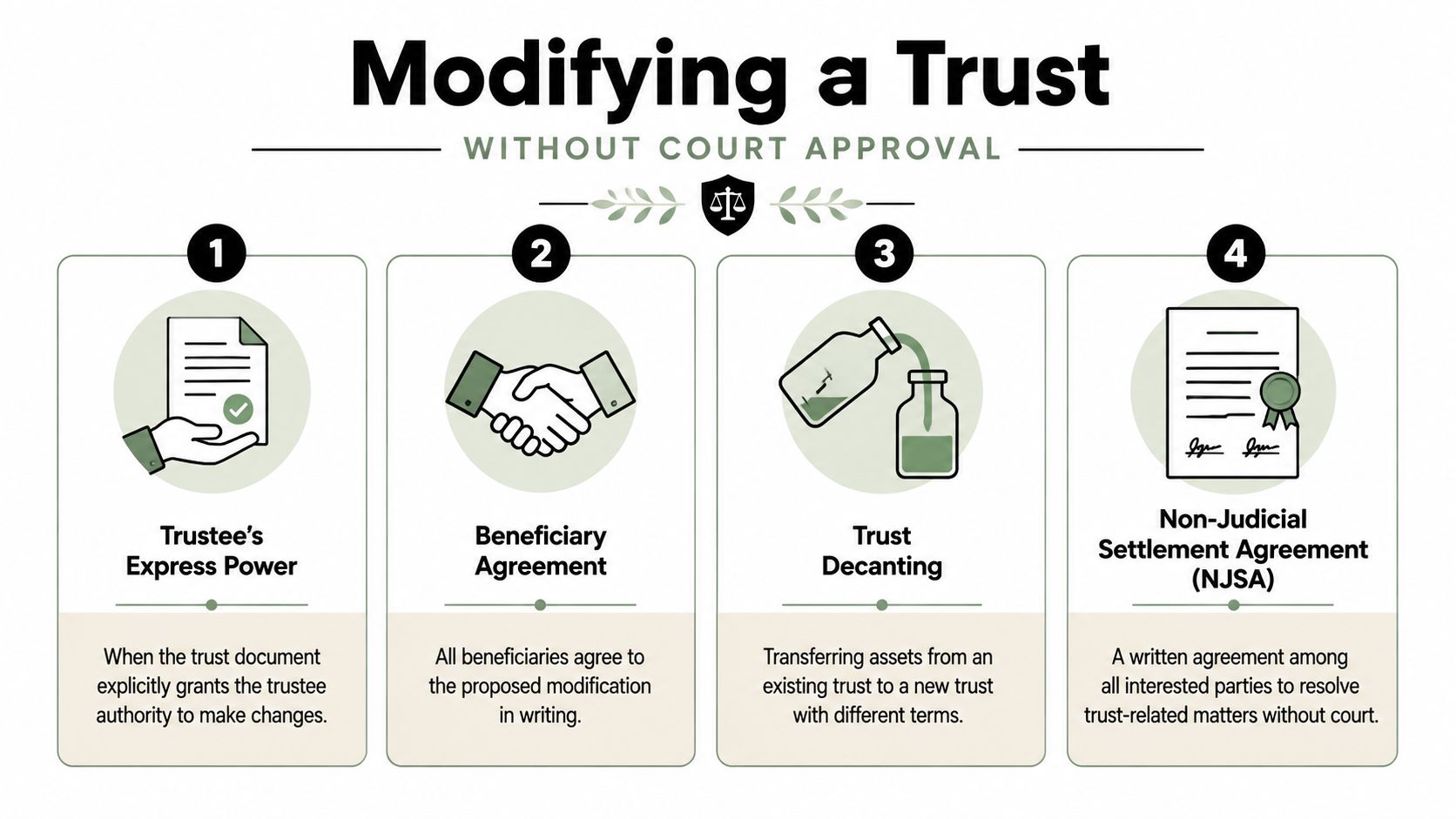
If the family can solve the problem outside of court, that's usually the first route worth evaluating. It can reduce delay, preserve privacy, and lower the emotional cost of the process. It also tends to work best when the requested change is practical rather than adversarial.
That flexibility is part of a broader legal trend. Over the last 25 or so years, states have increasingly adopted statutes allowing limited changes to irrevocable trusts, including changes by agreement and by decanting, as noted by ACTEC's discussion of modern irrevocable trust modification tools.
Nonjudicial settlement agreements
A nonjudicial settlement agreement, often shortened to NJSA, is one of the most practical tools in Texas trust work. It allows interested parties to resolve certain trust matters by written agreement instead of asking a court to decide them.
This can be a strong option when everyone is aligned and the issue is limited. For example, a family may need to clarify an accounting method, approve a trustee transition, or settle an administrative question that doesn't rewrite the trust's core purpose.
What makes an NJSA attractive is simple. It can be faster, more private, and more controlled than litigation.
But there are limits.
An NJSA generally works best for matters such as:
- Administrative clarification: Fixing uncertainty about how the trustee should carry out duties.
- Trustee issues: Addressing resignation, appointment, or related administration points.
- Implementation disputes: Resolving how an existing provision should operate in practice.
It is a poor fit when the family is really trying to do something more aggressive, such as changing beneficial interests in a way that alters the settlor's basic design. If the requested change affects who inherits, in what share, or under what substantive standard, the analysis becomes more delicate.
If all parties are calling the change “administrative,” but one beneficiary ends up with more and another ends up with less, that's not just administration. It needs closer legal review.
In practice, unanimous agreement often matters. Even where agreement appears broad, one missing signature, one minor beneficiary, or one beneficiary with a different interpretation can turn an informal solution into a later dispute.
Decanting
Decanting is a more specialized tool. The easiest way to explain it is to use the traditional analogy: a trustee pours assets from one trust into a new trust with revised terms, much like pouring wine from one bottle into another.
That analogy is useful, but it can make decanting sound easier than it is. It isn't a free-form rewrite. It depends on the trustee's powers, the trust language, and statutory limits.
Decanting often comes into the conversation when:
- The old trust has outdated administrative language
- The trustee needs cleaner management provisions
- The trust would work better with modern fiduciary or investment terms
- A beneficiary's circumstances require a more functional structure
A decanting strategy may help when direct amendment is unavailable but the trustee has enough discretionary authority to move assets into a new trust framework. For many families, the appeal is that it can fix operational problems without asking a judge to rewrite the original trust line by line.
The trade-off is that decanting requires careful drafting and careful restraint. A trustee can't treat it as permission to favor one branch of the family or to override the trust's material purpose.
For readers exploring options, this overview of an amendment to a trust helps clarify why post-death changes follow a different process than pre-death amendments.
Choosing between agreement and decanting
Here is the practical difference:
| Option | Best when | Main trade-off |
|---|---|---|
| NJSA | Everyone agrees and the issue is limited | Weak fit for major beneficial changes |
| Decanting | The trustee needs structural flexibility | Requires close analysis of trustee authority |
A cooperative, narrow fix usually points toward agreement. A structural update to how the trust operates may point toward decanting. If the family is divided, or the desired change reaches too far into dispositive terms, court involvement is often the safer route.
This is one place where legal counsel matters more than optimism. A document that appears efficient on paper can create fiduciary exposure if the trustee used the wrong tool.
Using the Courts for Trust Modification or Reformation
Sometimes court involvement is the right tool, not a sign that anyone failed. If the family can't reach agreement, if the trust language contains a serious mistake, or if the requested change goes beyond what out-of-court options can safely accomplish, a judge can provide a binding answer.

A common court scenario
Consider a trust created years ago for a grandchild's education. The trust says funds may be used for tuition and related school costs. After the settlor's death, the grandchild develops needs that make a traditional education path unlikely. The family now believes the settlor would have wanted the trust used more broadly for long-term support, training, and care.
That kind of problem often can't be solved by wishful thinking or a side letter among relatives. The trustee still owes duties to all beneficiaries. If the trustee starts making different distributions because the family believes it feels fair, the trustee may face claims later.
A court petition can put the issue in the proper legal frame. The judge can review the trust, the changed circumstances, and the evidence of the settlor's intent. If modification is appropriate, the court's order gives the trustee a lawful path.
Modification, reformation, and termination
These court-based remedies do different jobs.
Judicial modification
Judicial modification is often used when circumstances changed in a way the settlor did not anticipate. The question is usually whether changing the trust would better carry out the trust's purpose under present conditions.
Examples may include:
- Changed beneficiary needs: A support structure no longer fits the beneficiary's condition or life situation.
- Administrative dysfunction: The trust's management terms create waste, deadlock, or unworkable administration.
- Tax-sensitive concerns: The trust may need revision to better align with the settlor's planning objectives.
Judicial reformation
Reformation is different. It usually addresses a mistake in the document itself. A drafting error, an internal inconsistency, or language that clearly fails to reflect the settlor's intended design may justify asking the court to correct the text.
That matters because courts are not supposed to invent a new estate plan. They are asked to make the written trust conform more closely to what the settlor intended.
Court supervision can protect a trustee as much as it constrains one. When the facts are difficult, a court order often becomes the trustee's safest form of authority.
Judicial termination
In some cases, the practical answer is to terminate part or all of the trust. That may arise when the trust no longer serves a useful purpose or when continuing it imposes more burden than benefit.
The analysis is fact-specific. The court will want to know why termination is consistent with the trust's purpose rather than merely convenient for one party.
Why families choose court even when they dislike conflict
A formal court process has trade-offs. It can take longer. It costs more. It creates a public proceeding. But it also provides structure.
That structure helps when:
- one beneficiary disagrees with the proposed change
- a minor or incapacitated beneficiary is involved
- the trustee wants clear protection before acting
- the desired change affects beneficial interests in a serious way
If you're comparing approaches in other jurisdictions, resources like Wisconsin estate planning services can be useful for understanding how states handle similar family concerns differently. Texas procedure and trust law remain controlling for a Texas trust, but seeing how these issues arise elsewhere can help families ask sharper questions.
When conflict is already building, a trustee may also need counsel experienced in dispute resolution and litigation in Texas trusts. That's especially true when the modification request and breach-of-duty allegations start to overlap.
Common Pitfalls and Fiduciary Duties to Uphold
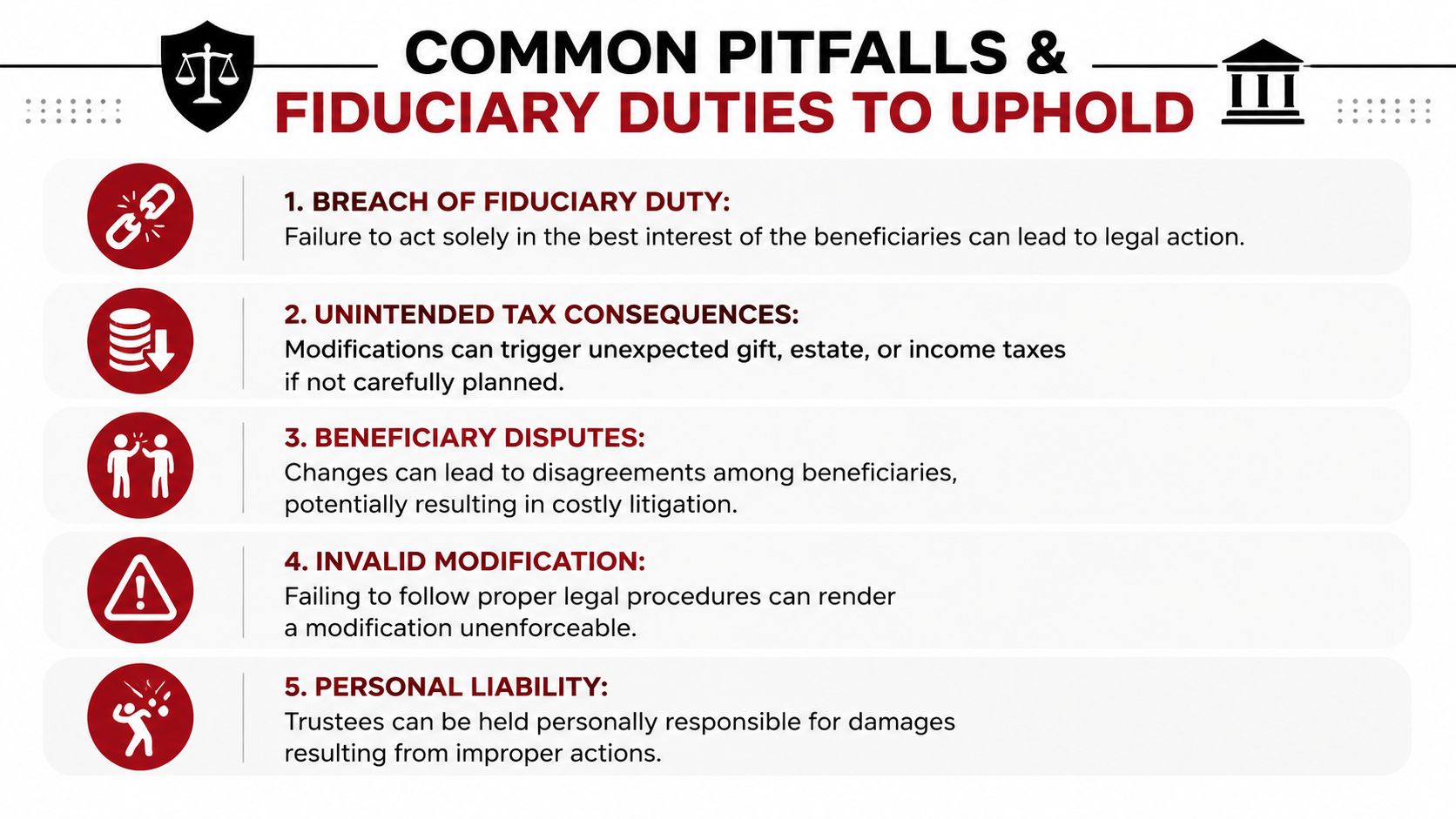
Trust modification is not just a legal drafting exercise. It is a fiduciary exercise. The trustee must act for the benefit of the beneficiaries and in accordance with the trust's terms and Texas law. That duty shapes every decision, from whether to pursue a change at all to how information is shared and documented.
Families sometimes focus only on the desired result. Trustees can't afford to do that. The process matters. A good outcome reached the wrong way can still expose the trustee to personal liability.
The duties trustees can't ignore
A trustee considering modification should keep three obligations in view.
- Loyalty to beneficiaries: The trustee can't use a modification to benefit personally or to favor one beneficiary without lawful authority.
- Care in administration: The trustee must understand the trust, gather the relevant documents, and act with deliberation rather than speed.
- Transparency and records: Written notices, signed agreements, accountings, and a clean paper trail protect both the trust and the trustee.
Those principles matter whether the trustee is handling a family settlement, exploring decanting, or petitioning a court.
The mistakes that create most disputes
The most common problems are usually avoidable.
Informal family agreements
A trustee hears that “everyone is on board” and starts acting before documents are finalized. Later, someone changes position or claims they misunderstood the proposal. That is how a practical family conversation turns into litigation.
Early distributions
A trustee distributes assets too soon, before taxes, debts, expenses, or unresolved claims are sorted out. That can leave the trustee scrambling to recover funds or explain why one beneficiary was paid before liabilities were resolved.
Poor notice and weak documentation
Even a reasonable modification can become vulnerable if interested parties were not properly informed or if the trustee cannot show the basis for the decision. Memory is not a record.
The trustee's best defense is usually not an argument. It's a file. Signed documents, written analysis, notices, and accounting records carry more weight than a later explanation.
Unexamined tax consequences
Some trust changes affect more than administration. They can affect transfer planning, income tax treatment, or benefit eligibility. If a trustee treats modification as “just paperwork,” the trustee may miss consequences that reach far beyond the trust itself.
What prudent trustees do instead
A careful trustee usually follows a disciplined approach:
- Identify the actual problem. Is it an administrative defect, a beneficiary issue, a drafting mistake, or a conflict question?
- Match the problem to the right tool. Agreement, decanting, or court relief each serves a different purpose.
- Give proper notice. Silence is not consent.
- Create a written record. Keep drafts, communications, legal analysis, and signed approvals.
- Get legal advice early. That is especially important when beneficial interests may shift or family conflict already exists.
If you need practical help, a Texas estate planning attorney or Texas trust administration lawyer can coordinate document review, trustee guidance, beneficiary communication, and court filings where needed. The Law Office of Bryan Fagan, PLLC handles trust administration, modification, dispute-related matters, and related estate planning issues in Texas.
Modifying a trust after death can be done. It just can't be done casually. The families who manage it well are usually the ones who slow down, respect the trustee's fiduciary role, and use the proper legal path from the beginning.
If you're managing a trust or planning your estate, contact Law Office of Bryan Fagan, PLLC for a free consultation. Our attorneys provide trusted, Texas-based guidance for every step of the process, including estate planning, probate, guardianship, asset protection, trust administration, and disputes over fiduciary duties in Texas.