Skip to content
A trust can feel like a gift and a burden at the same time.
A family may be caring for a trust that made perfect sense years ago, but now it creates friction. The trustee is handling paperwork, tax filings, and beneficiary questions. The beneficiaries may be adults now, financially stable, and wondering why assets are still locked inside a structure that no longer seems to help anyone. In other families, the trust was built for a problem that has faded, like long-term care needs that no longer exist or a management plan for children who are now fully capable adults.
That frustration is common. It doesn't mean anyone is being ungrateful. It usually means life changed, while the trust document stayed the same.
Texas law recognizes that reality. A trust is meant to carry out a purpose, not trap a family in unnecessary cost or delay. In some situations, terminating a trust early in Texas is allowed. In others, it isn't. The answer depends less on what the family wants today and more on why the trust was created in the first place, whether that purpose still matters, and whether the law provides a valid path to end it.
Families often come to this question after a death, after a beneficiary's circumstances improve, or when trust administration starts costing more time and money than seems reasonable. Trustees ask whether they must keep administering an outdated trust. Beneficiaries ask whether they can agree to end it. Both questions are understandable.
Introduction When a Trust No Longer Fits the Family's Needs
A common Texas scenario looks like this. A parent created a trust years ago to protect a child, preserve assets, or manage money carefully over time. The parent has since passed away. The child is now older, responsible, and trying to buy a home, pay for education, or simplify family finances. Meanwhile, the trustee is still preparing records, coordinating distributions, and trying to follow directions written for a very different moment in life.
The family starts asking the same practical question. Does this trust still serve a real purpose, or is it just continuing because no one knows how to stop it?
That question deserves a careful answer. Trust law isn't designed to punish families for outgrowing an old plan. It is designed to protect the settlor's intent, which is the purpose the person who created the trust wanted to accomplish. Texas trust law gives courts and families structured ways to respond when a trust's purpose has been fulfilled, has become impossible, or no longer justifies continued administration.
Practical rule: The key issue usually isn't whether the beneficiaries want the trust to end. The key issue is whether the trust still has a material purpose worth preserving.
That phrase causes confusion for many people. A material purpose is the trust's meaningful reason for existing. If the trust was meant to protect assets from a beneficiary's creditors, delay distributions until maturity, provide medical care, or achieve tax planning goals, a court will want to know whether that reason still exists.
For trustees, this is also a fiduciary question. Fiduciary duties in Texas require a trustee to act in the beneficiaries' interests while still honoring the trust terms and the settlor's purpose. Ending a trust too casually can create risk. Refusing to consider termination when the trust has plainly outlived its purpose can create a different kind of problem.
The First Question Revocable vs Irrevocable Trusts
The first step is simple. Figure out what kind of trust you're dealing with.
A revocable trust is like a document saved on your computer. The person who created it usually keeps the power to revise it, replace it, or delete it. An irrevocable trust is more like a letter already mailed. Once it's sent, taking it back is much harder because the creator has given up direct control.
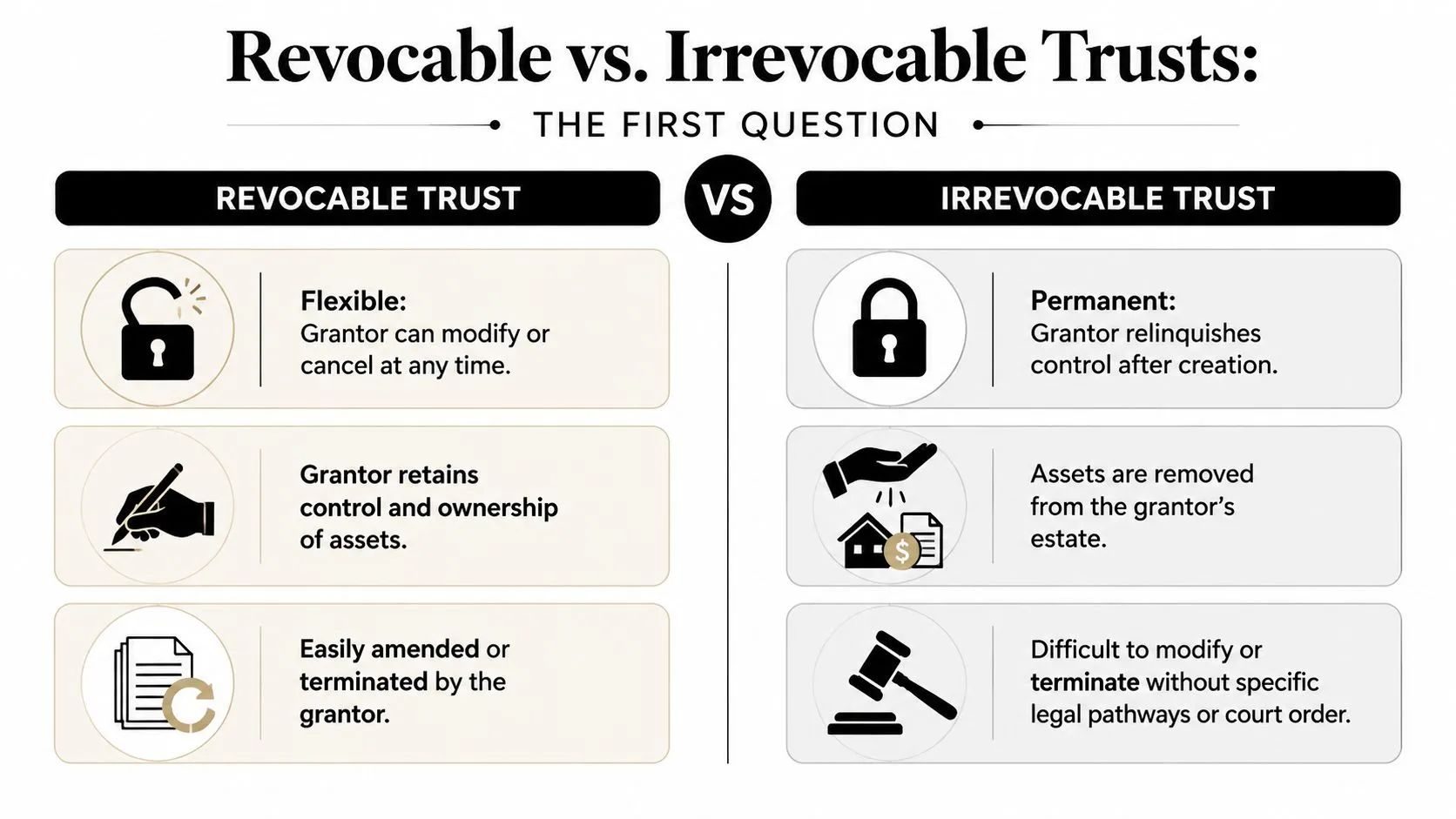
Why revocable trusts are usually simpler
If the settlor is alive and the trust is still revocable, ending it is usually much more straightforward. That's why many families first need to confirm whether the trust changed status at death. A good starting point is this overview of what a revocable trust is.
After death, a revocable living trust typically no longer stays revocable. The resource on Administering a Revocable Living Trust After Death in Texas explains how a revocable trust becomes irrevocable and is administered at death.
Why irrevocable trusts raise the real legal question
Most disputes about early termination involve irrevocable trusts. These trusts are usually designed to be stable. They may protect assets, restrict access, preserve family wealth, or carry out tax planning. Because of that, Texas law doesn't let families end them merely because the arrangement feels inconvenient.
Here's the practical distinction:
| Trust type | Who usually controls changes | Early termination question |
|---|---|---|
| Revocable trust | The settlor, while living and competent | Usually a direct decision by the settlor |
| Irrevocable trust | Trustee, beneficiaries, and sometimes the court | Requires a legal pathway under Texas law |
For concerned families, this is often the moment when things click. If the trust is irrevocable, the conversation changes from "Can we change it?" to "What legal grounds exist to change or end it?"
That's where a Texas estate planning attorney or Texas trust administration lawyer becomes important. The trust's label matters, but so do its exact terms, the identity of all beneficiaries, and whether the trust still serves the reason it was created.
Legal Pathways for Early Termination in Texas
Texas provides several ways an irrevocable trust may end early, but each path asks the same deeper question. Why should this trust stop now?
Under Texas Property Code Section 112.054, a court may modify or terminate a trust if the trust's purposes have been fulfilled or become impossible, or if all beneficiaries agree and continuation is not needed for an important unfulfilled purpose. That statutory approach reflects a more flexible framework than older common-law rules while still protecting the settlor's intent, as discussed in this Texas trust law analysis.

Path one through unanimous beneficiary consent
Families often assume that if everyone agrees, the trust can end. Texas law is more careful than that.
If all beneficiaries consent, a court may approve termination of an irrevocable trust if continuing the trust is not necessary to achieve a material, unfulfilled purpose. That means unanimous agreement helps, but it doesn't automatically decide the case. The law still asks whether the trust has an important job left to do.
Often, families are surprised to learn that a trust may still have a material purpose even when everyone wants immediate distribution. Examples can include preserving assets, delaying access, or protecting a vulnerable beneficiary.
A few points matter here:
- Every beneficiary means every beneficiary: The consent requirement includes current beneficiaries and future beneficiaries with contingent interests.
- Minor or unborn interests still count: If someone can't legally consent, the court may need to appoint a representative.
- Affidavits matter: Written evidence of consent is often part of the proof presented to the court.
Path two through changed circumstances and court intervention
Sometimes unanimous consent isn't available, but the trust no longer fits reality.
Texas law allows judicial modification or termination when the trust's purpose has been fulfilled, has become unlawful or impossible, or when changed circumstances make continuation inconsistent with the trust's function. The court looks at whether ending or modifying the trust would further the purposes of the trust rather than undermine them.
A trust created for a specific need may stop making sense when that need disappears, but the family still has to show the court why ending the trust honors the original purpose instead of defeating it.
For example, a trust created to fund a beneficiary's medical care may be a candidate for termination if that medical need is no longer present and no other material purpose remains. But the court won't assume that. It will look for proof.
Path three when administration no longer makes economic sense
Sometimes the reason for termination is practical. The trust still exists, but its upkeep no longer seems worth the burden.
Texas-focused legal guidance notes that if a trust holds less than $50,000, the trustee may be able to end it without court involvement in some situations, with notice to beneficiaries and distributions consistent with the trust's purpose, as explained in this discussion of terminating a trust in Texas. That figure is not a universal rule for all trusts, but it is a useful operational marker.
In other cases, a court may terminate a trust when management is no longer economically feasible and ending the trust would not conflict with a material purpose. This matters when administrative costs, recordkeeping, tax filings, or ongoing management consume the trust's value in a way that no longer benefits anyone.
Path four by operation of law through merger
A trust can also end through merger. That happens when one person ends up holding both legal title and equitable title to the trust property. In plain language, if the same person becomes both the sole trustee and sole beneficiary, the trust may terminate by operation of law.
This isn't the most common path for family trusts, but it matters because not every trust termination requires a courtroom battle. Some trusts end because the legal structure itself collapses into one person.
A simple decision framework
When families ask whether terminating a trust early in Texas is allowed, I usually suggest they sort the issue into one of these practical categories:
The purpose is finished
The trust achieved what it was built to do.The purpose can't be achieved
Circumstances changed so much that the original plan no longer works.The trust has become inefficient
Administration no longer makes economic or practical sense.The legal structure has dissolved
Merger or the trust's own terms bring it to an end.
That framework helps trustees and beneficiaries avoid the most common mistake. They stop focusing only on what they want and start focusing on what the law needs to see.
Common Roadblocks to Terminating a Trust
Even when a family has a good reason to ask for termination, some trusts are harder to end than others. The obstacle is often built into the trust itself.

Spendthrift provisions often signal a continuing purpose
A spendthrift provision is designed to protect trust assets from a beneficiary's creditors and sometimes from the beneficiary's own poor financial decisions. If the settlor included that protection, a court may view it as evidence that the trust still has a material purpose.
That doesn't mean termination is impossible. It does mean the family has to confront the actual reason the trust was created. If the trust exists to shield assets until a better time, ending it early may defeat the very protection the settlor wanted.
Creditors and avoidance concerns can complicate the picture
A trust generally isn't something a family can dissolve to put assets beyond reach or avoid legitimate obligations. Trustees must continue acting under fiduciary principles, which include fairness, loyalty, and careful administration. If a proposed termination would prejudice rights tied to the trust property, that issue may affect both the legal process and the court's view of the request.
This is one reason trustees shouldn't treat termination like an informal family agreement. Even when emotions are running high, the trustee's role is not to pick sides. The trustee's job is to protect the trust, the beneficiaries, and compliance with Texas law.
Watch for this: A trustee who rushes to distribute assets without resolving the trust's obligations can create personal risk.
Tax consequences can change the answer
Many families focus first on legal permission and only later on taxes. That's backward.
Early termination of an irrevocable trust can trigger immediate capital gains taxes or cause the loss of a step-up in basis at death. Terminating a trust designed for asset protection, such as one with spendthrift provisions, may also void its creditor shields and expose the assets to claims, as discussed in this analysis of trust termination consequences.
Those issues matter because a trust that looks inefficient on paper may still be preserving tax treatment or asset protection that is far more valuable than the convenience of ending it.
A careful review often asks questions like these:
- What assets are inside the trust: Real estate, business interests, and appreciated investments may create very different tax outcomes.
- Why was the trust structured this way: Asset protection and tax planning often overlap.
- What happens after distribution: Once assets are distributed outright, the legal shield may disappear.
Family agreement doesn't erase legal complexity
People understandably think harmony solves everything. It helps, but it doesn't erase the legal analysis.
A family may be fully united, yet still face barriers if the trust serves a continuing protective purpose or if early distribution causes serious financial harm. That is why a Texas trust administration lawyer often works closely with tax professionals, fiduciaries, and beneficiaries before anyone files a petition or signs a consent.
Smarter Alternatives to Full Trust Termination
Sometimes the best answer isn't ending the trust. It's updating the plan so it works better.
That approach often preserves the settlor's goals while reducing friction for the trustee and beneficiaries. If you're exploring how to amend a trust in Texas, it helps to think in terms of tools rather than all-or-nothing choices.
Decanting into a better structure
Decanting is the trust law version of pouring from an old container into a new one. In the right situation, assets may move from an older trust into a new trust with terms that better fit current needs.
Families often consider this when the original trust language is rigid, outdated, or hard to administer. The goal isn't to erase the settlor's purpose. The goal is to carry that purpose forward in a structure that works better now.
Non-judicial agreements can solve narrower problems
Not every trust issue requires a courtroom. In some situations, trustees and beneficiaries can use a non-judicial settlement agreement to resolve administration issues, clarify responsibilities, or address ambiguities without full-blown litigation.
This can help when the problem isn't the trust's existence but the way it operates day to day. A targeted agreement may reduce conflict, improve communication, and save the family from an unnecessary termination fight.
Dividing or combining trusts may improve administration
Sometimes one trust has become too unwieldy. In other cases, several small trusts create repetitive work and needless expense. Depending on the circumstances, dividing one trust or combining multiple trusts may make administration more sensible.
Here are common reasons families consider alternatives instead of termination:
- Preserve protection: The trust may still offer asset protection or controlled distribution benefits.
- Reduce conflict: A smaller change can be easier for family members to support.
- Improve administration: The trustee may be able to manage the trust more efficiently without ending it.
For families who want relief but don't want to lose important planning benefits, these alternatives can be the wiser path.
How to Petition the Court for Trust Termination
A court petition usually enters the picture when the family has reached a practical point. The trust no longer fits the job it was built to do, yet no one wants to act too quickly and create a bigger problem.
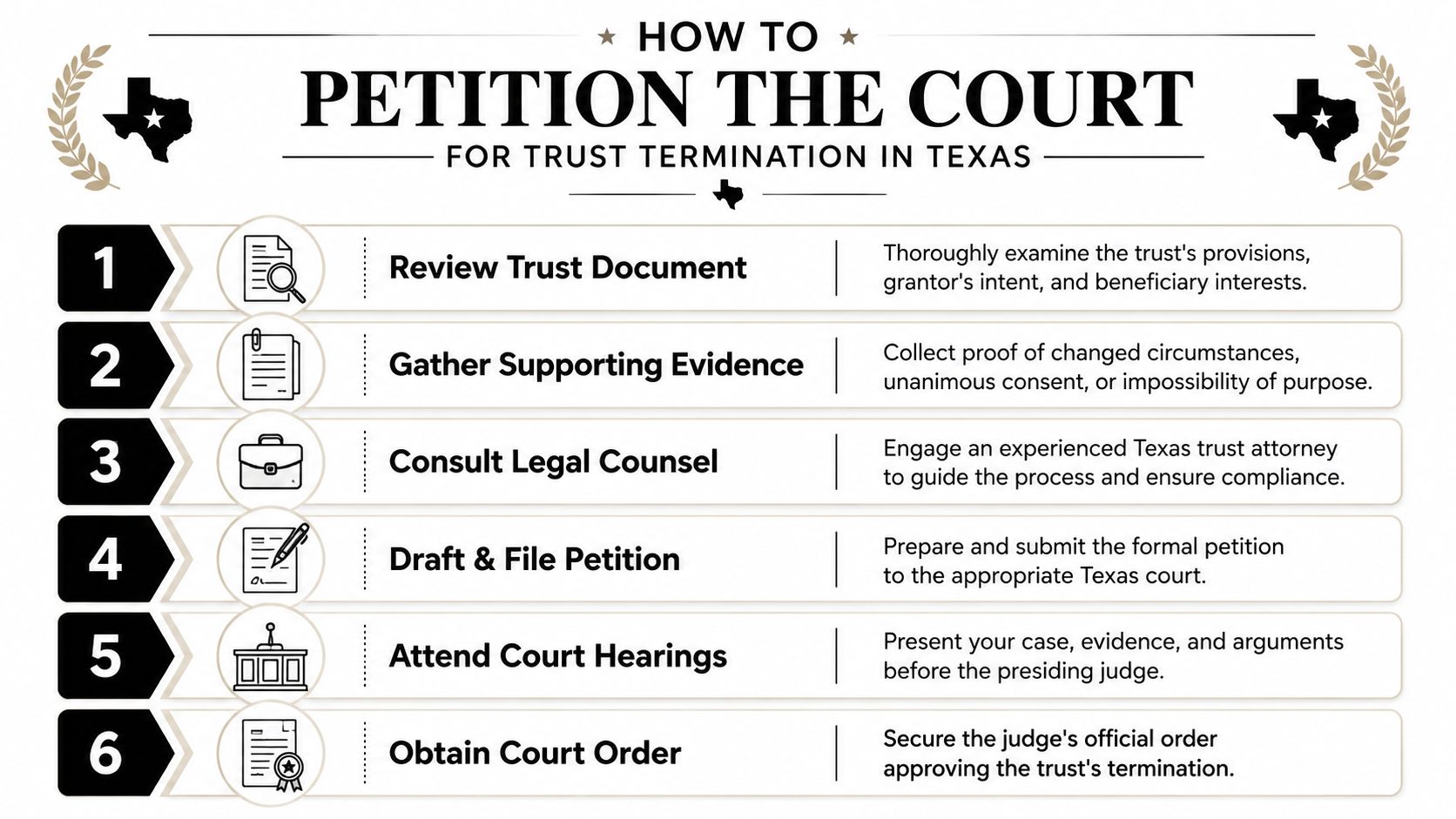
A helpful starting point is this guide on how to terminate a trust in Texas, which gives a practical overview of the process.
Start with the trust's purpose, not just the family's frustration
Before anyone files anything, the court will want a clear answer to one question: why should this trust end early?
That question matters more than many families expect. A judge is not just checking whether administration has become annoying, expensive, or tense. The court is asking whether termination still makes sense in light of the settlor's original goal. In plain English, the petition has to show that ending the trust is a reasoned legal step, not just a family preference.
That usually means reviewing the trust instrument closely and identifying everyone whose rights could be affected, including:
- The trustee: The person currently managing the trust
- Current beneficiaries: Those receiving benefits now
- Future or contingent beneficiaries: Those who may receive benefits later
- Anyone who needs representation: Such as a minor, an incapacitated person, or an unborn beneficiary
A trust case often turns on details that seem small at first. One missing beneficiary, one unclear provision, or one misunderstood purpose can slow the process considerably.
Match the proof to the reason for termination
Filing a petition is a little like asking the court to approve a change in course for a ship. The judge needs to see the map, the reason for changing direction, and the people who will be affected by the decision.
For that reason, the evidence needs to line up with the legal basis for termination. If the argument is that circumstances have changed, the petition should show what changed and why continuing the trust no longer serves its intended purpose in a sensible way. If the request depends on beneficiary consent, the paperwork must show who consented and whether anyone needs a representative to act on their behalf.
Common supporting materials include trust records, account statements, written consents, affidavits, and documents showing why ongoing administration has become impractical or inconsistent with the trust's purpose.
Strong petitions explain why termination better carries out the trust's purpose under current conditions.
The court process is procedural, but the family story still matters
After the petition is filed, notice usually must go out to interested parties. In some cases, the court may set a hearing. If there is disagreement, the matter can become more involved and more expensive. If the parties agree and the supporting documents are organized, the process is often more manageable.
Even then, the court does not serve as a rubber stamp.
The judge has an independent duty to review the request. That is why careful preparation matters so much. Families often assume the hardest part is making the decision to seek termination. In practice, the harder part is presenting a complete and legally sound explanation that respects the trust's terms and each beneficiary's rights.
Trustees should stay steady while the case is pending
Until the court signs an order, the trust is still alive and the trustee still has duties.
That means continuing to keep records, make proper distributions, protect trust property, and avoid informal side deals based on the assumption that termination will be approved. A trustee who acts too early can create personal risk, even when everyone expects the court to agree.
A trustee or beneficiary often benefits from legal guidance at this stage. The Law Office of Bryan Fagan, PLLC handles Texas trust administration, modification, termination, fiduciary accounting, and related trust disputes under Texas law.
What families should expect emotionally and practically
Families usually want certainty. The court process rarely gives it right away.
A better expectation is this: the petition process is a structured way to test whether early termination is the right fit for the family and the trust's purpose. If the answer is yes, the court order provides a clean legal path. If the answer is no, the process often reveals where the underlying issue lies, whether that is administration, distribution terms, beneficiary conflict, or trustee decision-making.
That clarity has value by itself.
Get Trusted Guidance on Your Texas Trust Matter
The question isn't just whether a trust can end early. It's whether ending it is the right legal and financial move for your family.
Texas law does provide pathways. A trust may be terminated when its purpose has been fulfilled, when changed circumstances justify court action, when administration is no longer economically sensible, or when the legal structure ends by operation of law. But each path requires careful analysis of the trust terms, beneficiary interests, fiduciary duties in Texas, and possible tax or asset protection consequences.
Families often feel pressure to solve the problem quickly. That impulse is understandable. Still, trust termination is one of those areas where a quick fix can create lasting problems. A trustee may face liability. A beneficiary may lose protections they didn't realize they had. A family may trigger taxes or disputes that could have been avoided with better planning.
If you're managing a trust, questioning whether it still fits the family's needs, or trying to understand how to modify a trust in Texas, careful legal advice can bring clarity and peace of mind.
If you're managing a trust or planning your estate, contact The Law Office of Bryan Fagan, PLLC for a free consultation. Our attorneys provide trusted, Texas-based guidance for every step of the process.