Managing a loved one’s trust can feel overwhelming, but with the right legal guidance, it doesn’t have to be. Many first-time trustees start in the same place. They have a binder, a bank account, a few questions from family members, and a growing concern that one wrong move could create conflict.
That concern is reasonable. A trustee isn’t just paying bills or moving money around. You’re managing property that belongs in a legal structure, for the benefit of other people, under fiduciary duties in Texas that carry real responsibility. The good news is that one of the best tools for reducing tension is also one of the most practical. A clear, thoughtful informal accounting trust texas process.
An informal accounting can help you answer questions before they become accusations. It can help beneficiaries understand what happened, why it happened, and where the trust stands now. Just as important, it can help you stay organized and make better decisions as you administer the trust.
Your Role as Trustee Navigating a Texas Trust
If you’re serving as trustee after a parent’s death or because a loved one can no longer manage assets, you may already feel pulled in different directions. One beneficiary wants updates. Another doesn’t respond at all. A rental property needs repairs. Investment statements keep arriving. You may also be grieving, working, or caring for children while trying to figure out what the trust document requires.
That’s where many trustees get stuck. They think the job is mostly about making distributions. In reality, a trustee’s role also includes recordkeeping, communication, and disciplined decision-making. Texas law treats trustees as fiduciaries, which means you must act for the benefit of the beneficiaries and handle trust property with care.
A practical starting point is understanding that transparency usually lowers family friction. An informal accounting is often the simplest way to create that transparency. It gives beneficiaries a readable summary of trust activity without turning every update into a legal standoff.
For a fuller overview of the trustee’s legal obligations, review these fiduciary duties of trustees in Texas. That background helps you see why accounting isn’t just paperwork. It’s part of the duty you owe.
Practical rule: If a beneficiary is asking, “What’s going on with the trust?” you usually need more than a casual verbal answer. You need records, a timeline, and a clear explanation.
Think of the trustee role as stewardship. You are protecting a legacy, following the trust terms, and keeping enough documentation to explain your choices later if needed. When you approach the job that way, an informal accounting becomes less intimidating. It becomes one of your best management tools.
What Is an Informal Accounting for a Texas Trust
An informal accounting is a written summary of the trust’s financial activity that a trustee provides voluntarily. It usually covers a specific period and shows what the trust owned, what came in, what went out, and what remains. It is not a casual email saying, “Everything is fine.” It is a real report, just without the rigid format usually associated with a court-driven process.
Think of it this way. A formal accounting is like a complete tax return prepared for exact legal compliance. An informal accounting is more like a detailed family financial statement prepared to answer questions clearly and truthfully. It should still be accurate. It should still be organized. It just isn’t built around a courtroom first.

What informal means and what it doesn’t
“Informal” often confuses trustees because it sounds like “less important.” It doesn’t mean that.
It usually means:
- Voluntary communication that the trustee chooses to provide
- Flexible format designed for the trust and the family
- Readable presentation that helps beneficiaries understand the trust’s activity
It does not mean:
- Incomplete records with missing transactions
- Rough estimates instead of actual figures from statements and receipts
- Loose handling of fiduciary duties in Texas
A good informal accounting is still grounded in records. If your trust has a checking account at one bank, a brokerage account somewhere else, and a house that generated expenses, your summary should tie back to those records.
Why trustees use informal accountings
Many trustees use informal accountings for one simple reason. Silence creates suspicion.
Beneficiaries often don’t see the daily work behind trust administration. They don’t see insurance premiums, property taxes, accountant correspondence, or the time spent coordinating repairs. Without a summary, they may assume the trustee is disorganized or withholding information. An informal accounting gives context.
Trustees also benefit. Preparing the report forces you to reconcile records, spot missing documents, and evaluate whether your administration is on track. In that sense, the report isn’t just for the beneficiary. It’s also for you.
A strong primer on the nuts and bolts is this explanation of what trust accounting involves in Texas administration.
A simple example
Suppose your mother created a trust for you and your brother. The trust owns a house, a bank account, and an investment account. During the year, the trustee paid insurance, taxes, lawn care, and a roof repair. The trustee also made one distribution for your brother’s education costs.
An informal accounting would usually show:
- the property and account balances at the start of the period
- income received, if any
- expenses paid, grouped in a way people can follow
- distributions made to or for beneficiaries
- the assets and balances remaining at the end
A good informal accounting answers the next question before the beneficiary has to ask it.
That’s why this tool matters. In many Texas families, the problem isn’t bad intent. It’s poor communication.
Formal vs Informal Accounting Under Texas Law
A common turning point for trustees looks like this: you send a clear year-end summary, and one beneficiary thanks you. Another replies with a sharper email asking whether this is the “official” accounting required by Texas law.
That question matters because the choice affects your risk, your workload, and the tone of the administration.
Under Texas Trust Code § 113.151, beneficiaries have a statutory right to demand a written accounting, and the trustee must provide it within 90 days. If the trustee does not respond properly, the dispute can shift from family tension to court involvement, including a request to compel the accounting and a fight over attorney’s fees.
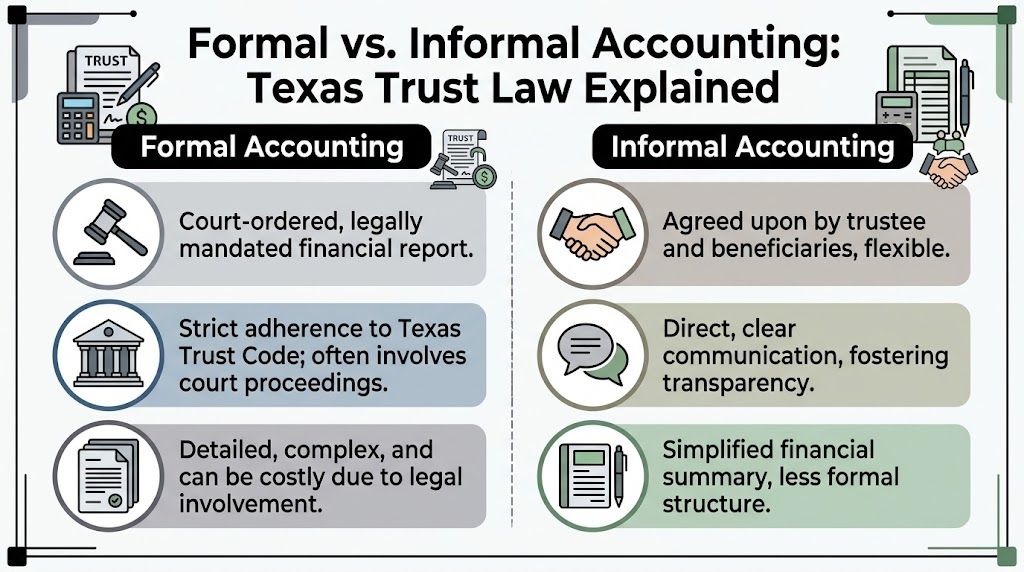
An informal accounting serves a different purpose. It is usually a voluntary report the trustee sends to keep beneficiaries informed, answer predictable questions, and lower suspicion before it grows into a legal dispute. A formal accounting is tied to legal rights and compliance.
The practical difference for a trustee
For a first-time trustee, the easiest way to understand the difference is to compare a progress update with a document prepared to satisfy a legal demand. Both may describe the same trust activity, but they do not serve the same function.
An informal accounting gives you flexibility in format and tone. You can organize it in plain English, group expenses in a way the family can follow, and include context that reduces misunderstanding. That often works well if the trust assets are easy to track, the beneficiaries are generally cooperative, and no one is claiming misconduct.
A formal accounting calls for more caution. If a beneficiary cites the Texas Trust Code, asks for a statutory accounting, or has already accused you of hiding information, this is no longer just a communication problem. It is a compliance problem. At that point, an informal summary may still be helpful, but it may not be enough.
Trustees often get into trouble here. They assume, reasonably but incorrectly, that a helpful informal report gives them the same protection as a formal response. It may not. An informal accounting can calm concerns and sometimes prevent litigation, but it does not automatically give the trustee every legal benefit that may come with a properly handled formal accounting.
Formal vs. Informal Trust Accounting in Texas
| Feature | Informal Accounting | Formal (Judicial) Accounting |
|---|---|---|
| How it starts | Usually sent voluntarily by the trustee | Usually follows a statutory demand or court involvement |
| Format | Flexible and easier for a beneficiary to read | Structured to satisfy legal requirements |
| Purpose | Build trust, answer questions, reduce friction | Comply with the law and create an enforceable response |
| Cost and burden | Usually lower | Usually higher |
| Best use case | Cooperative beneficiaries and simpler administration | Disputes, formal demands, unclear records, or higher litigation risk |
| Protection for trustee | Helpful as a communication tool, but limited if poorly prepared | Stronger legal footing when properly prepared |
| Tone | Explanatory and practical | More technical and formal |
How to decide which path fits your situation
If you are administering a modest trust, your records are in order, and the beneficiary mainly wants transparency, an informal accounting is often the smart first move. It can show that you are attentive, organized, and willing to answer questions before small doubts harden into accusations.
If you receive a written demand that appears formal, or the relationship has already broken down, caution matters more than convenience. In that setting, guessing can make things worse. A casual report may leave out items the beneficiary expected to see, and the omission itself can become part of the complaint.
One timing rule also catches trustees off guard. As noted earlier, Texas law generally does not allow a beneficiary to compel repeated accountings more often than the statute permits without court involvement. For a trustee, that creates a practical lesson. Voluntary updates often help keep frustration from building, but a formal demand changes the stakes and should be treated carefully.
Key point: Use an informal accounting to build confidence and document good administration. Use a formal response when the law, the beneficiary’s demand, or the level of conflict requires it.
If you are unsure which category you are dealing with, pause before sending anything. A trustee can fix a drafting issue more easily than a litigation mistake.
Essential Contents of a Proper Informal Accounting
A solid informal accounting should be easy to follow, but detailed enough that a beneficiary can see what happened without guessing. If the report is vague, it often creates more suspicion than reassurance.

Start with the time period and trust identity
At the top of the report, identify the trust and the accounting period. Don’t assume everyone knows what dates you’re covering.
Include basics such as:
- Trust name and, if useful, the date of the trust
- Trustee name and role
- Accounting period with a clear beginning and ending date
That opening matters because many disputes begin with confusion over scope. A beneficiary may think you’re reporting on all activity since the trust began, while you intended only to summarize the last several months.
Show what the trust owned at the beginning and end
A beneficiary should be able to compare the starting point and ending point without hunting through attachments.
List the trust’s assets in a practical format, such as:
- Cash accounts with beginning and ending balances
- Investment accounts with the holdings or account values shown in a consistent way
- Real property with a brief description
- Personal property or business interests if the trust holds them
For hard-to-value assets, don’t pretend certainty if the value is still being determined. Be candid and describe the asset accurately.
Break down money in and money out
This is the heart of the report. Most beneficiaries want to know two things. What money came into the trust, and what money left it.
Use categories that make sense:
- Income received such as rent, dividends, interest, or sale proceeds
- Expenses paid such as taxes, insurance, repairs, maintenance, professional fees, or mortgage payments
- Distributions made directly to a beneficiary or paid on a beneficiary’s behalf
- Trustee compensation if any was taken
Trustee compensation deserves special attention. If you took compensation, say so plainly. Don’t bury it in a miscellaneous category. Hidden compensation causes resentment fast.
If a beneficiary can’t tell why money left the trust, the accounting hasn’t done its job.
Explain unusual transactions
A bare spreadsheet may not be enough. Add short notes for major events.
Examples include:
- Sale of an asset and why it was sold
- Large repair bill for a trust-owned home
- Special distribution made under a health, education, maintenance, or support standard
- Change in investment positioning after professional advice
These explanations don’t need legal jargon. A few plain-English sentences often prevent days of argument.
Offer backup documents
A proper informal accounting should either attach supporting materials or tell the beneficiary that supporting documents are available on request. Common examples include account statements, invoices, receipts, closing statements, and tax notices.
You do not need to overwhelm people with paper from the start. But you should be prepared to show the source records behind the summary. That readiness gives the report credibility.
A Trustee's Step-by-Step Guide to Preparing the Accounting
A common trustee problem starts like this. Your sister asks for an accounting, you open a drawer full of statements and receipts, and within ten minutes you are wondering whether sending anything at all will create more trouble. The better approach is to build the report the same way you would build a paper trail for a home insurance claim. One document at a time, in order, with enough explanation that another person can follow what happened.

Gather the records before you draft anything
Start with the original records. Memory is helpful for context, but it is a poor accounting system.
Pull together:
- Bank statements for every trust account
- Brokerage statements and trade confirmations if relevant
- Receipts and invoices for expenses
- Closing documents for any sale or purchase
- Distribution records showing what was paid and to whom
- Tax documents and correspondence connected to trust property
Set up your files in a way that lets you answer questions quickly. Many trustees do well with one folder for each account and one folder for each major asset, such as the house, ranch, or investment account. If you keep digital files, use dates at the front of the file name so items sort in order.
That small habit saves hours later.
Pick a clean cutoff date
An accounting works best when it covers a fixed period. If you keep dropping in new transactions while you draft, the report starts to feel slippery to the reader, even if nothing improper happened.
Choose a start date and an end date, then hold that line. If the trust paid a bill after the end date, it usually belongs in the next accounting period. You can mention a later event briefly if it helps explain a decision, but keep the numbers tied to the stated dates.
Reconcile every transaction
This step protects trustees more than any other. Reconciliation involves matching each entry in your accounting to the record that proves it.
If the trust paid for a roof repair, find the invoice and proof of payment. If you distributed money to a beneficiary for tuition, confirm the amount, date, and reason. If funds moved between two trust accounts, label that transfer clearly so nobody mistakes it for a missing payment or an extra distribution.
The goal is simple. A beneficiary should be able to point to a line item and ask, "What is this?" and you should be able to answer with a document, not a guess.
Texas trustees benefit from careful fiduciary recordkeeping for the same practical reason any person handling someone else's money would. Clear records lower suspicion, reduce avoidable disputes, and put you in a better position if a court ever reviews your work. For a trustee-focused discussion of fiduciary duties and good administration practices, the State Bar of Texas offers public guidance through its trust law resources.
A short video can help make the accounting mindset more concrete for trustees handling these duties:
Draft a summary a family member could understand
After you verify the numbers, add a short written summary in plain English. This is often the difference between an accounting that calms people down and one that starts an argument.
You might explain:
- the trust’s main assets
- the major actions taken during the period
- any significant expenses
- the reason for notable distributions
- any open issues still being worked through
Keep the tone factual and steady. You are not writing a defense brief. You are giving an honest report.
For example: “I paid the roof invoice in June to prevent further water damage to the trust property. The home is owned by the trust, so the expense was paid from trust funds.”
That kind of explanation helps beneficiaries see judgment, not just math.
Review for problem spots before sending
Before you send anything, read it once as a skeptical beneficiary would read it. That perspective catches problems early.
Ask yourself:
- Would a person outside the process understand each category?
- Have I clearly disclosed any payment to myself?
- Are there missing receipts or unexplained transfers?
- Does any transaction look personal, even if it was not?
If something would raise your own eyebrow, clean it up now. Informal accountings work best when they answer questions before the phone rings.
Send it professionally
How you send the accounting affects how it is received. A short cover letter or email should identify the accounting, state the time period covered, and invite reasonable follow-up questions. That invitation matters. It shows you are acting like a fiduciary who expects transparency, not like a relative trying to win an argument.
In some situations, it also makes sense to ask the beneficiary to confirm receipt. Sometimes a signed acknowledgment is appropriate. Sometimes it is not worth pressing for one. The practical point for trustees is this: a well-prepared informal accounting can build credibility early, which often lowers the odds of formal demands, court involvement, and family conflict later.
Common Pitfalls and How to Avoid Them
Most trustee disputes don’t begin with theft or dramatic misconduct. They begin with ordinary mistakes that look suspicious from the outside.
Vague descriptions create distrust
A trustee sends an informal accounting with a line item that says “miscellaneous expenses.” That may seem harmless. To a beneficiary, it may sound like a black hole.
Use real descriptions. “Plumbing repair for trust-owned home” is better than “maintenance.” “2024 property tax payment” is better than “government expense.” The more specific you are, the less room there is for doubt.
Hidden compensation causes personal conflict
A trustee pays himself or herself and includes the payment inside a larger administrative category. The beneficiary later spots it in a bank statement and assumes the trustee was trying to conceal it.
That family argument was avoidable. If you took trustee compensation, disclose it directly and consistently. Even when compensation is proper, poor communication can make it look improper.
Commingling is a serious problem
A trustee pays a trust bill from a personal account one month, then reimburses himself later without clean backup. Or the trustee deposits trust funds into a personal account temporarily because “it was easier.”
That kind of mixing can damage credibility quickly. Trust money should stay in trust accounts. Trust expenses should be traceable. If reimbursement is necessary, document it carefully and preserve the underlying records.
Partial information can backfire
Some trustees try to keep the peace by providing only a short summary. They leave out difficult issues, hoping no one will ask.
That strategy often fails. Beneficiaries usually notice gaps. If the accounting omits major repairs, omits a property sale, or avoids explaining a delay in distributions, the missing information becomes the story.
The safest accounting is usually the one that is clear enough to survive follow-up questions.
Future-interest beneficiaries raise a harder question
A particularly tricky issue involves contingent or remainder beneficiaries. Under Texas law, there is meaningful uncertainty about whether people with a future interest can demand an accounting in the same way current beneficiaries can. As noted in this discussion of contingent and remainder beneficiary accounting rights in Texas, court interpretations vary, which leaves trustees in a difficult position.
That gray area creates a real risk. If you disclose too little, someone may later argue you kept them in the dark. If you disclose too much, you may share sensitive information with someone whose rights are not yet fully aligned with current beneficiaries.
A common example is a trust that pays income or support to a surviving spouse now, with children from a prior marriage receiving what remains later. The spouse may want privacy. The children may want visibility. The trustee sits in the middle.
That’s not a situation for guesswork. It’s a situation for legal judgment.
When to Act and When to Ask for Help
A beneficiary emails on Monday morning and asks for "a full accounting by Friday." You have bank statements, a few spreadsheets, and a stack of notes about distributions, but you also know there was a disputed reimbursement last year. That is the moment many trustees freeze.
A better way to approach the decision is to ask what your next move needs to accomplish. Sometimes you need to inform. Sometimes you need to protect the trust and yourself. An informal accounting is often a good communication tool, but it is not a cure-all.
When an informal accounting is a smart first move
An informal accounting usually works well when the trust administration is calm and the facts are easy to explain. A simple trust with a checking account, a brokerage account, and one rental house is easier to report on than a trust holding a family business or mineral rights. If your records are organized and the beneficiaries mainly want reassurance that you are doing the job carefully, a well-prepared informal accounting can lower tension before suspicion grows.
It helps to view the accounting like a homeowner showing the receipts after a remodel. If the work was ordinary and the paperwork is in order, transparency tends to settle people down.
Common signs that an informal accounting makes sense include:
- The assets are straightforward, such as cash, marketable investments, or one piece of real estate
- The beneficiaries are asking reasonable questions, not making accusations
- Your records are current and readable
- There is no active fight over distributions, trust terms, or your conduct as trustee
- You want to create a paper trail of openness before misunderstandings harden into conflict
In that setting, sending a clear accounting can build trust while the cost and stress are still low.
When pressing pause is the prudent choice
Some situations call for more caution. If the trust has messy facts, family conflict, or possible exposure for the trustee, a quick informal report can create new problems instead of solving old ones. A rushed accounting may lock you into numbers that need correction later. It may also invite arguments about omissions, valuation methods, or whether the right people received the information.
Pause and get advice if any of these facts are present:
- A beneficiary is threatening litigation or demanding a formal accounting
- The trust owns a closely held business, mineral interests, unusual investments, or hard-to-value property
- Prior records are incomplete, inconsistent, or missing
- Beneficiaries are divided and may use the accounting against each other
- You made discretionary decisions that could be second-guessed
- There is real uncertainty about who is entitled to receive trust information
If the conflict has already shifted from questions to accusations, this discussion of trustee refusing to provide accounting issues in Texas trusts can help you see how quickly an information dispute can turn into a larger fiduciary fight.
Asking for help can protect both the trustee and the family
First-time trustees sometimes worry that calling a lawyer makes them look defensive. In practice, it often shows care and good judgment. Trustees are not expected to guess their way through hard judgment calls.
A Texas trust attorney can help you decide whether to send an informal accounting now, revise it before sending it, limit supporting material, or move toward a more formal process. That advice matters most when the accounting touches a sensitive distribution decision, a family loan, a reimbursement, or an asset sale that one beneficiary may view differently from another.
Good advice also protects family relationships. A carefully timed response can prevent one beneficiary from feeling ignored and another from feeling overexposed. In many families, the trustee is trying to do two jobs at once: administer the trust and keep Thanksgiving civil. Legal guidance will not remove every disagreement, but it can help you choose a path that is fair, documented, and much easier to defend later.
Frequently Asked Questions about Texas Trust Accountings
Does an informal accounting have to follow a court-approved format
No. An informal accounting is flexible by nature. But it still needs to be accurate, organized, and supported by records. Flexible format does not excuse sloppy content.
Should I send account statements with the accounting
Sometimes yes, sometimes no. Many trustees send a readable summary first and make supporting records available on request. That keeps the report digestible while showing that backup exists.
Can email work for delivering an informal accounting
Email can work if it is secure, complete, and likely to be received and preserved. In tense situations, trustees often use a more formal delivery method so there is less room for later disagreement about what was sent.
What if the beneficiary keeps asking follow-up questions
That often means the accounting needs either more explanation or a more structured response. Reasonable follow-up is normal. Endless, repetitive demands may signal a larger dispute. When that happens, the issue may no longer be accounting alone.
If I’m also serving in a probate matter, do the same ideas apply
Many principles overlap. Executors and trustees both owe fiduciary duties, both need strong records, and both benefit from clear communication. But probate and trust administration involve different statutes and procedures, so don’t assume one process automatically satisfies the other.
Can an informal accounting help avoid litigation
It can. A thoughtful accounting often lowers suspicion and answers concerns early. But once a dispute is already active, an informal report by itself may not be enough. That’s where specific legal advice matters.
If you’re managing a trust or planning your estate, contact Law Office of Bryan Fagan, PLLC for a free consultation. Our attorneys provide trusted, Texas-based guidance for every step of the process, including trust administration, probate, guardianship, estate planning, asset protection, and resolving beneficiary disputes with clarity and confidence.