Managing a loved one's trust can feel overwhelming, especially when the trust was created years ago for a problem your family no longer has. You may be looking at annual paperwork, tax filings, bank statements, and family questions, all while wondering whether the trust still makes sense.
That's when people often ask a very direct question: Can all beneficiaries agree to dissolve a trust in Texas? The short answer is yes, sometimes. The longer answer is where families get into trouble.
Texas law allows trust termination in some agreed cases, but the actual process is rarely as simple as getting everyone around a table and saying “we all agree.” The biggest problems usually aren't obvious at first. A missing beneficiary, a minor child, an old protective clause in the trust, or an incomplete closing process can stop the plan or expose the trustee to personal liability later.
Untangling an Old Trust When Is It Time to Move On
A common situation looks like this. A parent created a trust years ago after a divorce, a business sale, or a health scare. The trust made sense at the time. Now the parent has passed away, the children are adults, and the trust holds a modest mix of cash and investment assets. Everyone in the family gets along, and everyone would rather receive the property outright than keep paying for administration.
At first glance, the answer seems easy. If the beneficiaries all agree, why not just end the trust and move on?
The problem is that trusts don't work like informal family agreements. A trust is a legal arrangement with its own terms, its own purpose, and a trustee with fiduciary duties in Texas. Even when a family is cooperative, the trustee still has to follow the trust document and Texas law. That's true whether you're a child-beneficiary, a surviving spouse, or the person now serving as trustee.
Families usually don't run into trouble because they acted in bad faith. They run into trouble because they assumed agreement was enough.
Some trusts were designed to last only until a beneficiary reached a certain age. Others were created to protect assets from poor spending decisions, creditor issues, or family conflict. If that original purpose has already been fulfilled, termination may be possible. If the trust still serves an active purpose, ending it may not be allowed privately even if the adult beneficiaries want it.
Before anyone distributes a dollar, the family needs to answer a few basic questions:
- What does the trust state? The trust document may contain termination language, distribution triggers, or restrictions.
- Who counts as a beneficiary? Not just the people receiving money today.
- What is the trustee's risk? The trustee can't safely rely on assumptions or verbal approval.
- Would court involvement be required? In some cases, yes, even with a cooperative family.
That's why a careful review by a Texas trust administration lawyer often saves families from expensive mistakes at the very beginning.
The Power of Unanimous Consent in Texas Trust Law
Texas starts from a rule that sounds simple but is much stricter than many families expect.
Under Texas trust law, a trust may be terminated by agreement only when every beneficiary with a present, future, or contingent interest consents, and the trust no longer serves a material purpose; this is the core rule reflected in Texas Property Code Section 112.054. Because the standard requires unanimous consent, even a single dissenting beneficiary can prevent a private dissolution, which makes beneficiary identification and notice critical in practice.
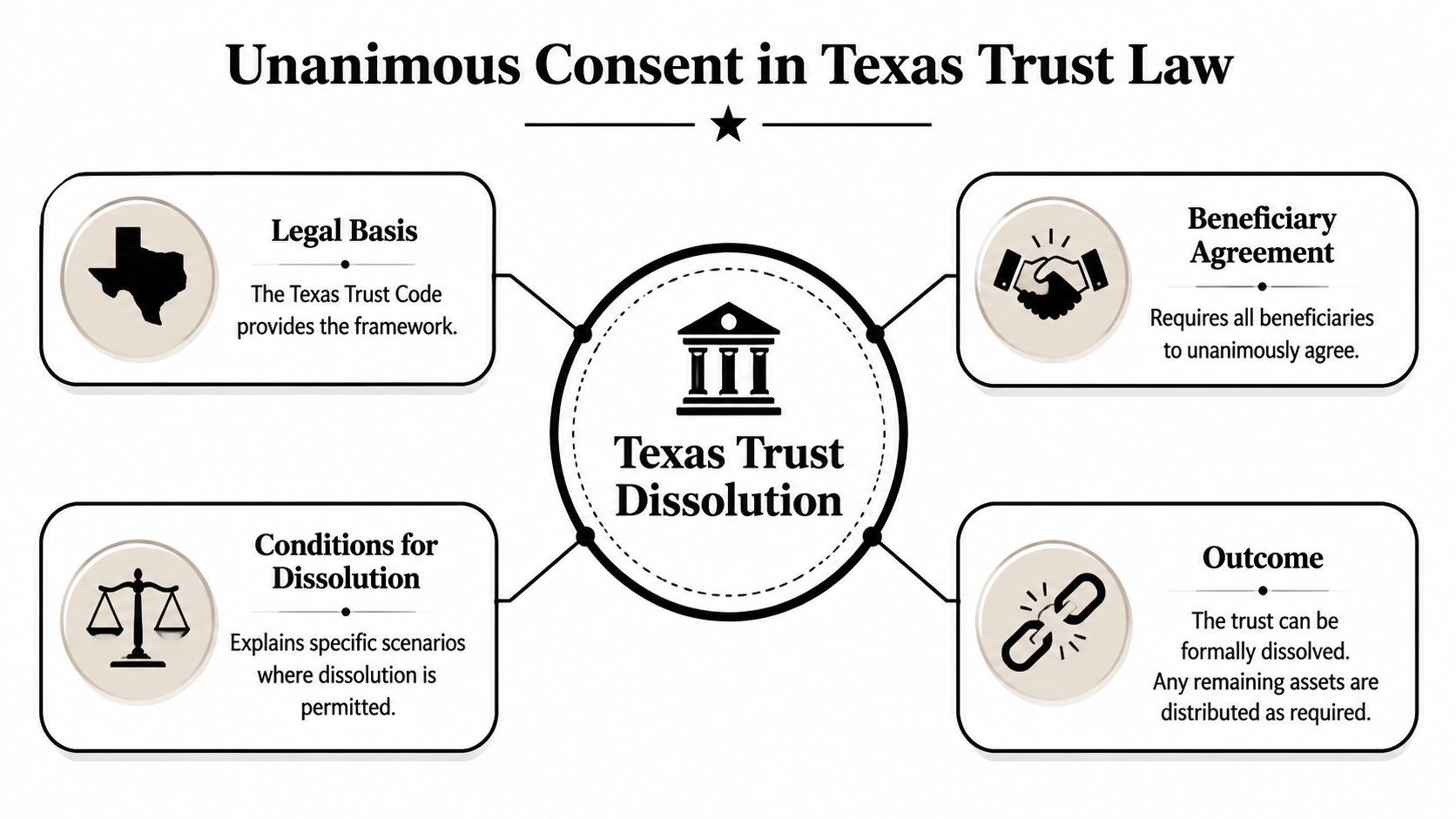
Who must agree
Many readers find this surprising: “All beneficiaries” doesn't just mean the people currently receiving checks. It can include people with future interests and contingent interests too.
For example, a trust might say income goes to a surviving spouse for life, then the remainder goes to the children, and if a child dies first, that child's descendants take the share. In that setup, the current spouse isn't the only beneficiary. The children matter. Potential descendants may matter too, depending on how the trust is written.
If you want a plain-English overview of who may have enforceable rights, this guide on rights of trust beneficiaries in Texas is a useful starting point.
What material purpose means
Even full consent doesn't end the analysis. The trust also must no longer serve a material purpose.
A material purpose is the core reason the settlor created the trust in the first place. Courts often look at whether the trust was designed to do something specific, such as:
- Delay ownership until maturity so a younger beneficiary doesn't receive assets too early
- Protect assets from misuse, outside pressure, or family conflict
- Provide structured support over time instead of one lump sum
- Preserve management of property that needs ongoing oversight
If the trust was meant to protect a beneficiary until age thirty, and that beneficiary is well past that age, the purpose may have been fulfilled. If the trust still protects someone who needs long-term financial management, the purpose may still be active.
Why the trustee can't guess
Trustees often step into this process after a death, with limited context and a lot of pressure from family members. That's why practical guidance matters. First Steps for a Successor Trustee in Texas addresses what to do immediately after stepping into the trustee role, including gathering documents and identifying who has a legal interest before making distributions.
Practical rule: In Texas, unanimous agreement is a legal standard, not a family vibe. The trustee needs actual consent from every person whose interest counts.
Common Roadblocks to Dissolving a Trust by Agreement
The hardest part of dissolving a trust usually isn't the family meeting. It's discovering that “everyone” doesn't solely mean the people sitting in the room.
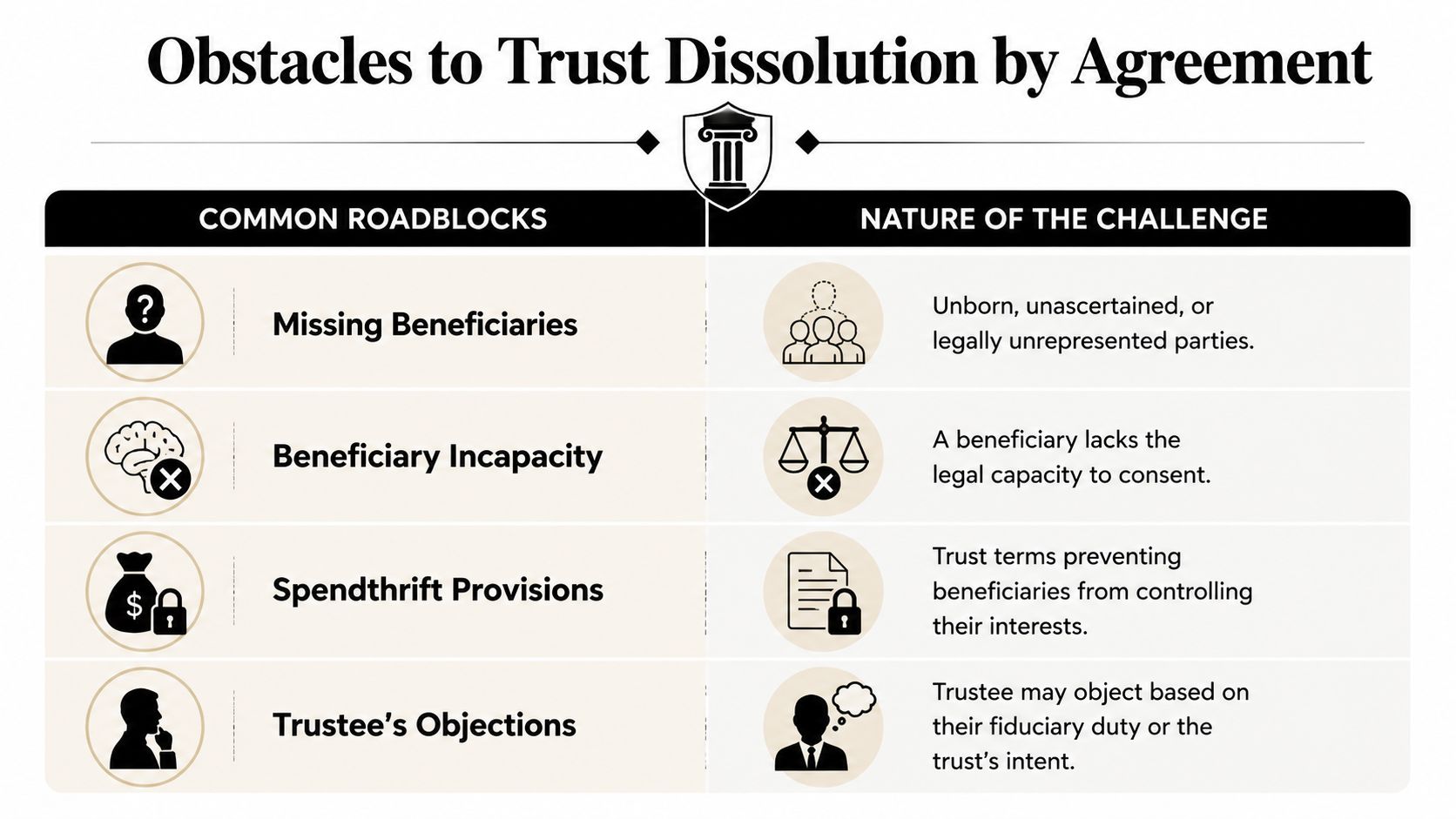
The missing beneficiary problem
One of the biggest practical barriers is locating and legally dealing with all interested parties. According to the Texas State Bar's 2024 Trust Administration Survey, 38% of attempted private dissolutions fail due to missing or incapacitated beneficiaries, and those cases often require judicial steps such as appointing a guardian ad litem to act on behalf of someone who cannot personally consent.
That number matters because it reflects what trustees and families face, not just what the statute seems to allow on paper.
Consider a trust that names “my descendants” as remainder beneficiaries if a current beneficiary dies before final distribution. That language may pull in minors, people not yet born, or relatives the family hasn't spoken to in years. A private agreement can stall quickly.
Minor and incapacitated beneficiaries
A child can't sign a consent and make the problem disappear. The same is true for an adult beneficiary who lacks legal capacity.
In those situations, the law usually requires a more formal process. A judge may need to approve the plan, and the court may appoint a representative to protect that beneficiary's interests. Families often feel frustrated here because they do agree on the outcome. The law's concern is different. It asks whether the person who cannot speak for themselves is adequately protected.
When a trust includes a minor, an unborn beneficiary, or a person who can't legally consent, “all beneficiaries agree” may be impossible without court help.
Protective trust terms can block the plan
Some trusts contain spendthrift provisions or other protective language. These clauses are designed to limit a beneficiary's control over trust assets and to preserve the settlor's original intent. If the trust was built to keep assets managed and shielded, that can cut against private termination.
Trust type matters here too. If you're trying to understand how the structure of a trust affects flexibility, this overview comparing trust forms from Miles Hansford trust comparison gives helpful background on why some trusts are easier to change than others.
Sometimes modification works better than termination
Families often focus on ending the trust because that feels like the cleanest solution. But in practice, some situations call for a narrower fix. If the main problem is an outdated administrative rule, a distribution standard that no longer fits, or a trustee succession issue, a modification may solve the problem without the risks that come with a full dissolution.
A helpful place to explore that option is this article on how to amend a trust in Texas.
Here's a simple comparison:
| Issue | Private dissolution may fail because | Another path may fit better |
|---|---|---|
| Missing beneficiary | No valid unanimous consent | Court petition |
| Minor beneficiary | No legal capacity to sign | Court approval with representation |
| Protective trust clause | Trust still serves its original purpose | Targeted modification |
| Family wants simpler administration | Full termination may be too aggressive | Administrative amendment or judicial adjustment |
The Trustee's Role and Risks in Termination
A common family meeting goes like this. Everyone says they agree the trust should end, the trustee is told to “just divide it up,” and the room gets quiet when the trustee asks for time, paperwork, and legal review.
That hesitation usually means the trustee understands the risk.

A trustee has to do more than carry out the family's wishes. The trustee must follow the trust terms, protect current and future beneficiaries, and meet fiduciary duties under Texas law. Even when the beneficiaries seem fully cooperative, the trustee can still face personal exposure if the termination is handled loosely.
Agreement is helpful. It is not a shield by itself.
This is one of the biggest practical traps in trust termination. Families often treat unanimous agreement like a signed permission slip that ends all future problems. It is closer to opening the door than finishing the job.
If assets are distributed too early, a trustee may still be blamed later for unpaid taxes, overlooked debts, unequal distributions, bad valuations, or a beneficiary who later claims they did not understand what they signed. A friendly conversation does not resolve those risks. Neither does a text message chain.
Texas trustees often focus on one question: “Do all the beneficiaries agree?” The safer question is broader: “Can I prove the trust was closed correctly, with enough documentation to defend my decisions later?” For a fuller discussion of when early trust termination is allowed in Texas, it helps to review the legal grounds separately from the trustee's closing process.
What a careful trustee usually needs before making final distributions
A trust termination works like closing out a business account. Before the last dollar goes out, the trustee needs to know what came in, what is still owed, and who is signing off.
That usually means gathering several pieces in order:
- A final accounting showing trust assets, income, expenses, prior distributions, and the amount each beneficiary will receive
- Written notice and clear explanations so beneficiaries understand what is being proposed and what information they are approving
- Receipts and release documents signed after distribution details are disclosed, reducing the chance of later claims
- Tax clearance and debt review so the trustee is not distributing property that should have been used to pay obligations
- Confirmation of beneficiary status including whether any minor, incapacitated, unborn, contingent, or hard-to-locate beneficiary still has an interest
That last point causes more trouble than families expect. The room may feel unanimous, but the legal picture may not be. If one person with an interest cannot legally consent, or cannot be found, the trustee should slow down instead of guessing.
Why trustees sometimes say no to a “simple” family plan
Beneficiaries sometimes read caution as stalling. In many cases, caution is how a trustee protects the family from a much bigger mess.
For example, one beneficiary may be ready to sign anything today, then question valuations six months later after learning a piece of real estate was worth more than expected. Another may agree in principle but not understand that ending the trust also ends creditor protections, spendthrift protections, or structured management for younger beneficiaries. The trustee is the person who gets blamed if those details were skipped.
A careful trustee may insist on legal review, formal signatures, reserve funds for final expenses, or court approval. That is often the sensible response, especially where “everyone agrees” only works at a surface level.
Self-protection is part of the trustee's job
Trustees are not being difficult when they ask for written releases, a complete accounting, or professional help. They are building a record. That record can matter just as much as the distribution itself.
It can also matter when unanimous agreement falls apart late in the process. One beneficiary hesitates. Another stops responding. A third wants cash while the others want property in kind. At that point, the trustee should avoid ad hoc solutions and get advice on whether the trust can still be terminated privately or whether court protection is the safer route.
One option families and fiduciaries may consider for these issues is Law Office of Bryan Fagan, PLLC, which handles trust administration, trustee duties, and termination-related compliance under Texas law.
When Court Involvement Becomes Necessary
Court involvement doesn't always mean there's a fight. Often, it means the family has reached the point where a judge is the only person who can give everyone a binding, legally safe answer.
Common situations that require court action
Private dissolution usually breaks down when one of these problems appears:
- A beneficiary can't consent because they are a minor, incapacitated, unborn, or missing
- The trust's purpose is disputed and the parties disagree about whether it still matters
- The trust language is unclear about who benefits or when termination is allowed
- The trustee needs protection from future liability before making final distributions
If that sounds like your situation, this guide on terminating a trust early in Texas when it is allowed helps frame when judicial involvement may be the proper path.
What a guardian ad litem does
A phrase that worries families is guardian ad litem. In simple terms, this is a person appointed by the court to protect the interests of someone who cannot represent themselves in the case.
That might be a minor child, an unborn beneficiary, or someone without legal capacity. The guardian ad litem reviews the proposed action and considers whether ending or modifying the trust would harm that person's interests.
This can feel like an extra obstacle. In reality, it often provides the legitimacy a family needs to move forward without second-guessing later.
What the court process can accomplish
A judicial order can do what private agreement cannot. It can:
- Approve termination when legal requirements are met
- Approve modification instead of termination if that better fits the trust's purpose
- Authorize representation for protected beneficiaries
- Give the trustee clear authority to distribute assets and close the trust administration
Here's the practical value:
| Private approach | Court-supervised approach |
|---|---|
| Depends on perfect consent | Can address parties who cannot consent |
| Leaves more room for later dispute | Produces a binding order |
| May expose trustee to later claims | Gives stronger procedural protection |
| Works best in simple cases | Fits complex family structures |
Court involvement often feels slower, but it can be the safer and cleaner path when private consent is incomplete or legally impossible.
For many families, this is also where broader planning questions come into view. A trust that no longer works may need more than termination. It may signal the need for updated estate planning, guardianship review, probate guidance, or asset protection planning for the next generation.
A Practical Checklist for Beneficiaries Seeking Dissolution
If your family believes termination is the right step, an organized approach will save time and reduce conflict. The goal is not to rush. The goal is to avoid a mistake that can't be undone.
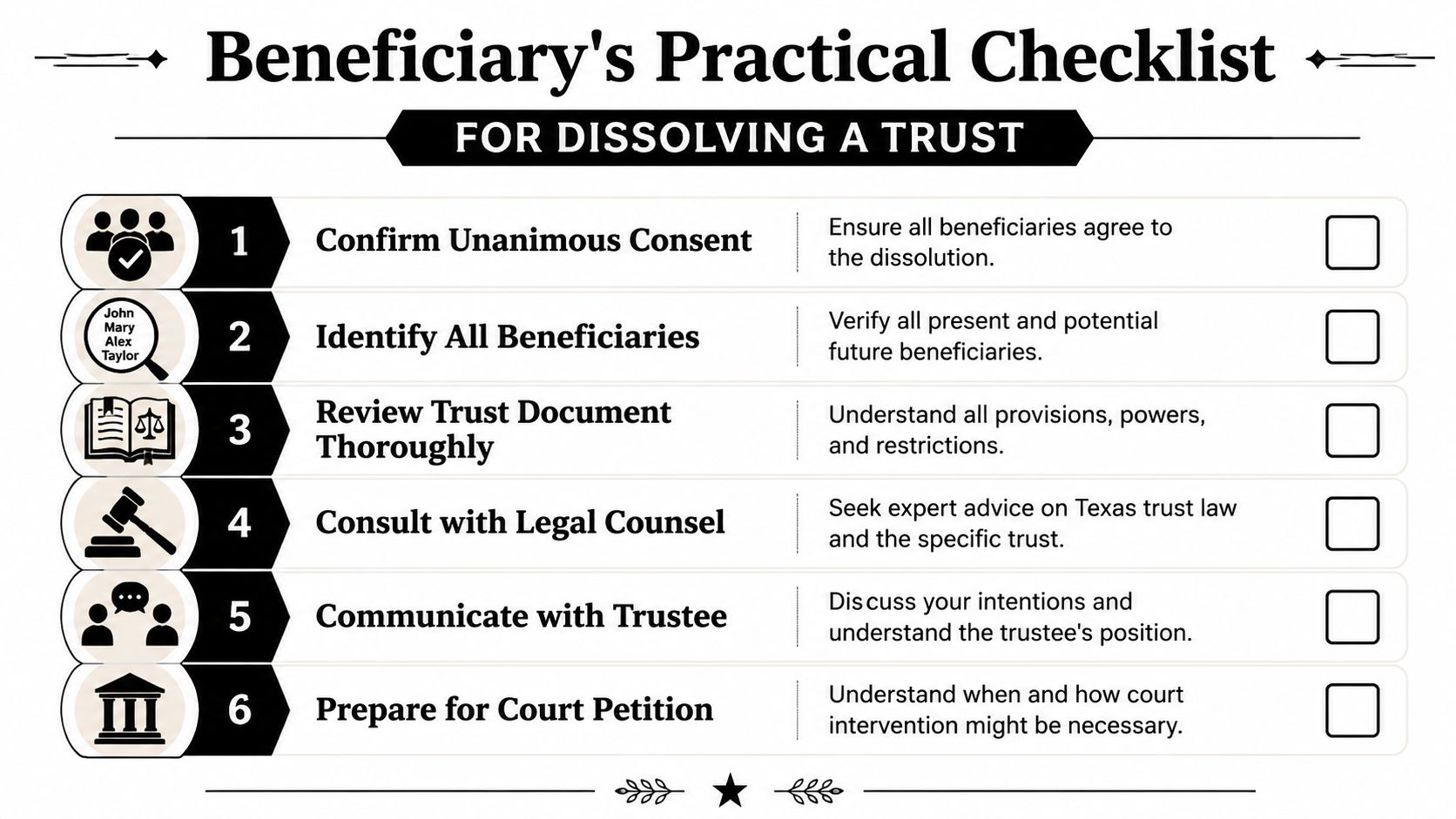
Start with the trust and the people
Begin by gathering the controlling documents and identifying every person who may have a legal interest.
- Get the complete trust document. Don't rely on summaries or memory.
- List all possible beneficiaries. Include current, future, and contingent interests.
- Check whether anyone is a minor, incapacitated, unborn, or hard to locate.
- Review the trust's original purpose. Ask whether that purpose still exists.
This first pass often answers the main question behind “can all beneficiaries agree to dissolve a trust Texas.” Sometimes the answer becomes clear immediately. Sometimes it reveals that unanimous private consent was never realistic.
Evaluate whether the trust is small enough for a simpler path
A practical administrative boundary often cited in Texas is $50,000 in trust assets. If a trust holds less than that amount, the trustee may be able to terminate it without court involvement, while larger trusts almost always require a more formal process involving court review or a formal beneficiary agreement, as discussed in this Texas resource on how to terminate a trust in Texas.
That figure does not mean every smaller trust can be ended casually. It means the administrative route may be less burdensome in the right case.
Move carefully toward closure
Once the legal picture is clearer, focus on process:
- Talk with the trustee early. The trustee's cooperation matters, and so does the trustee's risk.
- Prepare for a formal accounting. Beneficiaries should expect transparency.
- Use written agreements, not verbal understandings. Clear signatures matter.
- Be ready for court if needed. That's often part of doing it correctly, not a sign that something has gone wrong.
A short decision guide can help:
| Question | If yes | If no |
|---|---|---|
| Are all beneficiaries identified? | Continue review | Stop and investigate further |
| Can each beneficiary legally consent? | Consider private route | Evaluate court petition |
| Does the trust still serve a material purpose? | Termination may be blocked | Termination may be possible |
| Is the trustee willing to proceed with documentation? | Draft formal closing papers | Resolve objections first |
For final distribution issues, beneficiaries and trustees often also need guidance on estate administration, probate coordination, and how assets should pass once the trust ends. That's especially true when the trust holds real property or accounts with complicated title issues.
Get Trusted Guidance for Your Texas Trust
Families often hope trust termination will be a simple matter of agreement. Sometimes it is. But many Texas trusts involve hidden legal interests, old protective clauses, or trustee liability concerns that don't show up until the family is already halfway through the process.
That's why careful legal review matters before anyone signs, distributes, or closes accounts. A trustee may need help with fiduciary accounting, beneficiary notice, and release documents. Beneficiaries may need help figuring out whether the trust should be terminated, modified, or taken to court for instructions. In many families, the safest answer is not the fastest one.
A good plan protects more than money. It protects relationships. It reduces the chance that one sibling feels misled, one trustee gets blamed, or one overlooked beneficiary reappears after the trust has already been emptied.
If you're facing questions about trust termination, trust administration, probate, guardianship, or asset protection, it helps to work with a lawyer who understands how these issues connect under Texas law.
If you're managing a trust or planning your estate, contact Law Office of Bryan Fagan, PLLC for a free consultation. Our attorneys provide trusted, Texas-based guidance for every step of the process.