Skip to content
Managing a loved one's trust can feel overwhelming, especially when you're asking simple questions and getting silence back. If you're a beneficiary wondering why no accounting has arrived, that frustration is reasonable. Texas law gives you a real path to transparency, and the process becomes much more manageable once you know what to demand, when to demand it, and what to do when the trustee still won't answer.
A trustee not providing accounting in Texas is not just a communication problem. It can be a fiduciary problem, a recordkeeping problem, and sometimes a court problem. The key is to move from guessing to documenting, because Texas trust law is built around written demand, proof of delivery, and a clear deadline for compliance.
Feeling Left in the Dark by a Trustee
The hardest part is often the uncertainty. You know a trust exists, you know someone else controls the records, and you may have already asked more than once without getting a straight answer. That kind of silence can leave a beneficiary feeling stuck, but Texas law does not leave you without options.
Silence is a warning sign, not a legal strategy
A trustee cannot hide behind vague explanations forever. Texas trust materials describe a trustee's duty to keep adequate records and to provide the core information that belongs in an accounting, including receipts, disbursements, trust assets, liabilities, and trustee compensation, after a proper demand is made. That is why a beneficiary's written demand matters so much. It changes a frustrating exchange into a request that can be enforced.
You may hear that the trust is still being handled or that the books are not ready yet. That kind of answer does not satisfy the duty to account. Texas trust law sources also note that periodic accountings are not automatically required unless the trust instrument says so, which makes the written-demand process the primary trigger for accountability.
Practical rule: If records are not coming in, stop relying on casual follow-ups. Put everything in writing and save every response, because the paper trail is what a court will later examine.
A beneficiary in this position does not need to solve the whole dispute on day one. The first step is narrower, make the accounting demand clear and make the trustee's next move measurable. If the trustee complies, you can review the numbers. If the trustee does not, you have already started building the record you will need for enforcement.
Your Right to an Accounting Under the Texas Trust Code
A trustee who controls trust property also owes the beneficiaries fiduciary duties in Texas, and transparency is part of that duty. In practical terms, the trustee must manage the trust loyally, prudently, and for the beneficiaries' benefit, not for personal convenience or self-interest. That duty is the legal basis for a beneficiary's right to press for a formal accounting.
Fiduciary duty and accounting work together
A beneficiary does not need to prove fraud before asking for information. Texas trust law recognizes that a trustee should be able to account for what happened to trust property after a proper demand is made. In plain English, a beneficiary is entitled to ask what came in, what went out, what remains, and what the trustee paid themselves.
That is why the accounting right matters in practice. It is not just a technical rule. It is the tool that lets a beneficiary test whether the trustee is following the trust terms and handling the property the way the law requires.
The trustee holds the records and the keys, but the beneficiary is still entitled to know how the trust was used. Under Texas trust law, periodic accountings are not automatically required in every trust, but that does not erase the trustee's duty to respond to a proper demand from a beneficiary who is entitled or permitted to receive distributions, or who would receive a distribution if the trust terminated at that time. See the Texas fiduciary disclosure overview for a general discussion of that duty.
For a concise overview of trustee obligations, The Fiduciary Duties of a Texas Trustee explains the core duties of loyalty, prudence, and impartiality under the Trust Code. In practice, an accounting is one of the main ways those duties get tested.
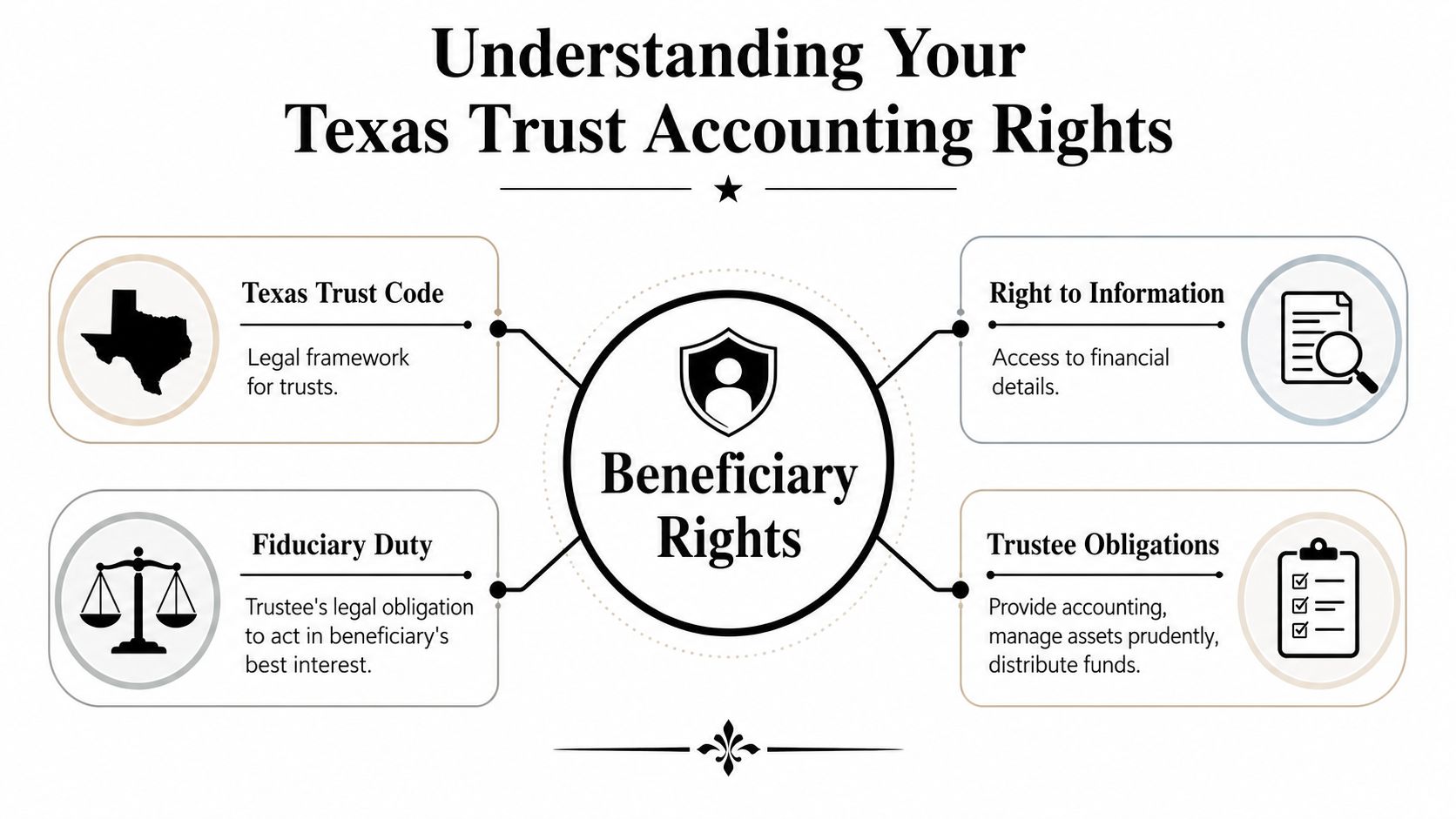
Who can demand the accounting
Texas Property Code § 113.151 governs the formal demand process. A beneficiary must make a written demand, and the trustee must provide a written statement covering all transactions since the last accounting or since the trust was created. The statute generally limits beneficiaries to one demand every 12 months, so the request has to be used carefully, and a Texas trust accounting demand should be drafted with that limit in mind.
That annual limit makes the demand more important, not less. Beneficiaries should treat it as a deliberate legal step, not a routine message. If the demand is used casually, the beneficiary may end up waiting when answers were needed sooner.
How to Formally Demand a Trust Accounting in Texas
A written demand does more than ask for information. It creates the record you may need later, identifies exactly what the trustee must produce, and starts the statutory response period. Texas trust disputes often turn on that paper trail, so a clear demand matters from the start.
What to put in the demand
Keep the letter direct and specific. Identify yourself, identify the trust if you can, and ask for the accounting for the correct period. If you want the tone right, be firm and precise, not argumentative.
Please provide a written trust accounting for all transactions since the last accounting, or since the creation of the trust if no prior accounting exists. The accounting should include receipts, disbursements, trust assets, liabilities, and trustee compensation. Please send the accounting to my mailing address and preserve proof of delivery.
That wording tracks the core items a proper accounting should cover, and it helps reduce the chance of getting a vague response that skips over major categories. For a fuller draft structure, compare your letter with this Texas trust accounting demand guide.
How to send it so the receipt can't be disputed
Send the demand in a way that leaves proof. Certified mail is the standard choice because it creates a delivery record. Email can support the paper trail, but if a dispute comes later, the stronger evidence is a method that shows the trustee received the request. Keep a copy of the letter, the mailing receipt, and any return confirmation.
A practical workflow usually looks like this:
- Review the trust document to see whether it adds any reporting terms.
- Confirm your status as a beneficiary and identify the trustee correctly.
- Draft a written demand that asks for a full accounting, not just “updates.”
- Specify the accounting period if you know the last report date.
- Send it by a trackable method and save the proof.
- Calendar the 90-day deadline and watch for a complete response.
The trustee then has 90 days to comply, unless a court orders more time. Texas trust materials treat that deadline as the point where a demand either gets a real response or turns into an enforcement issue.
For a more detailed format, you can compare your draft with this Texas trust accounting demand guide.

Here's a short video walkthrough that may help you understand the demand process in context.
What not to do
Do not rely on oral requests. Do not assume repeated texts are enough. Do not leave the accounting period undefined if you can avoid it. A trustee can later argue that a casual request was never the formal demand the statute requires, and that argument becomes much harder to defeat if you never created a clean paper trail.
When the Trustee Ignores Your Demand
A trustee who lets the deadline pass without a real response has already shown you something important. The issue is no longer whether you should keep asking. It is whether you can get meaningful disclosure through a formal enforcement step.
Court petition or ADR
Two paths usually make sense. A court petition asks a judge to order the accounting produced. Alternative Dispute Resolution, usually mediation, tries to resolve the dispute without a full hearing. Each path has trade-offs, and the better choice depends on how the trustee has behaved and how much you already know about the trust records.
A petition is usually the better choice when the trustee has gone silent, refused to acknowledge the demand, or sent paperwork that leaves the main questions unanswered. Texas trust materials explain that a beneficiary can seek court help to compel production when the trustee does not comply, and this petition for accounting in Texas trust cases shows the kind of relief beneficiaries often request. If the trustee is giving you fragments instead of an accounting, court review is often the cleanest way to force the issue.
ADR can still help when the trustee is disorganized but not openly refusing to cooperate. Mediation may get the trustee to turn over records, explain gaps, or agree to a more usable format. It can also reduce conflict inside a family when the people involved still want to preserve some working relationship. But mediation only helps if the trustee participates in good faith and is willing to disclose information.
How to think about the trade-offs
A petition puts the dispute into a formal adversarial setting. That gives you pressure and structure, but it also means the trustee will usually defend the accounting rather than fix it. Mediation is less confrontational, but it does not force disclosure unless the trustee is prepared to cooperate.
If you suspect records are being withheld, recreated, or stitched together after the fact, a petition usually makes more sense. It gives the court a way to require production and monitor compliance. It also creates a cleaner record if the trustee later claims the missing information never existed or cannot be found.
A trustee who ignores a written demand often ignores softer pressure too. Once the deadline passes and nothing useful arrives, more waiting usually helps the trustee, not the beneficiary.
The practical question is simple. Can the trustee be made to answer, or are you now dealing with a fiduciary who will only comply under court supervision? If it is the second situation, the enforcement path is the one that matters.

Building Your Case What to Document and Preserve
A beneficiary's position strengthens quickly when the record is organized. Courts care about the demand, the trustee's response, and the details that show whether the accounting is incomplete or impossible to trust.
The documents that matter most
Start with the trust document itself. Then gather every written communication with the trustee, including emails, letters, and texts if that's how the trustee communicates. Keep notes from phone calls or meetings, especially if the trustee gave explanations that later changed.
Your file should also include:
- A copy of the written demand and proof it was delivered.
- Any partial accounting or summary the trustee sent.
- Distribution records showing what you received, if anything.
- Letters asking for clarification and the trustee's replies.
- Notes on missing assets, fees, or unexplained delays.
- Any documents showing the trustee's compensation or personal use of trust property.
If the trustee says records are missing, don't assume that ends the inquiry. Texas guidance notes that when a trustee claims there are no records, incomplete records, or the trustee has become incapacitated, courts can shift the burden of proof against the trustee, and the trustee's estate may even bear the cost of a corrective or reconstructed accounting (Texas trustee records and accounting issues).
Why incomplete records help the beneficiary
That burden shift matters because it changes who has to explain the gap. A trustee who failed to keep good books can't always blame the beneficiary for being suspicious. If the trustee can't reconstruct the history, the problem may become the trustee's problem, not yours.
Keep the file like you expect a judge to read it. If every major request, response, and missing document is organized, your position gets stronger before any lawsuit is filed.
A simple preservation habit
Save everything in dated folders. Separate the trust document, correspondence, financial statements, and distribution records. If you only do one thing, do that. A clean file is often the difference between a vague complaint and a focused case for enforcement.
Why and When to Hire a Texas Trust Administration Lawyer
Some trustees respond once they receive a formal demand. Others only respond after counsel gets involved. If the trustee has already crossed into noncompliance, a Texas trust administration lawyer can assess whether the next step should be a court petition, mediation, or a broader fiduciary claim, including a claim for trustee breach of fiduciary duty in Texas.
Red flags that justify legal help
Legal help becomes especially important when the trustee ignores the demand, sends an accounting that leaves out major transactions, or says there are no records at all. Those responses often point to more than delay. They can signal a deeper problem in the way the trust has been administered.
That is also where fiduciary duties in Texas become practical, not abstract. A missing accounting may tie to self-dealing, delayed distributions, or poor asset management. If the trust owns unusual property, such as a business interest, mineral rights, or rental property, the chance of mistakes rises quickly.
A lawyer also helps when legal timing and real-world suspicion do not match. Texas materials note that beneficiaries generally get only one accounting demand every 12 months, while trustees may rely on digital records and beneficiaries often want faster disclosure. That annual framework can turn into a waiting game unless someone knows how to press the issue correctly (Texas CPA article on accounting cadence).
What a lawyer actually adds
A lawyer can evaluate standing, draft a demand that tracks the statute, and decide whether the accounting is incomplete or legally deficient. Counsel can also review fees, distributions, and asset movements for patterns that suggest breach. In some cases, a lawyer will press for production first. In others, the right move is to file and let the court supervise compliance.
A Texas estate planning attorney may also be helpful when the trust issue overlaps with probate, guardianship, tax planning, or future trust modification questions. A trust dispute often sits inside a larger family and financial picture, so it helps to have someone who understands the full structure, not just one document.
The Law Office of Bryan Fagan, PLLC is one option families use for trust administration, trust disputes, estate planning, probate, guardianship, and asset protection matters in Texas. If the trustee still will not account, early legal guidance can keep the problem from turning into a deeper inheritance dispute.
If you're dealing with a trustee not providing accounting in Texas, do not wait for the situation to fix itself. Contact The Law Office of Bryan Fagan, PLLC for a free consultation. Our attorneys provide trusted, Texas-based guidance for every step of the process, including beneficiary demands, trust disputes, probate coordination, guardianship issues, and practical estate planning support.